
Pulp Fiction, 1954 · page 5 of 132
Astounding Science Fiction, British Edition — page 5: what you’re looking at
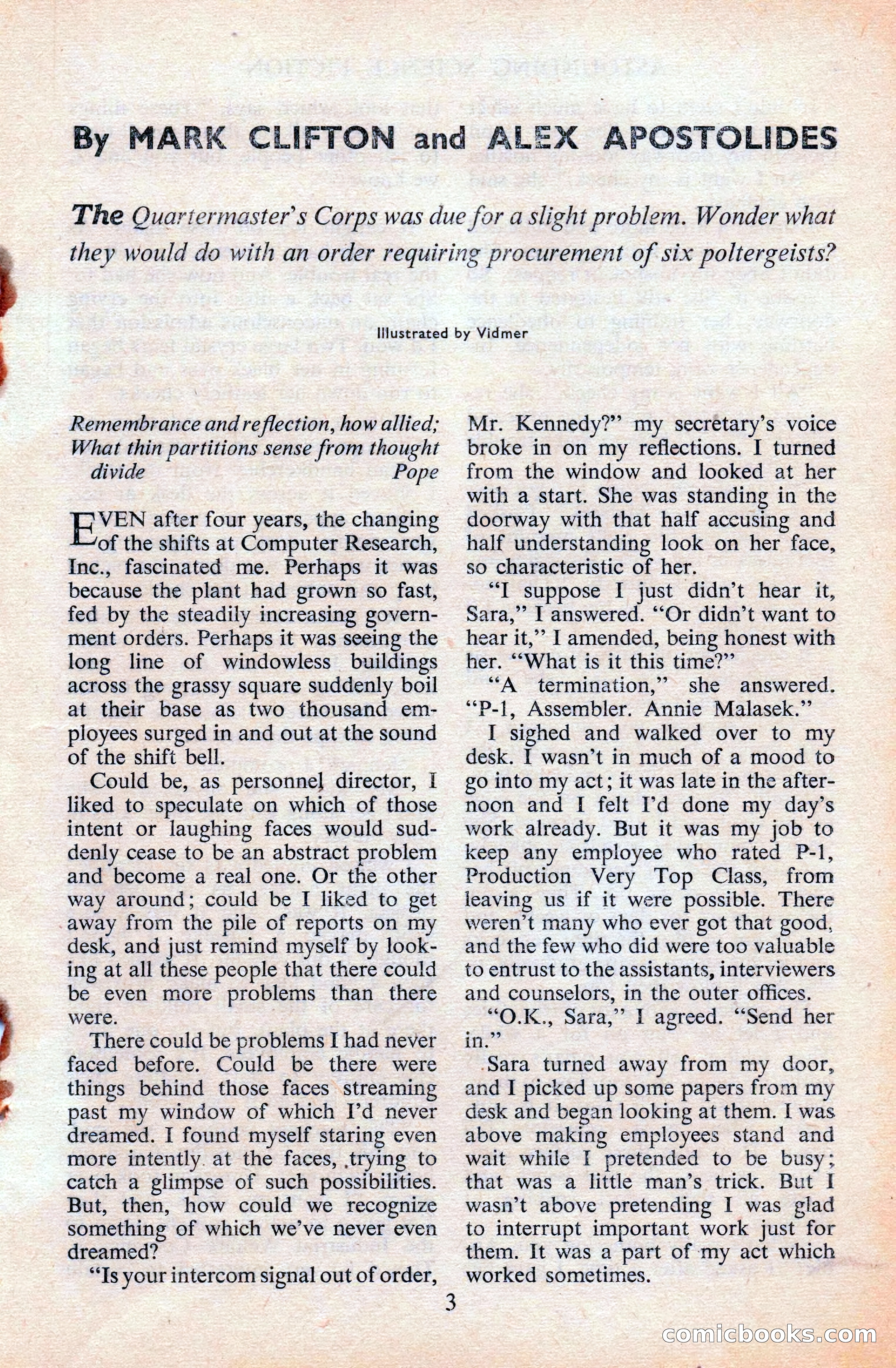
A restored page from Pulp Fiction, 1954. Page through the whole issue in the reader above.
📄 Transcribed text from this page (OCR, searchable)
Machine-transcribed from the original scan — historical spelling and the odd misread are preserved.
By MARK CLIFTON and ALEX APOSTOLIDES The Quartermaster’s Corps was due for a slight problem. Wonder what they would do with an order requiring procurement of six poltergeists? Illustrated by Vidmer Remembrance and reflection, how allied; What thin partitions sense from thought divide Pope Bees after four years, the changing of the shifts at Computer Research, Inc., fascinated me. Perhaps it was because the plant had grown so fast, fed by the steadily increasing govern- ment orders. Perhaps it was seeing the long line of windowless buildings across the grassy square suddenly boil at their base as two thousand em- ployees surged in and out at the sound of the shift bell. Could be, as personnel director, I liked to speculate on which of those intent or laughing faces would sud- denly cease to be an abstract problem and become a real one. Or the other way around; could be I liked to get away from the pile of reports on my desk, and just remind myself by look- ing at all these people that there could be even more problems than there were. There could be problems I had never faced before. Could be there were things behind those faces streaming past my window of which I’d never dreamed. I found myself staring even more intently. at the faces, trying to catch a glimpse of such possibilities. But, then, how could we recognize something of which we’ve never even dreamed? “Is your intercom signal out of order, Mr. Kennedy?” my secretary’s voice broke in on my reflections. I turned from the window and looked at her with a start. She was standing in the doorway with that half accusing and half understanding look on her face, so characteristic of her. “I suppose I just didn’t hear it, Sara,’ I answered. “‘Or didn’t want to hear it,’’ I amended, being honest with her. ““‘What is it this time?” ““A termination,’ she answered. **P-1, Assembler. Annie Malasek.”’ I sighed and walked over to my desk. I wasn’t in much of a mood to go into my act; it was late in the after- noon and [ felt ’'d done my day’s work already. But it was my job to keep any employee who rated P-1, Production Very Top Class, from leaving us if it were possible. There weren’t many who ever got that good, and the few who did were too valuable to entrust to the assistants, interviewers and counselors, in the outer offices. “O.K., Sara,’ I agreed. “Send her he rats Sara turned away from my door, and I picked up some papers from my desk and began looking at them. I was above making employees stand and wait while I pretended to be busy; that was a little man’s trick. But I wasn’t above pretending I was glad to interrupt important work just for them. It was a part of my act which worked sometimes. Conmielooolkks.<@ im