
Pulp Fiction, 1954 · page 34 of 132
Astounding Science Fiction, British Edition — page 34: what you’re looking at
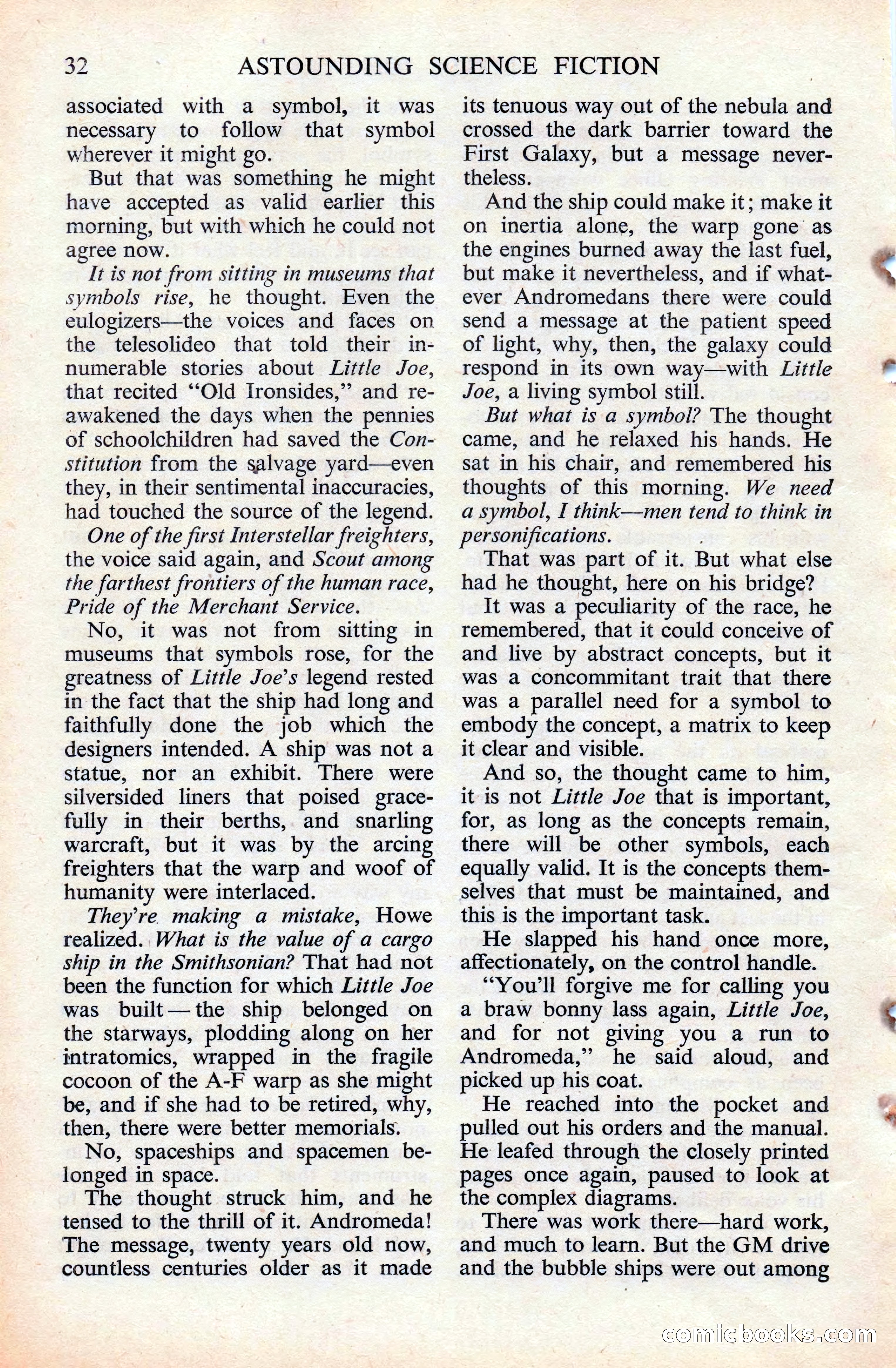
A restored page from Pulp Fiction, 1954. Page through the whole issue in the reader above.
📄 Transcribed text from this page (OCR, searchable)
Machine-transcribed from the original scan — historical spelling and the odd misread are preserved.
32 ASTOUNDING SCIENCE FICTION associated with a symbol, it was necessary to follow that symbol wherever it might go. But that was something he might have accepted as valid earlier this morning, but with which he could not agree now. It is not from sitting in museums that symbols rise, he thought. Even the eulogizers—the voices and faces on the telesolideo that told their in- numerable stories about Little Joe, that recited ‘‘Old Ironsides,”’ and re- awakened the days when the pennies of schoolchildren had saved the Con- stitution from the salvage yard—even they, in their sentimental inaccuracies, had touched the source of the legend. One of the first Interstellar freighters, the voice said again, and Scout among the farthest frontiers of the human race, Pride of the Merchant Service. No, it was not from sitting in museums that symbols rose, for the greatness of Little Joe’s legend rested in the fact that the ship had long and faithfully done the job which the designers intended. A ship was not a statue, mor an exhibit. There were silversided liners that poised grace- fully in their berths, and snarling warcraft, but it was by the arcing freighters that the warp and woof of humanity were interlaced. They’re. making a mistake, Howe realized. What is the value of a cargo ship in the Smithsonian? That had not been the function for which Little Joe was built—the ship belonged on the starways, plodding along on her intratomics, wrapped in the fragile cocoon of the A-F warp as she might be, and if she had to be retired, why, then, there were better memorials. No, spaceships and spacemen be- longed in space. The thought struck him, and he tensed to the thrill of it. Andromeda! The message, twenty years old now, countless centuries older as it made its tenuous way out of the nebula and crossed the dark barrier toward the First Galaxy, but a message never- theless. And the ship could make it; make it on inertia alone, the warp gone as the engines burned away the last fuel, but make it nevertheless, and if what- ever Andromedans there were could send a message at the patient speed of light, why, then, the galaxy could respond in its own way—with Little Joe, a living symbol still. But what is a symbol? The thought came, and he relaxed his hands. He sat in his chair, and remembered his thoughts of this morning. We need a symbol, I think—men tend to think in personifications. That was part of it. But what else had he thought, here on his bridge? It was a peculiarity of the race, he remembered, that it could conceive of and live by abstract concepts, but it was a concommitant trait that there was a parallel need for a symbol to embody the concept, a matrix to keep it clear and visible. And so, the thought came to him, it is not Little Joe that is important, for, as long as the concepts remain, there will be other symbols, each equally valid. It is the concepts them- selves that must be maintained, and this is the important task. He slapped his hand once more, affectionately, on the control handle. “You'll forgive me for calling you a braw bonny lass again, Little Joe, and for not giving you a run to Andromeda,” he said aloud, and picked up his coat. He reached into the pocket and pulled out his orders and the manual. He leafed through the closely printed pages once again, paused to look at the complex diagrams. There was work there—hard work, and much to learn. But the GM drive and the bubble ships were out among conniclboooks.€© iin