
Pulp Fiction, 1954 · page 33 of 132
Astounding Science Fiction, British Edition — page 33: what you’re looking at
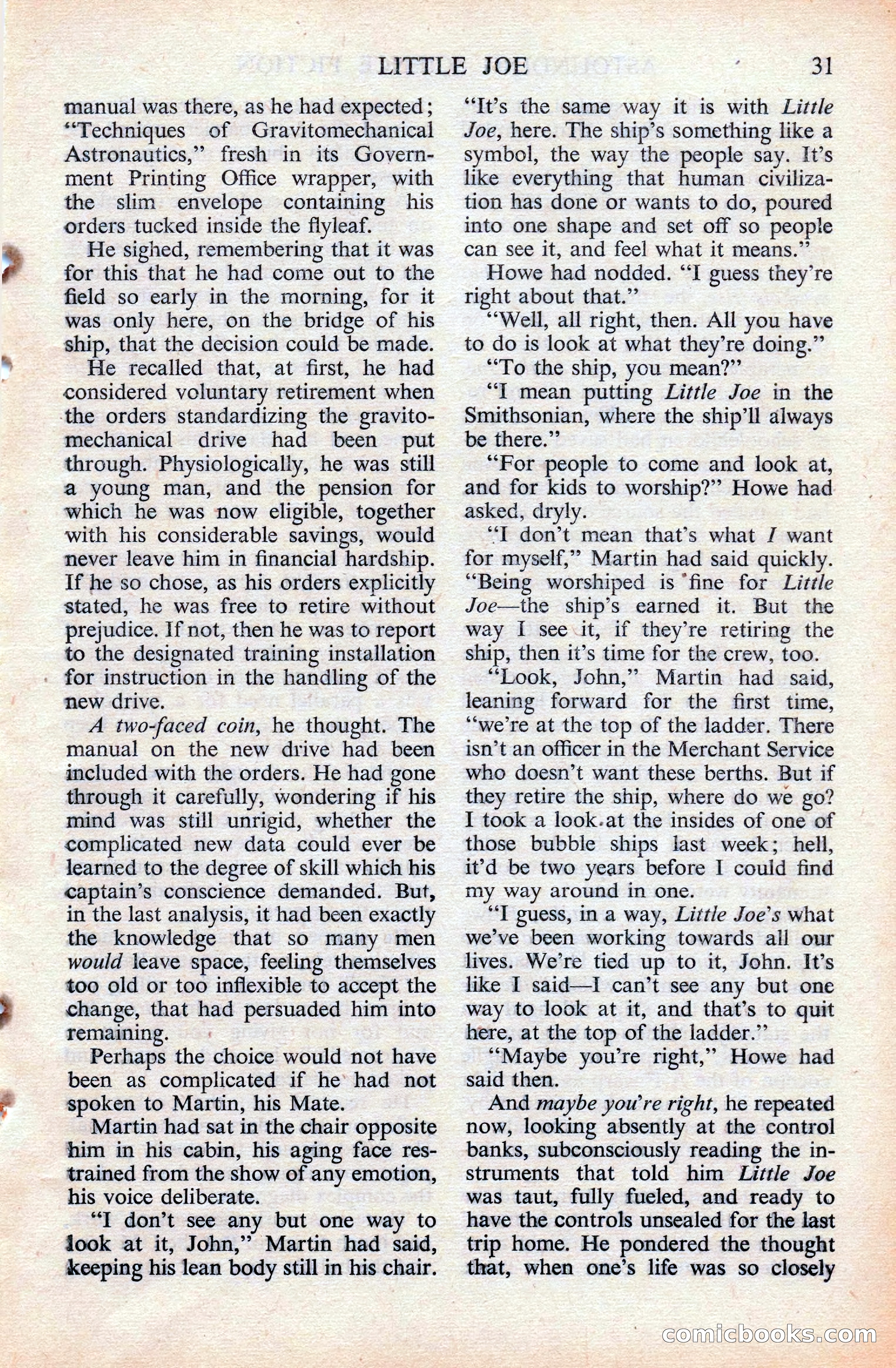
A restored page from Pulp Fiction, 1954. Page through the whole issue in the reader above.
📄 Transcribed text from this page (OCR, searchable)
Machine-transcribed from the original scan — historical spelling and the odd misread are preserved.
LITTLE JOE 31 manual was there, as he had expected ; “Techniques of Gravitomechanical Astronautics,” fresh in its Govern- ment Printing Office wrapper, with the slim envelope containing his orders tucked inside the flyleaf. He sighed, remembering that it was for this that he had come out to the field so early in the morning, for it was only here, on the bridge of his ship, that the decision could be made. He recalled that, at first, he had considered voluntary retirement when the orders standardizing the gravito- mechanical drive had been put through. Physiologically, he was still a young man, and the pension for which he was now eligible, together with his considerable savings, would never leave him in financial hardship. If he so chose, as his orders explicitly stated, he was free to retire without prejudice. If not, then he was to report to the designated training installation - for instruction in the handling of the new drive. A two-faced coin, he thought. The manual on the new drive had been imcluded with the orders. He had gone through it carefully, wondering if his mind was still unrigid, whether the complicated new data could ever be learned to the degree of skill which his captain’s conscience demanded. But, in the last analysis, it had been exactly the knowledge that so many men would leave space, feeling themselves too old or too inflexible to accept the change, that had persuaded him into remaining. Perhaps the choice would not have been as complicated if he had not spoken to Martin, his Mate. Martin had sat in the chair opposite him in his cabin, his aging face res- trained from the show of any emotion, his voice deliberate. “I don’t see any but one way to fook at it, John,’’ Martin had said, keeping his lean body still in his chair. “It’s the same way it is with Little Joe, here. The ship’s something like a symbol, the way the people say. It’s like everything that human civiliza- tion has done or wants to do, poured into one shape and set off so people can see it, and feel what it means.”’ Howe had nodded. “I guess they’re right about that.” “Well, all right, then. All you have to do is look at what they’re doing.” “To the ship, you mean?” “I mean putting Little Joe in the Smithsonian, where the ship’ll always be there.”’ “For people to come and look at, and for kids to worship?’” Howe had asked, dryly. “I don’t mean that’s what J want for myself,” Martin had said quickly. “Being worshiped is ‘fine for Little Joe—the ship’s earned it. But the way I see it, if they’re retiring the ship, then it’s time for the crew, too. “Look, John,” Martin had said, leaning forward for the first time, “we're at the top of the ladder. There isn’t an officer in the Merchant Service who doesn’t want these berths. But if they retire the ship, where do we go? I took a look.at the insides of one of those bubble ships last week; hell, it'd be two years before I could find my way around in one. “T guess, in a way, Little Joe’s what we've been working towards all our lives. We're tied up to it, John. It’s like I said—I can’t see any but one way to look at it, and that’s to quit here, at the top of the ladder.” “Maybe you're right,’ Howe had said then. And maybe you're right, he repeated now, looking absently at the control banks, subconsciously reading the in- struments that told him Little Joe was taut, fully fueled, and ready to have the controls unsealed for the last trip home. He pondered the thought that, when one’s life was so closely Cconnicloooks.c© im