
Pulp Fiction, 1954 · page 35 of 132
Astounding Science Fiction, British Edition — page 35: what you’re looking at
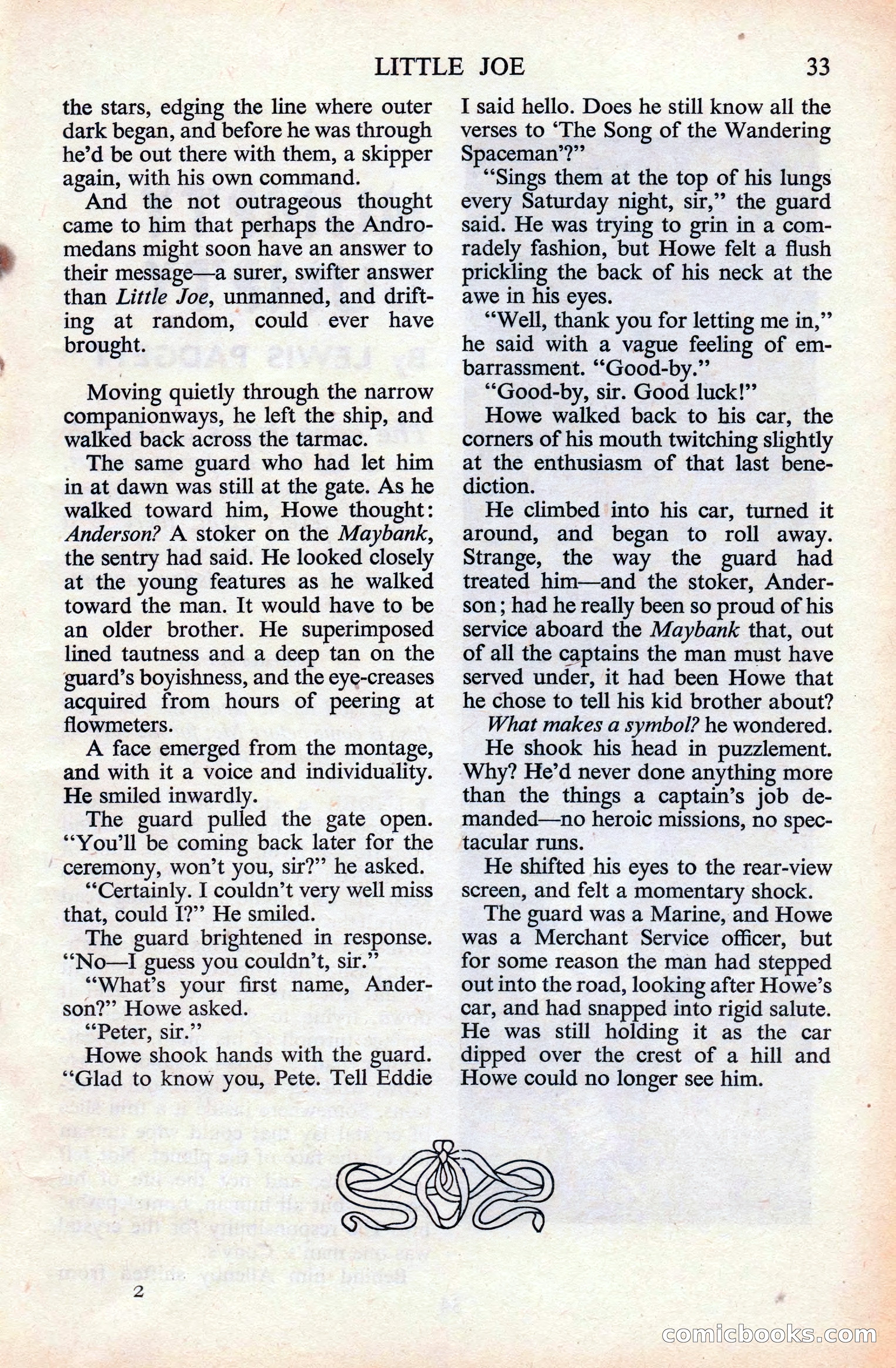
A restored page from Pulp Fiction, 1954. Page through the whole issue in the reader above.
📄 Transcribed text from this page (OCR, searchable)
Machine-transcribed from the original scan — historical spelling and the odd misread are preserved.
LITTLE JOE 33 the stars, edging the line where outer dark began, and before he was through he’d be out there with them, a skipper again, with his own command. And the not outrageous thought came to him that perhaps the Andro- medans might soon have an answer to their message—a surer, swifter answer than Little Joe, unmanned, and drift- ing at random, could ever have brought. Moving quietly through the narrow companionways, he left the ship, and walked back across the tarmac. The same guard who had let him in at dawn was still at the gate. As he walked toward him, Howe thought: Anderson? A stoker on the Maybank, the sentry had said. He looked closely at the young features as he walked toward the man. It would have to be an older brother. He superimposed lined tautness and a deep tan on the guard’s boyishness, and the eye-creases acquired from hours of peering at flowmeters. A face emerged from the montage, and with it a voice and individuality. He smiled inwardly. The guard pulled the gate open. “You'll be coming back later for the ceremony, won’t you, sir?” he asked. “Certainly. I couldn’t very well miss that, could I?’’ He smiled. The guard brightened in response. ‘““No—I guess you couldn’t, sir.” “What’s your first name, Ander- son?”’ Howe asked. ~ Peter; Sit.” Howe shook hands with the guard. “Glad to know you, Pete. Tell Eddie I said hello. Does he still know all the verses to “The Song of the Wandering Spaceman”?”’ ‘Sings them at the top of his lungs every Saturday night, sir,” the guard said. He was trying to grin in a com- radely fashion, but Howe felt a flush prickling the back of his neck at the awe in his eyes. “Well, thank you for letting me in,” he said with a vague feeling of em- barrassment. “‘Good-by.” ““Good-by, sir. Good luck!” Howe walked back to his car, the corners of his mouth twitching slightly at the enthusiasm of that last bene- diction. He climbed into his car, turned it around, and began to roll away. Strange, the way the guard had treated him—and the stoker, Ander- son ; had he really been so proud of his service aboard the Maybank that, out of all the captains the man must have served under, it had been Howe that he chose to tell his kid brother about? What makes a symbol? he wondered. He shook his head in puzzlement. Why? He’d never done anything more than the things a captain’s job de- manded—no heroic missions, no spec- tacular runs. He shifted his eyes to the rear-view screen, and felt a momentary shock. The guard was a Marine, and Howe was a Merchant Service officer, but for some reason the man had stepped out into the road, looking after Howe’s car, and had snapped into rigid salute. He was still holding it as the car dipped over the crest of a hill and Howe could no longer see him. comilcloooks.c© im