
Pulp Fiction, 1954 · page 32 of 132
Astounding Science Fiction, British Edition — page 32: what you’re looking at
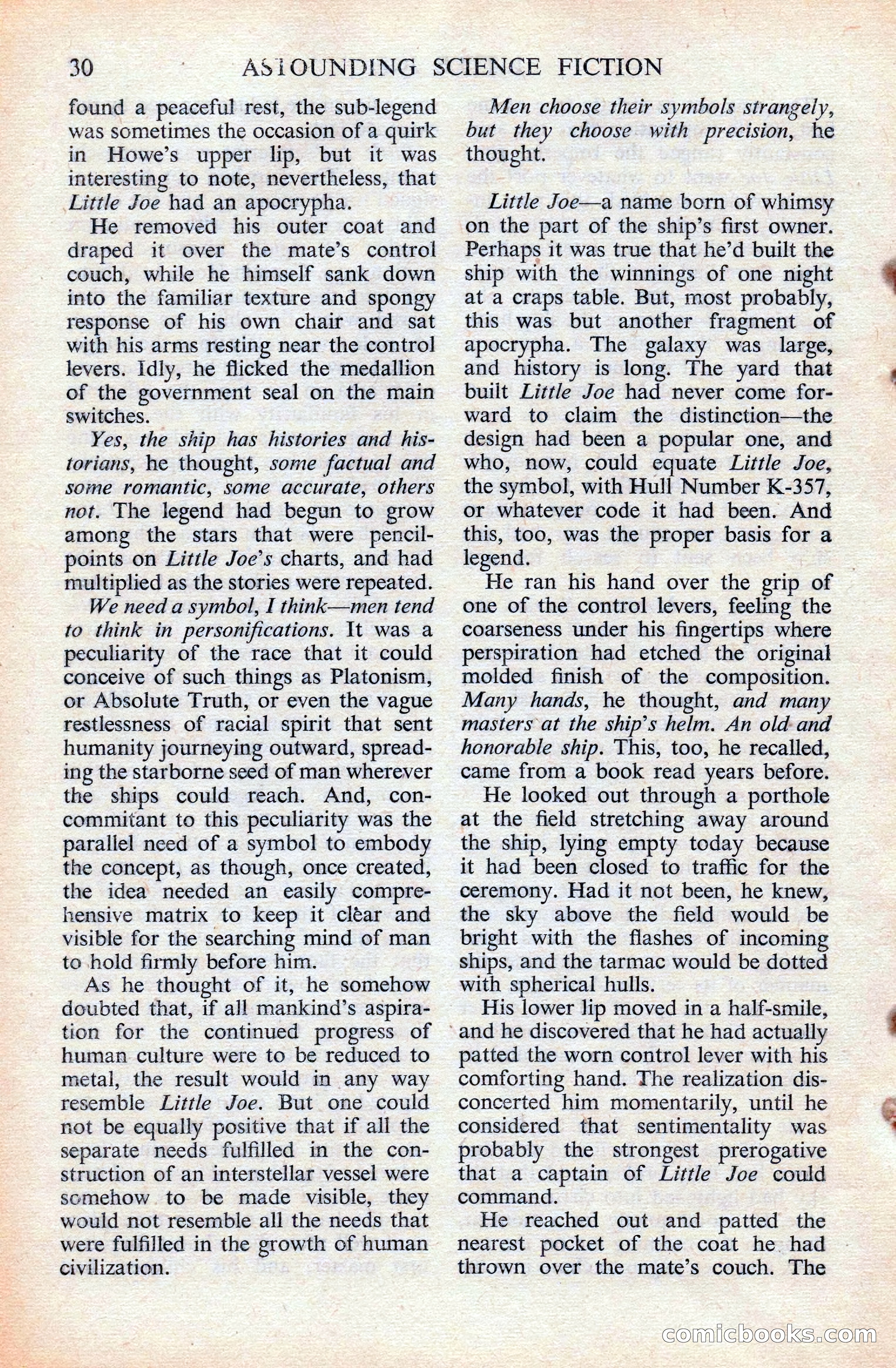
A restored page from Pulp Fiction, 1954. Page through the whole issue in the reader above.
📄 Transcribed text from this page (OCR, searchable)
Machine-transcribed from the original scan — historical spelling and the odd misread are preserved.
30 ; ASiOUNDING SCIENCE FICTION found a peaceful rest, the sub-legend was sometimes the occasion of a quirk in Howe’s upper lip, but it was interesting to note, nevertheless, that Little Joe had an apocrypha. He removed his outer coat and draped it over the mate’s control couch, while he himself sank down into the familiar texture and spongy response of his own chair and sat with his arms resting near the control levers. Idly, he flicked the medallion of the government seal on the main switches. Yes, the ship has histories and his- torians, he thought, some factual and some romantic, some accurate, others not. The legend had begun to grow among the stars that were pencil- points on Little Joe’s charts, and had multiplied as the stories were repeated. We need a symbol, I think—men tend to think in personifications. It was a peculiarity of the race that it could conceive of such things as Platonism, or Absolute Truth, or even the vague restlessness of racial spirit that sent humanity journeying outward, spread- ing the starborne seed of man wherever the ships could reach. And, con- commitant to this peculiarity was the parallel need of a symbol to embody the concept, as though, once created, the idea needed an easily compre- hensive matrix to keep it cléar and visible for the searching mind of man to hold firmly before him. As he thought of it, he somehow doubted that, if all mankind’s aspira- tion for the continued progress of human culture were to be reduced to metal, the result would in any way resemble Little Joe. But one could not be equally positive that if all the separate needs fulfilled in the con- struction of an interstellar vessel were somehow to be made visible, they would not resemble all the needs that were fulfilled in the growth of human civilization. Men choose their symbols strangely, but they choose with precision, he thought. Little Joe—a name born of whimsy on the part of the ship’s first owner. Perhaps it was true that he’d built the ship with the winnings of one night at a craps table. But, most probably, this was but another fragment of apocrypha. The galaxy was large, and history is long. The yard that built Little Joe had never come for- ward to claim the distinction—the design had been a popular one, and who, now, could equate Little Joe, the symbol, with Hull Number K-357, or whatever code it had been. And this, too, was the proper basis for a legend. He ran his hand over the grip of one of the control levers, feeling the coarseness under his fingertips where perspiration had etched the original molded finish of the composition. Many hands, he thought, and many masters at the ship’s helm. An old and honorable ship. This, too, he recalled, came from a book read years before. He looked out through a porthole at the field stretching away around the ship, lying empty today because it had been closed to traffic for the ceremony. Had it not been, he knew, the sky above the field would be bright with the flashes of incoming ships, and the tarmac would be dotted with spherical hulls. His lower lip moved in a half-smile, and he discovered that he had actually patted the worn control lever with his comforting hand. The realization dis- concerted him momentarily, until he considered that sentimentality was probably the strongest prerogative that a captain of Little Joe could command. He reached out and patted the nearest pocket of the coat he. had thrown over the mate’s couch. The comnniilcloooks.c© nl