
Pulp Fiction, 1954 · page 31 of 132
Astounding Science Fiction, British Edition — page 31: what you’re looking at
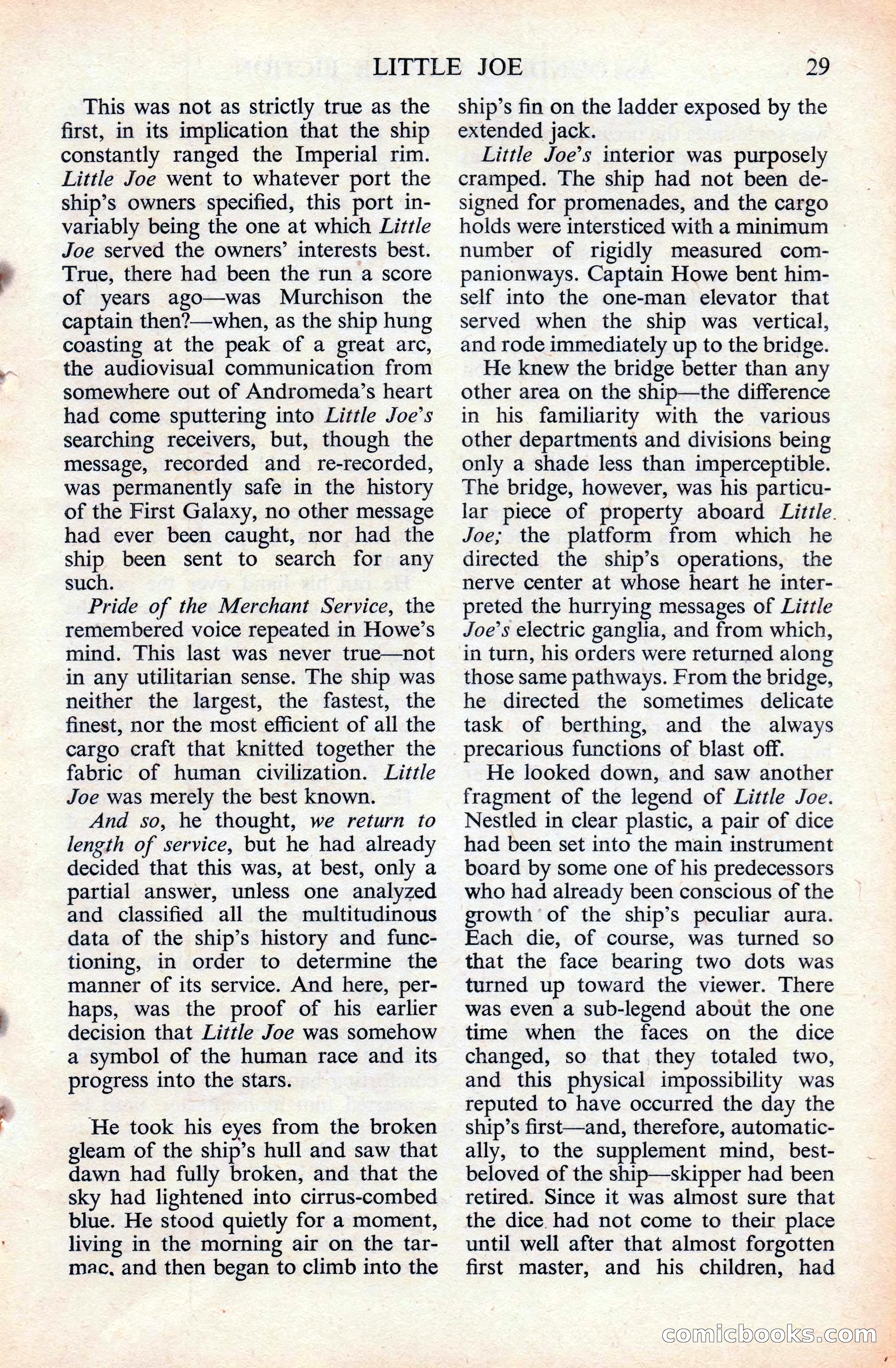
A restored page from Pulp Fiction, 1954. Page through the whole issue in the reader above.
📄 Transcribed text from this page (OCR, searchable)
Machine-transcribed from the original scan — historical spelling and the odd misread are preserved.
LITTLE JOE This was not as strictly true as the first, in its implication that the ship constantly ranged the Imperial rim. Little Joe went to whatever port the ship’s owners specified, this port in- variably being the one at which Little Joe served the owners’ interests best. True, there had been the run a score of years ago—was Murchison the captain then?—when, as the ship hung coasting at the peak of a great arc, the audiovisual communication from somewhere out of Andromeda’s heart had come sputtering into Little Joe’s searching receivers, but, though the message, recorded and re-recorded, was permanently safe in the history of the First Galaxy, no other message had ever been caught, nor had the ship been sent to search for any such. Pride of the Merchant Service, the remembered voice repeated in Howe’s mind. This last was never true—not in any utilitarian sense. The ship was neither the largest, the fastest, the finest, nor the most efficient of all the cargo craft that knitted together the fabric of human civilization. Little Joe was merely the best known. And so, he thought, we return to length of service, but he had already decided that this was, at best, only a partial answer, unless one analyzed and classified all the multitudinous data of the ship’s history and func- tioning, in order to determine the manner of its service. And here, per- haps, was the proof of his earlier decision that Little Joe was somehow a symbol of the human race and its progress into the stars. He took his eyes from the broken gleam of the ship’s hull and saw that dawn had fully broken, and that the sky had lightened into cirrus-combed blue. He stood quietly for a moment, living in the morning air on the tar- mac, and then began to climb into the 29 ship’s fin on the ladder exposed by the extended jack. Little Joe’s interior was purposely cramped. The ship had not been de- signed for promenades, and the cargo holds were intersticed with a minimum number of rigidly measured com- panionways. Captain Howe bent him- self into the one-man elevator that served when the ship was vertical, and rode immediately up to the bridge. He knew the bridge better than any other area on the ship—the difference in his familiarity with the various other departments and divisions being only a shade less than imperceptible. The bridge, however, was his particu- lar piece of property aboard Little. _ Joe; the platform from which he directed the ship’s operations, the nerve center at whose heart he inter- preted the hurrying messages of Little Joe’s electric ganglia, and from which, in turn, his orders were returned along those same pathways. From the bridge, he directed the sometimes delicate task of berthing, and the always precarious functions of blast off. He looked down, and saw another fragment of the legend of Little Joe. Nestled in clear plastic, a pair of dice had been set into the main instrument board by some one of his predecessors who had already been conscious of the growth of the ship’s peculiar aura. Each die, of course, was turned so that the face bearing two dots was turned up toward the viewer. There was even a sub-legend about the one time when the faces on the dice changed, so that they totaled two, and this physical impossibility was reputed to have occurred the day the ship’s first—and, therefore, automatic- ally, to the supplement mind, best- beloved of the ship—skipper had been retired. Since it was almost sure that the dice had not come to their place until well after that almost forgotten first master, and his children, had connicloooks.c© im