
Pulp Fiction, 1954 · page 125 of 132
Astounding Science Fiction, British Edition — page 125: what you’re looking at
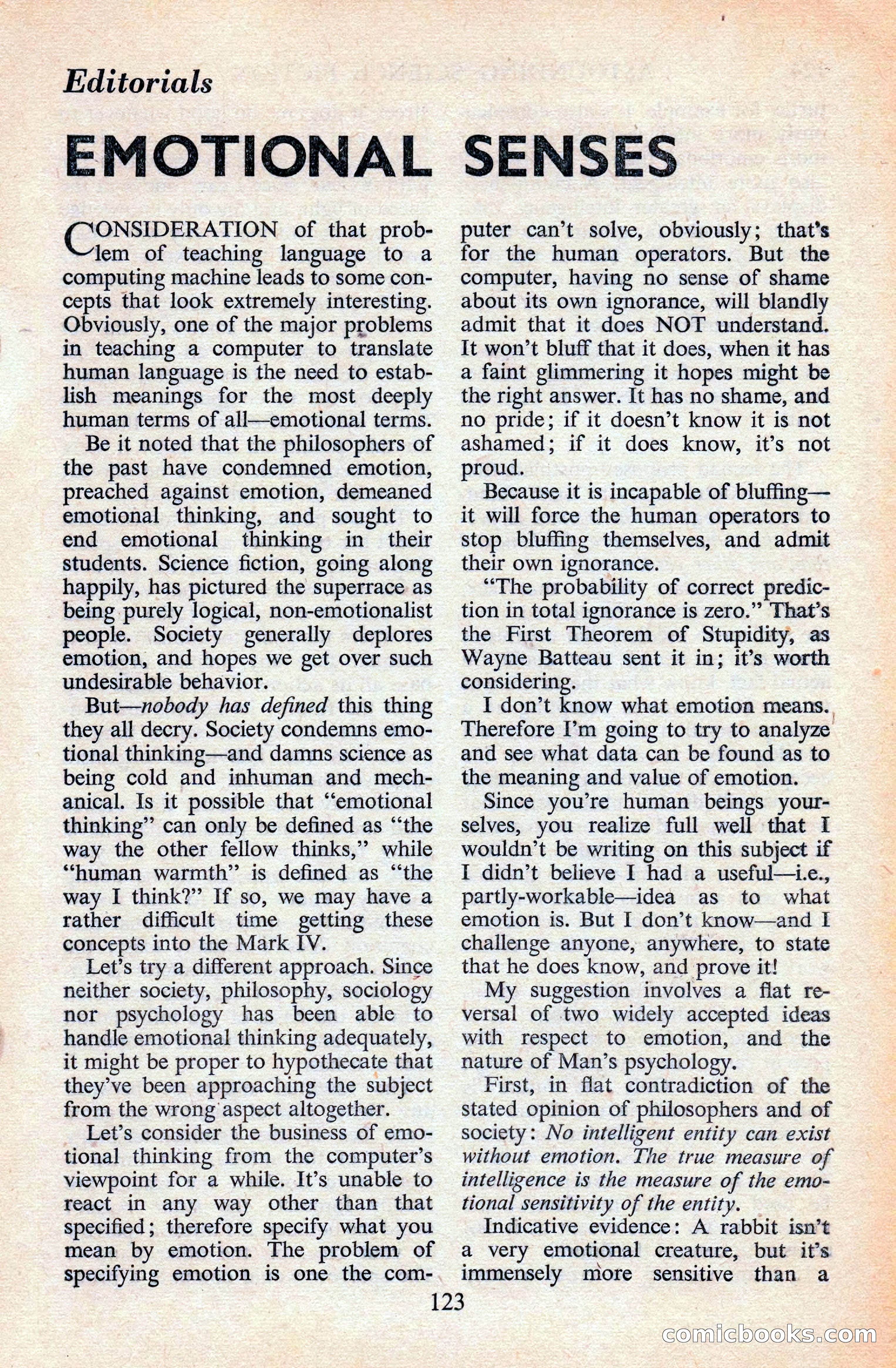
A restored page from Pulp Fiction, 1954. Page through the whole issue in the reader above.
📄 Transcribed text from this page (OCR, searchable)
Machine-transcribed from the original scan — historical spelling and the odd misread are preserved.
Editorials EMOTIONAL CSE TON of that prob- lem of teaching language to a computing machine leads to some con- cepts that look extremely interesting. Obviously, one of the major problems in teaching a computer to translate human language is the need to estab- lish meanings for the most deeply human terms of all—emotional terms. Be it noted that the philosophers of the past have condemned emotion, preached against emotion, demeaned emotional thinking, and sought to end emotional thinking in their students. Science fiction, going along happily, has pictured the superrace as being purely logical, non-emotionalist people. Society generally deplores emotion, and hopes we get over such undesirable behavior. But—nobody has defined this thing they all decry. Society condemns emo- tional thinking—and damns science as being cold and inhuman and mech- anical. Is it possible that “‘emotional thinking” can only be defined as “the way the other fellow thinks,” while “human warmth” is defined as “the way I think?’ If so, we may have a rather difficult time getting these concepts into the Mark IV. Let’s try a different approach. Since neither society, philosophy, sociology nor psychology has been able to handle emotional thinking adequately, it might be proper to hypothecate that they’ve been approaching the subject from the wrong aspect altogether. Let’s consider the business of emo- tional thinking from the computer’s viewpoint for a while. It’s unable to react in any way other than that specified; therefore specify what you mean by emotion. The problem of specifying emotion is one the com- SENSES puter can’t solve, obviously; that’s for the human operators. But the computer, having no sense of shame about its own ignorance, will blandly admit that it does NOT understand. It won’t bluff that it does, when it has a faint glimmering it hopes might be the right answer. It has no shame, and no pride; if it doesn’t know it is not ashamed; if it does know, it’s not proud, Because it is incapable of bluffing— it will force the human operators to stop bluffing themselves, and admit their own ignorance. “The probability of correct predic- tion in total ignorance is zero.” That’s the First Theorem of Stupidity, as Wayne Batteau sent it in; it’s worth considering. I don’t know what emotion means. Therefore I’m going to try to analyze and see what data can be found as to the meaning and value of emotion. Since you’re human beings your- selves, you realize full well that I wouldn’t be writing on this subject if I didn’t believe I had a useful—e., partly-workable—idea as to what emotion is. But I don’t know—and I challenge anyone, anywhere, to state that he does know, and prove it! My suggestion involves a flat re- versal of two widely accepted ideas with respect to emotion, and the nature of Man’s psychology. First, in flat contradiction of the stated opinion of philosophers and of society: No intelligent entity can exist without emotion. The true measure of intelligence is the measure of the emo- tional sensitivity of the entity. Indicative evidence: A rabbit isn’t a very emotional creature, but it’s immensely more sensitive than a 123 ECoOMmMichdooksnco im