
Pulp Fiction, 1954 · page 126 of 132
Astounding Science Fiction, British Edition — page 126: what you’re looking at
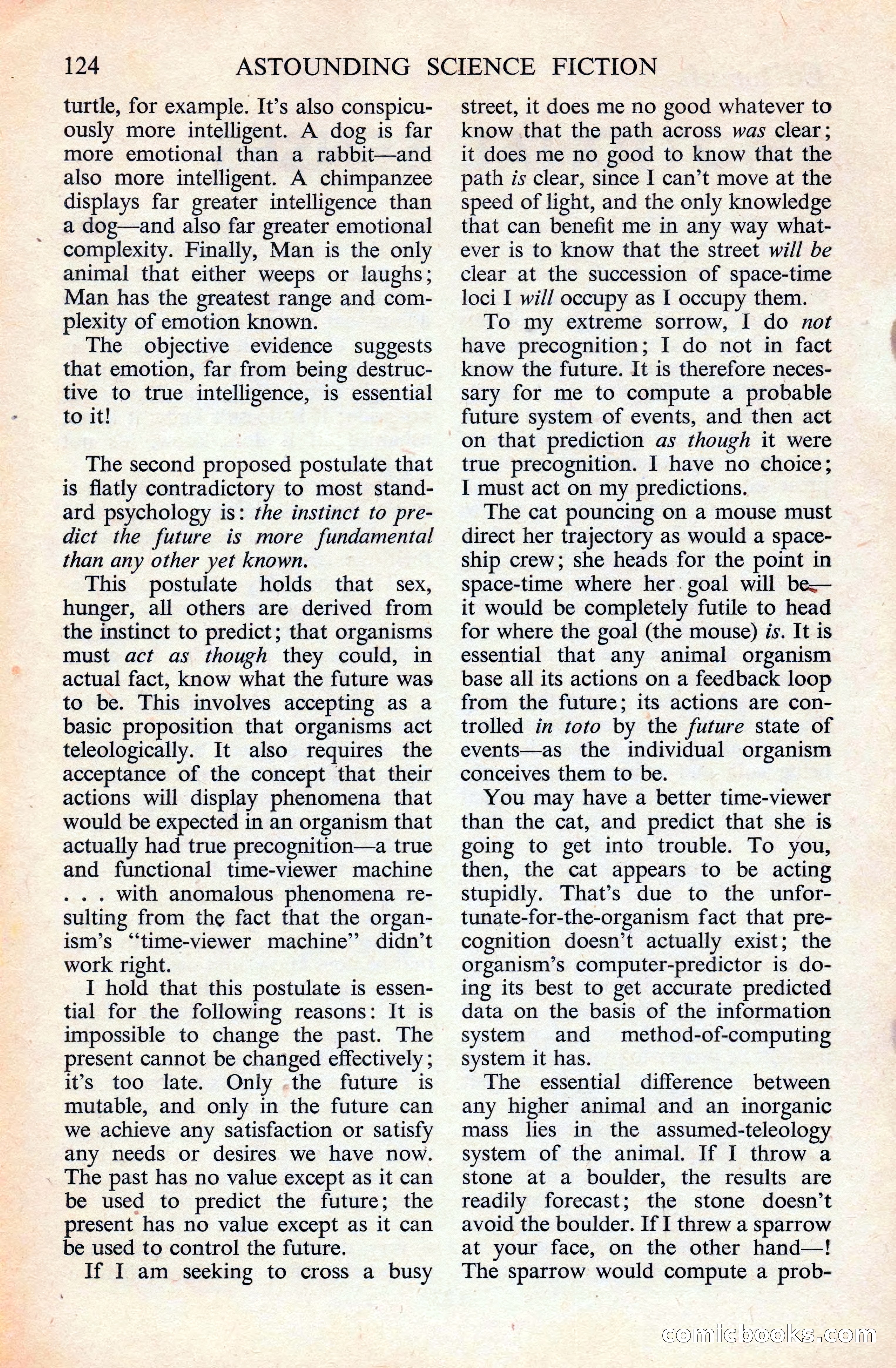
A restored page from Pulp Fiction, 1954. Page through the whole issue in the reader above.
📄 Transcribed text from this page (OCR, searchable)
Machine-transcribed from the original scan — historical spelling and the odd misread are preserved.
124 turtle, for example. It’s also conspicu- ously more intelligent. A dog is far more emotional than a rabbit—and also more intelligent. A chimpanzee displays far greater intelligence than a dog—and also far greater emotional complexity. Finally, Man is the only animal that either weeps or laughs; Man has the greatest range and com- plexity of emotion known. The objective evidence suggests that emotion, far from being destruc- tive to true intelligence, is essential to it! The second proposed postulate that is flatly contradictory to most stand- ard psychology is: the instinct to pre- dict the future is more fundamental than any other yet known. This postulate holds that sex, hunger, all others are derived from the instinct to predict; that organisms must act as though they could, in actual fact, know what the future was to be. This involves accepting as a basic proposition that organisms act teleologically. It also requires the acceptance of the concept that their actions will display phenomena that would be expected in an organism that actually had true precognition—a true and functional time-viewer machine . with anomalous phenomena re- sulting from the fact that the organ- ism’s ‘“‘time-viewer machine’ didn’t work right. I hold that this postulate is essen- tial for the following reasons: It is impossible to change the past. The present cannot be changed effectively ; its too late. Only .the future is mutable, and only in the future can we achieve any satisfaction or satisfy any needs or desires we have now. The past has no value except as it can be used to predict the future; the present has no value except as it can be used to control the future. If I am seeking to cross a busy ASTOUNDING SCIENCE FICTION street, it does me no good whatever to know that the path across was clear; it does me no good to know that the path is clear, since I can’t move at the speed of light, and the only knowledge that can benefit me in any way what- ever is to know that the street will be clear at the succession of space-time loci I will occupy as I occupy them. To my extreme sorrow, I do not have precognition; I do not in fact know the future. It is therefore neces- sary for me to compute a probable future system of events, and then act on that prediction as though it were true precognition. I have no choice; I must act on my predictions. The cat pouncing on a mouse must direct her trajectory as would a space- ship crew; she heads for the point in space-time where her. goal will be— it would be completely futile to head for where the goal (the mouse) is. It is essential that any animal organism base all its actions on a feedback loop from the future; its actions are con- trolled in toto by the future state of events—as the individual organism conceives them to be. You may have a better time-viewer than the cat, and predict that she is going to get into trouble. To you, then, the cat appears to be acting stupidly. That’s due to the unfor- tunate-for-the-organism fact that pre- cognition doesn’t actually exist; the organism’s computer-predictor is do- ing its best to get accurate predicted data on the basis of the information system and method-of-computing system it has. The essential difference between any higher animal and an inorganic mass lies in the assumed-teleology system of the animal. If I throw a stone at a boulder, the results are readily forecast; the stone doesn’t avoid the boulder. If I threw a sparrow at your face, on the other hand—! The sparrow would compute a prob- conniclooks.conn