
Pulp Fiction, 1954 · page 124 of 132
Astounding Science Fiction, British Edition — page 124: what you’re looking at
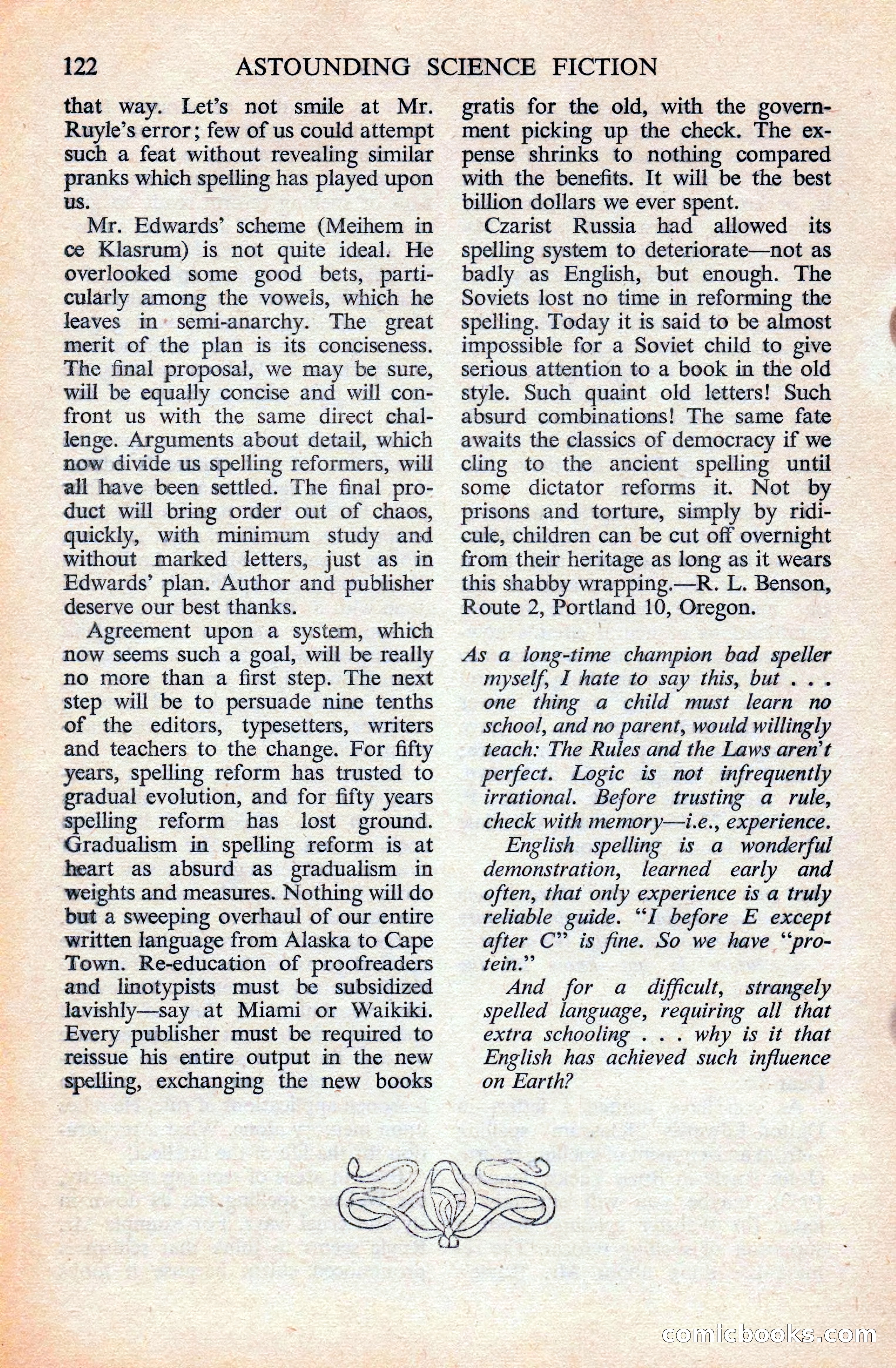
A restored page from Pulp Fiction, 1954. Page through the whole issue in the reader above.
📄 Transcribed text from this page (OCR, searchable)
Machine-transcribed from the original scan — historical spelling and the odd misread are preserved.
122 that way. Let’s not smile at Mr. Ruyle’s error; few of us could attempt such a feat without revealing similar pranks which spelling has played upon us. Mr. Edwards’ scheme (Meihem in ce Klasrum) is not quite ideal. He overlooked some good bets, parti- cularly among the vowels, which he leaves im semi-anarchy. The great merit of the plan is its conciseness. The final proposal, we may be sure, will be equally concise and will con- front us with the same direct chal- lenge. Arguments about detail, which now divide us spelling reformers, will all have been settled. The final pro- duct will bring order out of chaos, quickly, with minimum study and without marked letters, just as in Edwards’ plan. Author and publisher deserve our best thanks. Agreement upon a system, which now seems such a goal, will be really no more than a first step. The next step will be to persuade nine tenths of the editors, typesetters, writers and teachers to the change. For fifty years, spelling reform has trusted to gradual evolution, and for fifty years spelling reform has lost ground. Gradualism in spelling reform is at heart as absurd as gradualism in weights and measures. Nothing will do but a sweeping overhaul of our entire written language from Alaska to Cape Town. Re-education of proofreaders and limotypists must be subsidized lavishly—say at Miami or Waikiki. Every publisher must be required to reissue his entire output in the new spelling, exchanging the new books ASTOUNDING SCIENCE FICTION gratis for the old, with the govern- ment picking up the check. The ex- pense shrinks to nothing compared with the benefits. It will be the best — billion dollars we ever spent. Czarist Russia had allowed its spelling system to deteriorate—not as badly as English, but enough. The Soviets lost no time in reforming the spelling. Today it is said to be almost impossible for a Soviet child to give serious attention to a book in the old style. Such quaint old letters! Such absurd combinations! The same fate awaits the classics of democracy if we cling to the ancient spelling until some dictator reforms it. Not by prisons and torture, simply by ridi- cule, children can be cut off overnight from their heritage as long as it wears this shabby wrapping.—R. L. Benson, Route 2, Portland 10, Oregon. As a long-time champion bad speller myself, I hate to say this, but... one thing a child must learn no school, and no parent, would willingly teach: The Rules and the Laws aren’t perfect. Logic is not infrequently irrational. Before trusting a rule, check with memory—i.e., experience. English spelling is a wonderful demonstration, learned early and often, that only experience is a truly reliable guide. “I before E except after C” is fine. So we have “pro- tein.” And for a difficult, strangely spelled language, requiring all that extra schooling . . . why is it that English has achieved such influence on Earth? Cconmicloooks.c© nl