
Pulp Fiction, 1954 · page 123 of 132
Astounding Science Fiction, British Edition — page 123: what you’re looking at
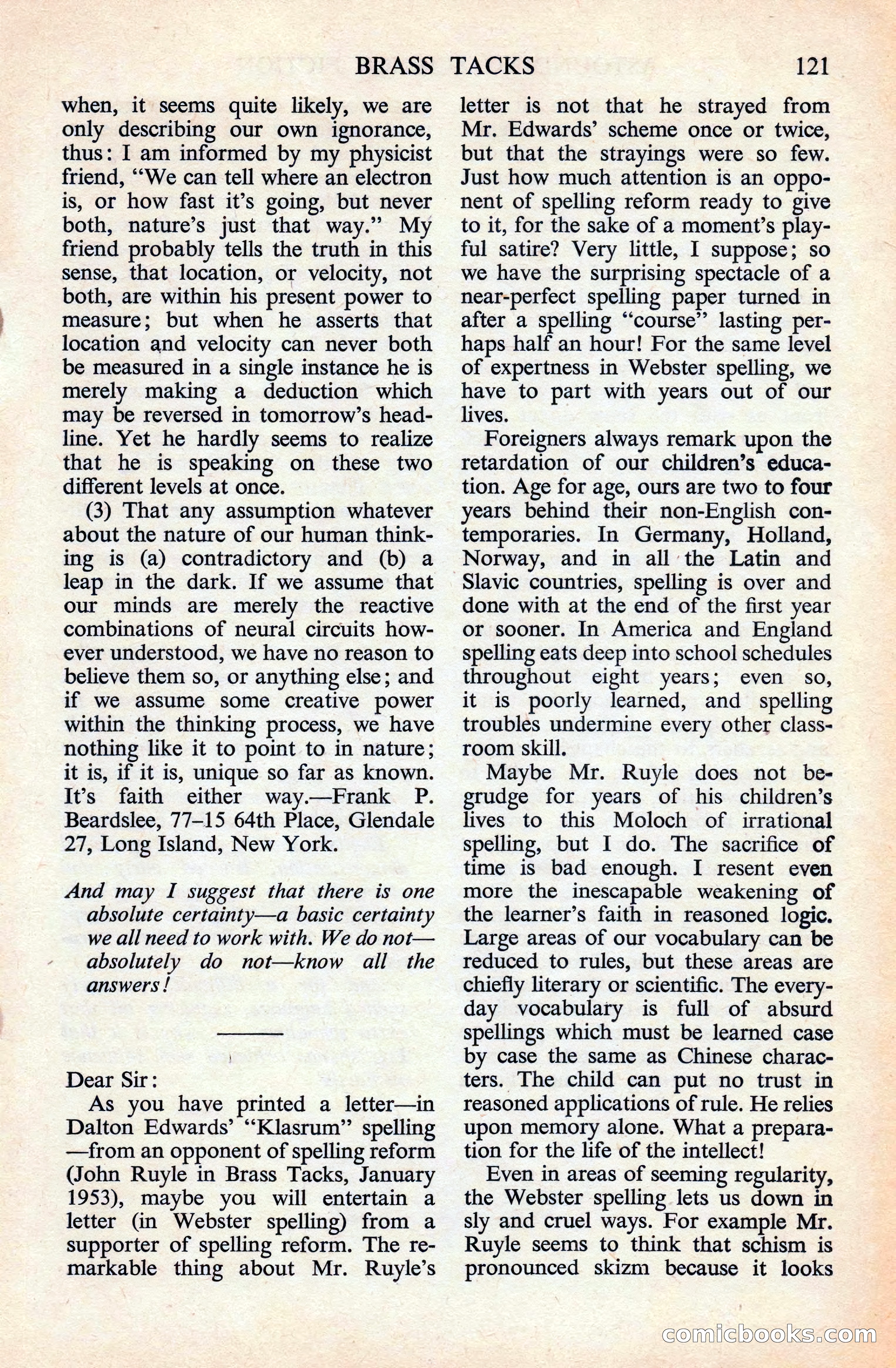
A restored page from Pulp Fiction, 1954. Page through the whole issue in the reader above.
📄 Transcribed text from this page (OCR, searchable)
Machine-transcribed from the original scan — historical spelling and the odd misread are preserved.
BRASS when, it seems quite likely, we are only describing our own ignorance, thus: I am informed by my physicist friend, ‘““We can tell where an electron is, or how fast it’s going, but never both, nature’s just that way.” My friend probably tells the truth in this sense, that location, or velocity, not both, are within his present power to measure; but when he asserts that location and velocity can never both be measured in a single instance he is merely making a deduction which may be reversed in tomorrow’s head- line. Yet he hardly seems to realize that he is speaking on these two different levels at once. (3) That any assumption whatever about the nature of our human think- ing is (a) contradictory and (b) a leap in the dark. If we assume that our minds are merely the reactive combinations of neural circuits how- ever understood, we have no reason to believe them so, or anything else; and if we assume some creative power within the thinking process, we have nothing like it to point to in nature; it is, if it is, unique so far as known. It’s faith either way.—Frank P. Beardslee, 77-15 64th Place, Glendale 27, Long Island, New York. And may I suggest that there is one absolute certainty—a basic certainty we all need to work with. We do not— absolutely do not—know all the answers ! Dear Sir: As you have printed a letter—in Dalton Edwards’ “‘Klasrum’’ spelling —from an opponent of spelling reform (John Ruyle in Brass Tacks, January 1953), maybe you will entertain a letter (in Webster spelling) from a supporter of spelling reform. The re- markable thing about Mr. Ruyle’s TACKS 121 letter is not that he strayed from Mr. Edwards’ scheme once or twice, but that the strayings were so few. Just how much attention is an oppo- nent of spelling reform ready to give to it, for the sake of a moment’s play- ful satire? Very little, I suppose; so we have the surprising spectacle of a near-perfect spelling paper turned in after a spelling “course” lasting per- haps half an hour! For the same level of expertness in Webster spelling, we have to part with years out of our lives. Foreigners always remark upon the retardation of our children’s educa- tion. Age for age, ours are two to four years behind their non-English con- temporaries. In Germany, Holland, Norway, and in all the Latin and Slavic countries, spelling is over and done with at the end of the first year or sooner. In America and England spelling eats deep into school schedules throughout eight years; even so, it is poorly learned, and _ spelling troubles undermine every other class- room skill. Maybe Mr. Ruyle does not be- grudge for years of his children’s lives to this Moloch of irrational spelling, but I do. The sacrifice of time is bad enough. I resent even more the inescapable weakening of the learner’s faith in reasoned logic. Large areas of our vocabulary can be reduced to rules, but these areas are chiefly literary or scientific. The every- day vocabulary is full of absurd spellings which must be learned case by case the same as Chinese charac- ters. The child can put no trust in reasoned applications of rule. He relies upon memory alone. What a prepara- tion for the life of the intellect! Even in areas of seeming regularity, the Webster spelling lets us down in sly and cruel ways. For example Mr. Ruyle seems to think that schism is pronounced skizm because it looks CoOMmicdooksnco im