
Pulp Fiction, 1954 · page 122 of 132
Astounding Science Fiction, British Edition — page 122: what you’re looking at
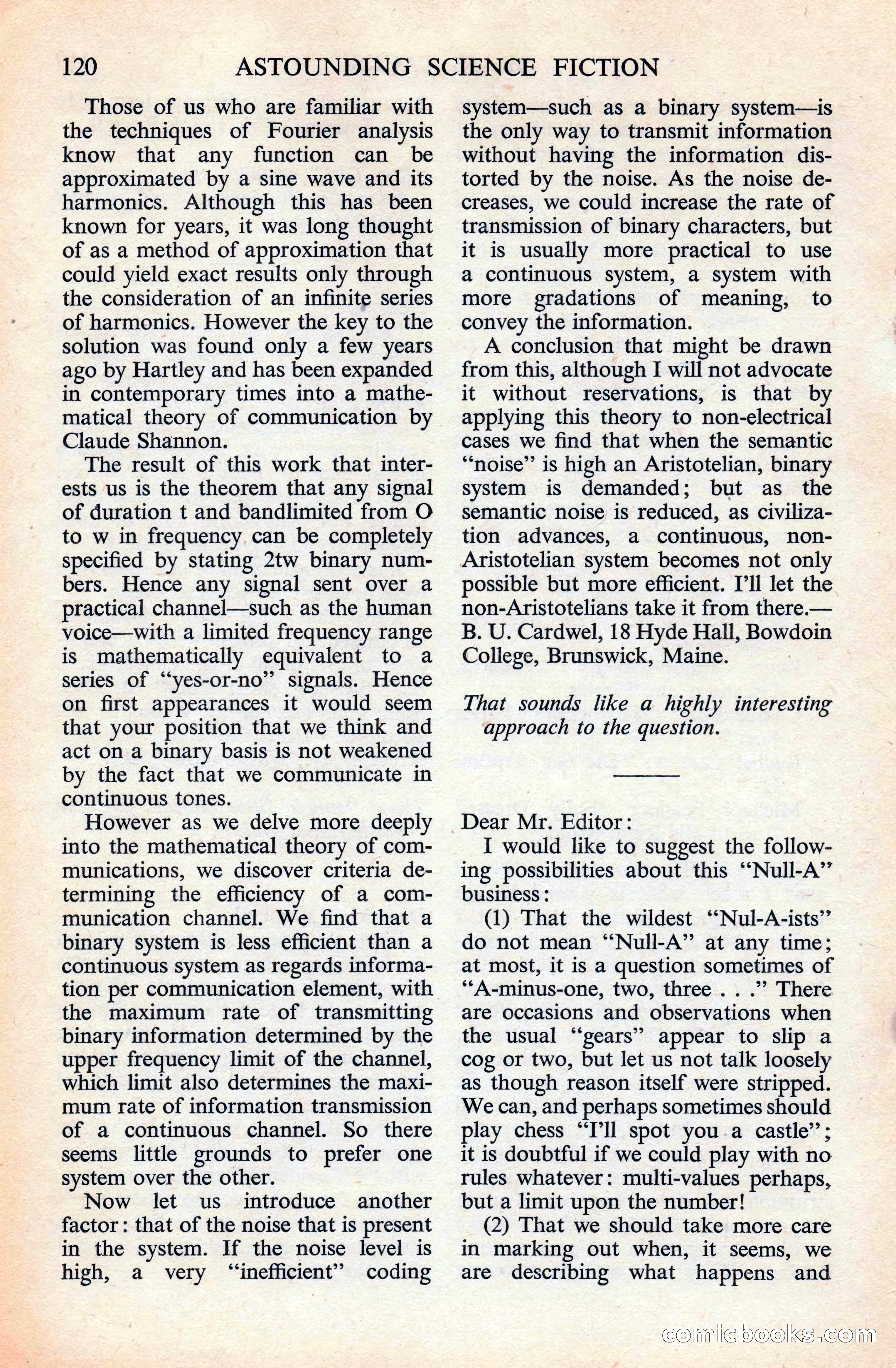
A restored page from Pulp Fiction, 1954. Page through the whole issue in the reader above.
📄 Transcribed text from this page (OCR, searchable)
Machine-transcribed from the original scan — historical spelling and the odd misread are preserved.
120 Those of us who are familiar with the techniques of Fourier analysis know that any function can be approximated by a sine wave and its harmonics. Although this has been known for years, it was long thought of as a method of approximation that could yield exact results only through _ the consideration of an infinite series of harmonics. However the key to the solution was found only a few years ago by Hartley and has been expanded in contemporary times into a mathe- matical theory of communication by Claude Shannon. The result of this work that inter- ests us is the theorem that any signal of duration t and bandlimited from O to w in frequency can be completely specified by stating 2tw binary num- bers. Hence any signal sent over a practical channel—such as the human voice—with a limited frequency range is mathematically equivalent to a series of “‘yes-or-no” signals. Hence on first appearances it would seem that your position that we think and act on a binary basis is not weakened by the fact that we communicate in continuous tones. However as we delve more deeply into the mathematical theory of com- munications, we discover criteria de- termining the efficiency of a com- munication channel. We find that a binary system is less efficient than a continuous system as regards informa- tion per communication element, with the maximum rate of transmitting binary information determined by the upper frequency limit of the channel, which limit also determines the maxi- mum rate of information transmission of a continuous channel. So there seems little grounds to prefer one system over the other. Now let us introduce another factor: that of the noise that is present in the system. If the noise level is high, a very “‘inefficient’” coding ASTOUNDING SCIENCE FICTION system—such as a binary system—is the only way to transmit information without having the information dis- torted by the noise. As the noise de- creases, we could increase the rate of transmission of binary characters, but it is usually more practical to use a continuous system, a system with more gradations of meaning, to convey the information. A conclusion that might be drawn from this, although I will not advocate it without reservations, is that by applying this theory to non-electrical cases we find that when the semantic “noise” is high an Aristotelian, binary system is demanded; but as_ the semantic noise is reduced, as civiliza- tion advances, a continuous, non- Aristotelian system becomes not only possible but more efficient. I’ll let the non-Aristotelians take it from there.— B. U. Cardwel, 18 Hyde Hall, Fowdois College, Brunswick, Maine. That sounds like a highly interesting approach to the question. ee Dear Mr. Editor: I would like to suggest the follow- ing possibilities about this ““Null-A”’ business : (1) That the wildest ‘‘Nul-A-ists’’ do not mean “Null-A”’ at any time; at most, it is a question sometimes of **A-minus-one, two, three . . .” There are occasions and observations when the usual “gears” appear to slip a cog or two, but let us not talk loosely as though reason itself were stripped. We can, and perhaps sometimes should play chess “I'll spot you a castle’; it is doubtful if we could play with no rules whatever: multi-values perhaps, but a limit upon the number! (2) That we should take more care in marking out when, it seems, we are describing what happens and connicloooks.c© im