
Pulp Fiction, 1954 · page 121 of 132
Astounding Science Fiction, British Edition — page 121: what you’re looking at
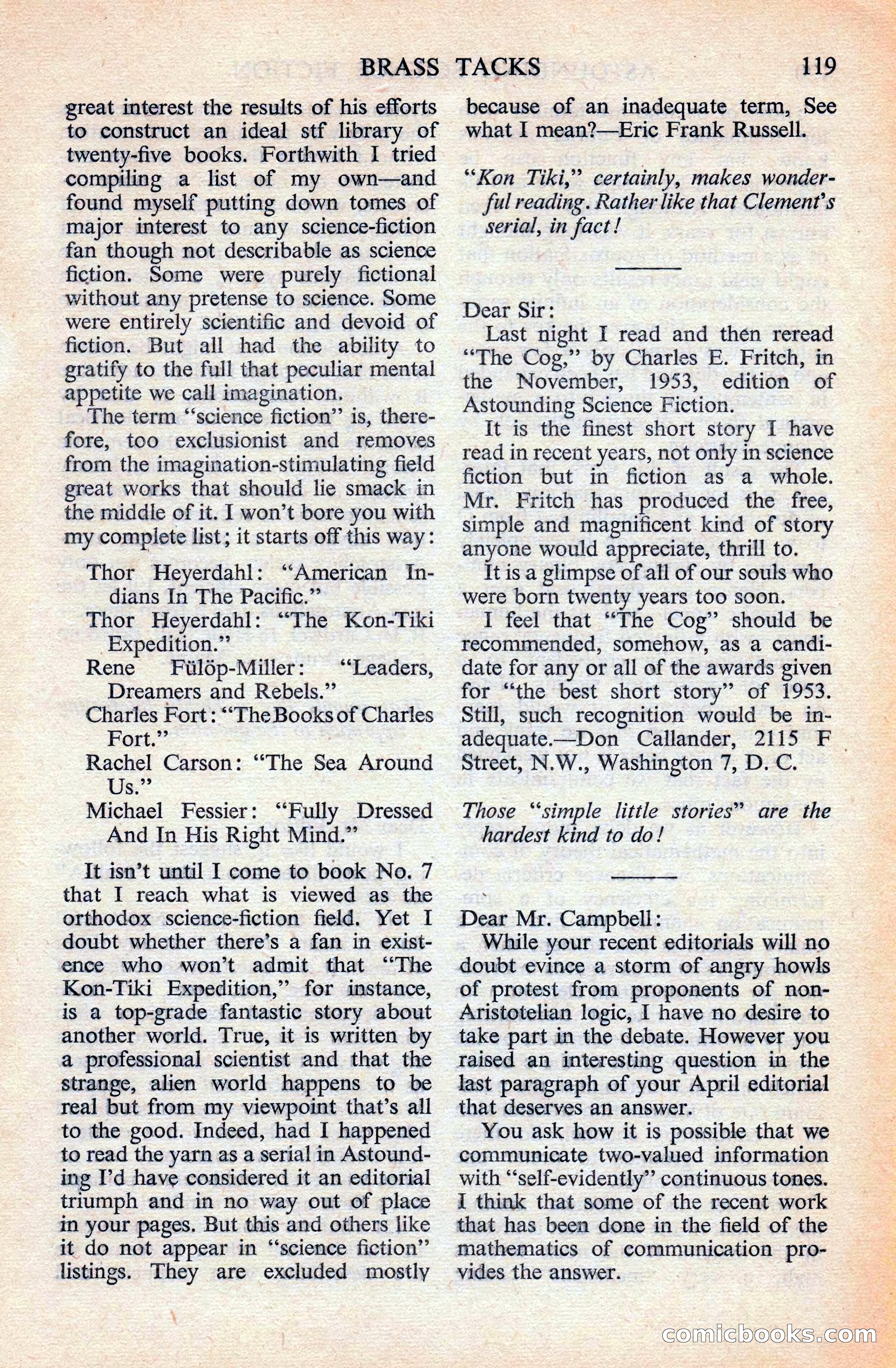
A restored page from Pulp Fiction, 1954. Page through the whole issue in the reader above.
📄 Transcribed text from this page (OCR, searchable)
Machine-transcribed from the original scan — historical spelling and the odd misread are preserved.
BRASS great interest the results of his efforts to construct an ideal stf library of twenty-five books. Forthwith I tried compiling a list of my own—and found myself putting down tomes of major interest to any science-fiction fan though not describable as science fiction. Some were purely fictional without any pretense to science. Some were entirely scientific and devoid of fiction. But all had the ability to gratify to the full that peculiar mental appetite we call imagination. The term “‘science fiction’’ is, there- fore, too exclusionist and removes from the imagination-stimulating field great works that should lie smack in the middle of it. | won’t bore you with my complete list; it starts off this way : Thor Heyerdahl: “American In- dians In The Pacific.” Thor Heyerdahl: “The Kon-Tiki Expedition.” Rene Fullop-Miller: Dreamers and Rebels.” Charles Fort : ““‘The Books of Charles Fort.” Rachel Carson: “The Sea Around Us.” Michael Fessier: “Fully Dressed And In His Right Mind.” It isn’t until I come to book No. 7 that I reach what is viewed as the orthodox science-fiction field. Yet I doubt whether there’s a fan in exist- ence who won’t admit that “The Kon-Tiki Expedition,” for instance, is a top-grade fantastic story about another world. True, it is written by a professional scientist and that the strange, alien world happens to be real but from my viewpoint that’s all to the good. Indeed, had I happened to read the yarn as a serial in Astound- ing I’d have considered it an editorial triumph and in no way out of place im your pages. But this and others like it do not appear in “science fiction” listings. They are excluded mostly *“Leaders, TACKS 119 because of an inadequate term, See what I mean?—Eric Frank Russell. “Kon Tiki,” certainly, makes wonder- ful reading. Rather like that Clement's serial, in fact! —_——— + Dear Sir: Last night I read and thén reread “The Cog,” by Charles E. Fritch, in the November, 1953, edition of Astounding Science Fiction. It is the finest short story I have read in recent years, not only in science fiction but in fiction as a whole. Mr. Fritch has produced the free, simple and magnificent kind of story anyone would appreciate, thrill to. It is a glimpse of all of our souls who were born twenty years too soon. I feel that “The Cog” should be recommended, somehow, as a candi- date for any or all of the awards given for “‘the best short story” of 1953. Still, such recognition would be in- adequate.—Don Callander, 2115 F - Street, N.W., Washington 7, D. C. Those “simple little stories” are the hardest kind to do! Dear Mr. Campbell: While your recent editorials will no doubt evince a storm of angry howls of protest from proponents of non- Aristotelian logic, I have no desire to take part in the debate. However you raised an interesting question in the last paragraph of your April editorial that deserves an answer. You ask how it is possible that we communicate two-valued information with “‘self-evidently”’ continuous tones. i think that some of the recent work that has been done in the field of the mathematics of communication pro- vides the answer. ConniclooolkS.e© me