
Pulp Fiction, 1954 · page 120 of 132
Astounding Science Fiction, British Edition — page 120: what you’re looking at
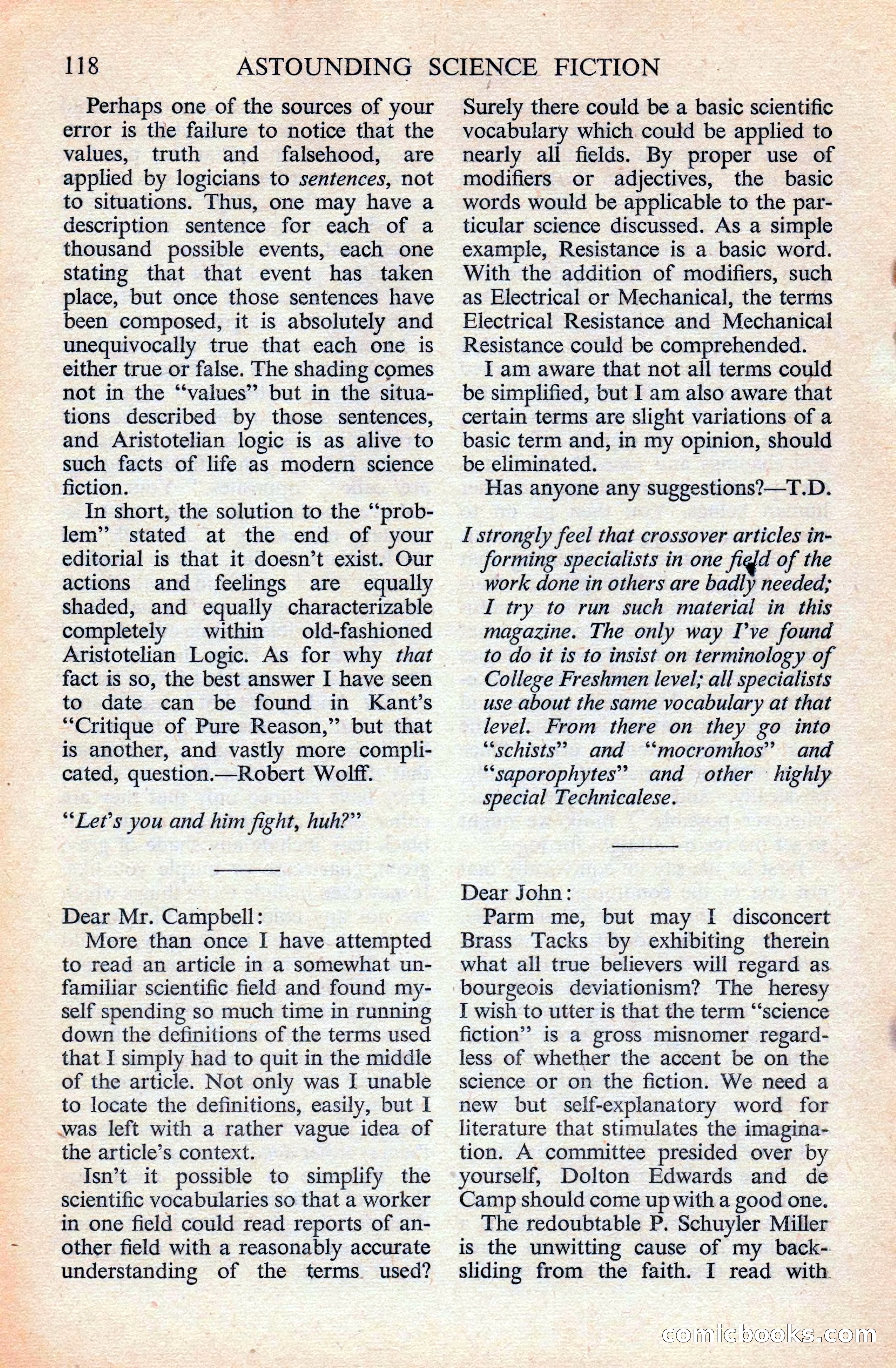
A restored page from Pulp Fiction, 1954. Page through the whole issue in the reader above.
📄 Transcribed text from this page (OCR, searchable)
Machine-transcribed from the original scan — historical spelling and the odd misread are preserved.
118 Perhaps one of the sources of your error is the failure to notice that the values, truth and falsehood, are applied by logicians to sentences, not to situations. Thus, one may have a description sentence for each of a thousand possible events, each one stating that that event has taken place, but once those sentences have been composed, it is absolutely and unequivocally true that each one is either true or false. The shading comes not in the “values” but in the situa- tions described by those sentences, and Aristotelian logic is as alive to such facts of life as modern science fiction. In short, the solution to the “prob- lem” stated at the end of your editorial is that it doesn’t exist. Our actions and feelings are equally Shaded, and equally characterizable completely within old-fashioned Aristotelian Logic. As for why that fact is so, the best answer I have seen to date can be found in Kant’s “Critique of Pure Reason,” but that is another, and vastly more compli- cated, question.—Robert Wolff. “Let’s you and him fight, huh?” —_—_—_— Dear Mr. Campbell: More than once I have attempted to read an article in a somewhat un- familiar scientific field and found my- self spending so much time in running down the definitions of the terms used that I simply had to quit in the middle of the article. Not only was I unable to locate the definitions, easily, but I was left with a rather vague idea of the article’s context. Isn’t it possible to simplify the scientific vocabularies so that a worker in one field could read reports of an- other field with a reasonably accurate understanding of the terms used? ASTOUNDING SCIENCE FICTION Surely there could be a basic scientific vocabulary which could be applied to nearly all fields. By proper use of modifiers or adjectives, the basic words would be applicable to the par- ticular science discussed. As a simple example, Resistance is a. basic word. With the addition of modifiers, such as Electrical or Mechanical, the terms Electrical Resistance and Mechanical Resistance could be comprehended. J am aware that not all terms could be simplified, but I am also aware that certain terms are slight variations of a basic term and, in my opinion, should be eliminated. Has anyone any suggestions?—T.D. I strongly feel that crossover articles in- forming specialists in one figld of the work done in others are badly needed; I try to run such material in this magazine. The only way I’ve found to do it is to insist on terminology of College Freshmen level; all specialists use about the same vocabulary at that level. From there on they go into “schists” and “‘mocromhos’” and ““saporophytes” and other highly special Technicalese. Dear John: Parm me, but may I disconcert Brass Tacks by exhibiting therein what all true believers will regard as bourgeois deviationism? The heresy I wish to utter is that the term “science fiction” is a gross misnomer regard- less of whether the accent be on the science or on the fiction. We need a new but self-explanatory word for literature that stimulates the imagina- tion. A committee presided over by yourself, Dolton Edwards and de Camp should come up with a good one. The redoubtable P. Schuyler Miller is the unwitting cause of my back- sliding from the faith. I read with connicloooks.c© im