
Pulp Fiction, 1954 · page 119 of 132
Astounding Science Fiction, British Edition — page 119: what you’re looking at
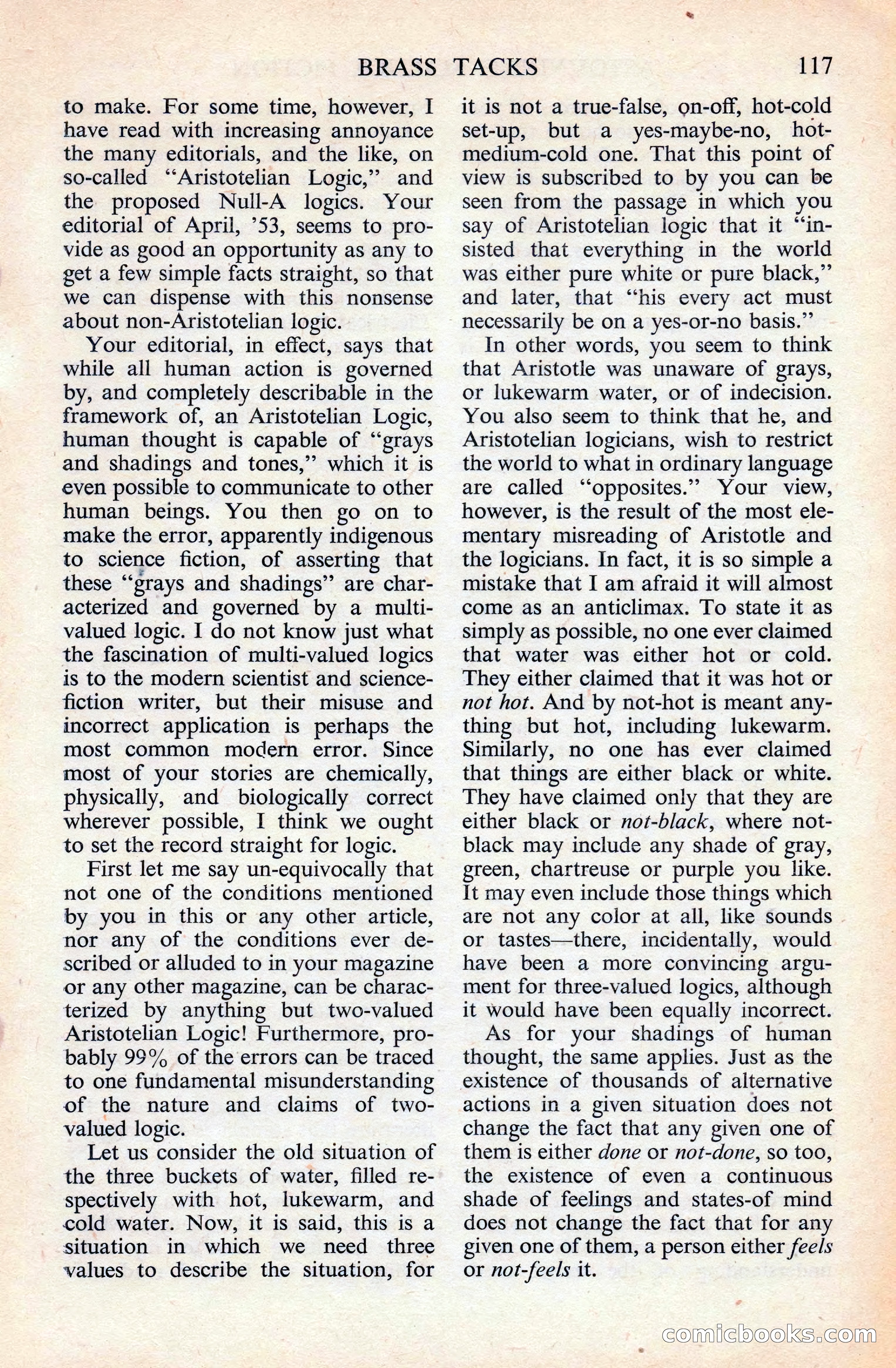
A restored page from Pulp Fiction, 1954. Page through the whole issue in the reader above.
📄 Transcribed text from this page (OCR, searchable)
Machine-transcribed from the original scan — historical spelling and the odd misread are preserved.
BRASS to make. For some time, however, I have read with increasing annoyance the many editorials, and the like, on so-called “Aristotelian Logic,” and the proposed Null-A logics. Your editorial of April, 53, seems to pro- vide as good an opportunity as any to get a few simple facts straight, so that we can dispense with this nonsense about non-Aristotelian logic. Your editorial, in effect, says that while all human action is governed by, and completely describable in the framework of, an Aristotelian Logic, human thought is capable of “grays and shadings and tones,”’ which it is even possible to communicate to other human beings. You then go on to make the error, apparently indigenous to science fiction, of asserting that these “grays and shadings” are char- acterized and governed by a multi- valued logic. I do not know just what the fascination of multi-valued logics is to the modern scientist and science- fiction writer, but their misuse and incorrect application is perhaps the most common modern error. Since most of your stories are chemically, physically, and biologically correct wherever possible, I think we ought to set the record straight for logic. First let me say un-equivocally that not one of the conditions mentioned by you in this or any other article, nor any of the conditions ever de- scribed or alluded to in your magazine or any other magazine, can be charac- terized by anything but two-valued Aristotelian Logic! Furthermore, pro- bably 99% of the errors can be traced to one fundamental misunderstanding of the nature and claims of two- valued logic. Let us consider the old situation of the three buckets of water, filled re- spectively with hot, lukewarm, and cold water. Now, it is said, this is a situation in which we need three values to describe the situation, for TACKS 117 it is not a true-false, on-off, hot-cold set-up, but a yes-maybe-no, hot- medium-cold one. That this point of view is subscribed to by you can be seen from the passage in which you say of Aristotelian logic that it “‘in- sisted that everything in the world was either pure white or pure black,” and later, that “his every act must necessarily be on a yes-or-no basis.”’ In other words, you seem to think that Aristotle was unaware of grays, or lukewarm water, or of indecision. You also seem to think that he, and Aristotelian logicians, wish to restrict the world to what in ordinary language are called “opposites.” Your view, however, is the result of the most ele- mentary misreading of Aristotle and the logicians. In fact, it is so simple a mistake that I am afraid it will almost come as an anticlimax. To state it as simply as possible, no one ever claimed that water was either hot or cold. They either claimed that it was hot or not hot. And by not-hot is meant any- thing but hot, including lukewarm. Similarly, no one has ever claimed that things are either black or white. They have claimed only that they are either black or not-black, where not- black may include any shade of gray, green, chartreuse or purple you like. It may even include those things which are not any color at all, like sounds or tastes—there, incidentally, would have been a more convincing argu- ment for three-valued logics, although it would have been equally incorrect. As for your shadings of human thought, the same applies. Just as the existence of thousands of alternative actions in a given situation does not change the fact that any given one of them is either done or not-done, so too, the existence of even a continuous shade of feelings and states-of mind does not change the fact that for any given one of them, a person either feels or not-feels it. connicloooks.c© in