
Pulp Fiction, 1954 · page 118 of 132
Astounding Science Fiction, British Edition — page 118: what you’re looking at
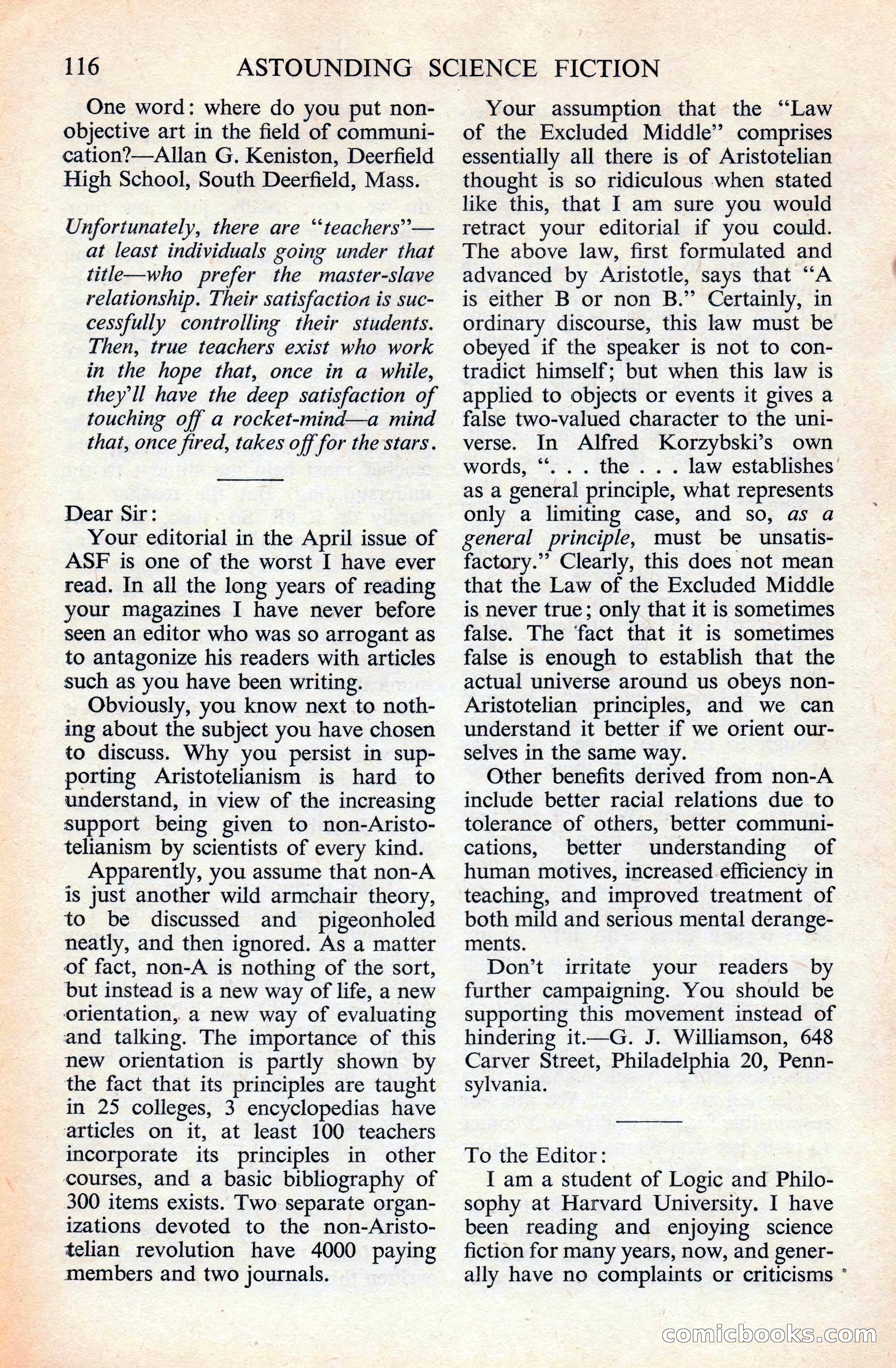
A restored page from Pulp Fiction, 1954. Page through the whole issue in the reader above.
📄 Transcribed text from this page (OCR, searchable)
Machine-transcribed from the original scan — historical spelling and the odd misread are preserved.
116 One word: where do you put non- objective art in the field of communi- cation?—Allan G. Keniston, Deerfield High School, South Deerfield, Mass. Unfortunately, there are “‘teachers”— at least individuals going under that title—who prefer the master-slave relationship. Their satisfaction is suc- cessfully controlling their students. Then, true teachers exist who work in the hope that, once in a while, they'll have the deep satisfaction of touching off a rocket-mind—a mind that, once fired, takes off for the stars. ——__ Dear Sir: Your editorial in the April issue of ASF is one of the worst I have ever read. In all the long years of reading your magazines I have never before seen an editor who was so arrogant as to antagonize his readers with articles such as you have been writing. Obviously, you know next to noth- ing about the subject you have chosen to discuss. Why you persist in sup- porting Aristotelianism is hard to understand, in view of the increasing support being given to non-Aristo- telianism by scientists of every kind. Apparently, you assume that non-A is just another wild armchair theory, to be discussed and pigeonholed neatly, and then ignored. As a matter of fact, non-A is nothing of the sort, but instead is a new way of life, a new orientation, a new way of evaluating and talking. The importance of this new orientation is partly shown by the fact that its principles are taught in 25 colleges, 3 encyclopedias have articles on it, at least 100 teachers incorporate its principles in other courses, and a basic bibliography of 300 items exists. Two separate organ- izations devoted to the non-Aristo- telian revolution have 4000 paying members and two journals. ASTOUNDING SCIENCE FICTION Your assumption that the “Law of the Excluded Middle” comprises essentially all there is of Aristotelian thought is so ridiculous when stated like this, that I am sure you would retract your editorial if you could. The above law, first formulated and advanced by Aristotle, says that “A is either B or non B.” Certainly, in ordinary discourse, this law must be obeyed if the speaker is not to con- tradict himself; but when this law is applied to objects or events it gives a false two-valued character to the uni- verse. In Alfred Korzybski’s own words. 3: . We. . as a general principle, what represents only a limiting case, and so, as a general principle, must be unsatis- factory.” Clearly, this does not mean that the Law of the Excluded Middle is never true; only that it is sometimes false. The ‘fact that it is sometimes false is enough to establish that the actual universe around us obeys non- Aristotelian principles, and we can understand it better if we orient our- selves in the same way. Other benefits derived from non-A include better racial relations due to tolerance of others, better communi- cations, better understanding of human motives, increased efficiency in teaching, and improved treatment of both mild and serious mental derange- ments. Don’t irritate your readers by further campaigning. You should be supporting this movement instead of hindering it.—G. J. Williamson, 648 Carver Street, Philadelphia 20, Penn- sylvania. To the Editor: I am a student of Logic and Philo- sophy at Harvard University. I have been reading and enjoying science fiction for many years, now, and gener- ally have no complaints or criticisms ° comilcloooks.c© . law establishes’ inn