
Pulp Fiction, 1954 · page 117 of 132
Astounding Science Fiction, British Edition — page 117: what you’re looking at
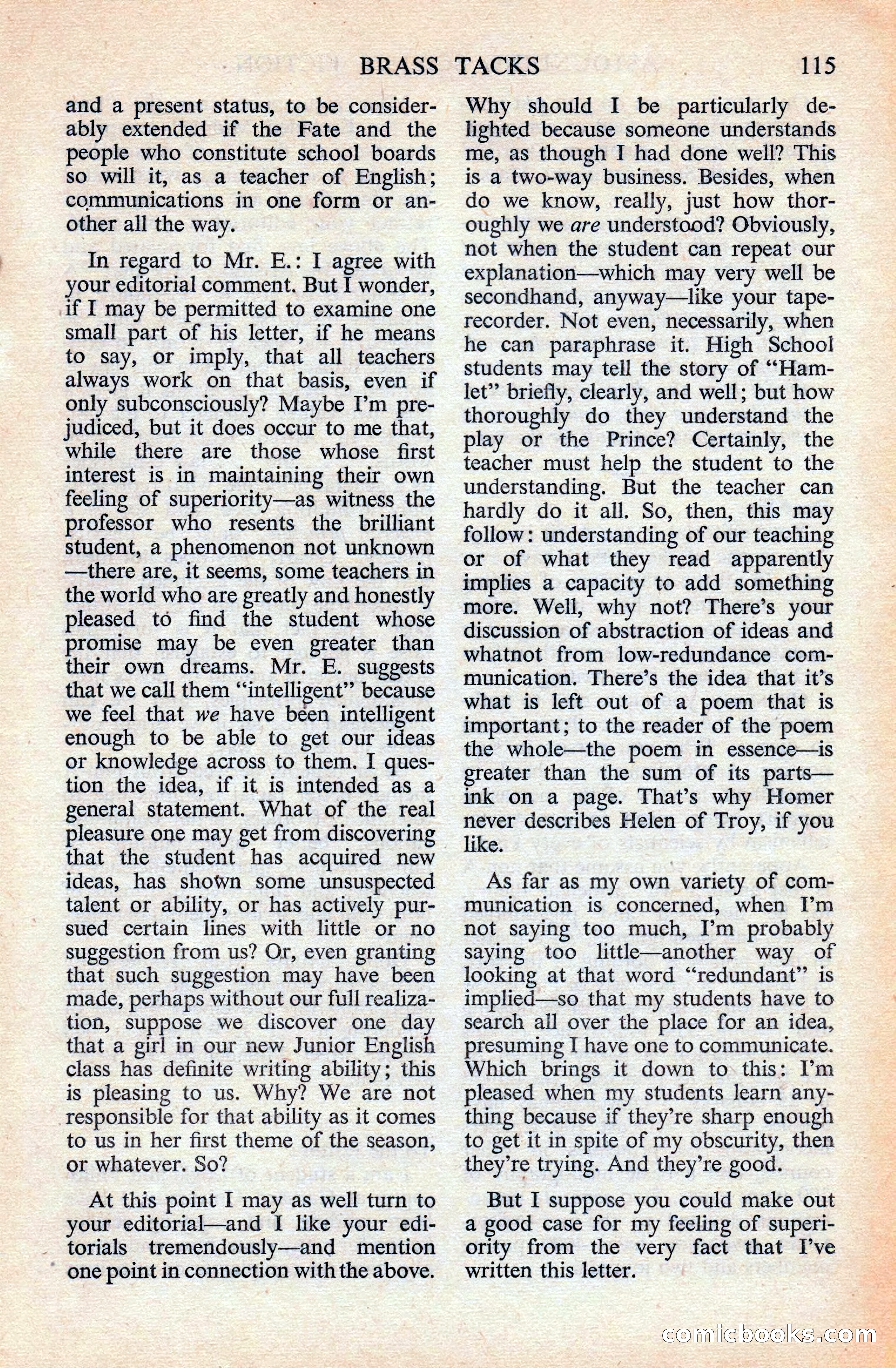
A restored page from Pulp Fiction, 1954. Page through the whole issue in the reader above.
📄 Transcribed text from this page (OCR, searchable)
Machine-transcribed from the original scan — historical spelling and the odd misread are preserved.
BRASS TACKS and a present status, to be consider- ably extended if the Fate and the people who constitute school boards so will it, as a teacher of English; communications in one form or an- other all the way. In regard to Mr. E.: I agree with your editorial comment. But I wonder, if I may be permitted to examine one small part of his letter, if he means to say, or imply, that all teachers always work on that basis, even if only subconsciously? Maybe I’m pre- judiced, but it does occur to me that, while there are those whose first interest is in maintaining their own feeling of superiority—as witness the professor who resents the brilliant student, a phenomenon not unknown —there are, it seems, some teachers in the world who are greatly and honestly pleased to find the student whose promise may be even greater than their own dreams. Mr. E. suggests that we call them “intelligent” because we feel that we have been intelligent enough to be able to get our ideas or knowledge across to them. I ques- tion the idea, if it is intended as a general statement. What of the real pleasure one may get from discovering that the student has acquired new ideas, has shown some unsuspected talent or ability, or has actively pur- sued certain lines with little or no suggestion from us? Or, even granting that such suggestion may have been made, perhaps without our full realiza- tion, suppose we discover one day that a girl in our new Junior English class has definite writing ability; this is pleasing to us. Why? We are not responsible for that ability as it comes to us in her first theme of the season, or whatever. So? At this point I may as well turn to your editorial—and I like your edi- _ torials tremendously—and mention ~ One point in connection with the above. 115 Why should I be particularly de- lighted because someone understands me, as though I had done well? This is a two-way business. Besides, when do we know, really, just how thor- oughly we are understood? Obviously, not when the student can repeat our explanation—which may very well be secondhand, anyway—like your tape- recorder. Not even, necessarily, when he can paraphrase it. High School students may tell the story of ““Ham- let” briefly, clearly, and well; but how thoroughly do they understand the play or the Prince? Certainly, the teacher must help the student to the understanding. But the teacher can hardly do it all. So, then, this may follow: understanding of our teaching or of what they read apparently implies a capacity to add something more. Well, why not? There’s your discussion of abstraction of ideas and whatnot from low-redundance com- munication. There’s the idea that it’s what is left out of a poem that is important; to the reader of the poem the whole—the poem in essence—is greater than the sum of its parts— ink on a page. That’s why Homer never describes Helen of Troy, if you like. As far as my own variety of com- munication is concerned, when I’m not saying too much, I’m probably saying too littl—another way of looking at that word “redundant” is implied—so that my students have to search all over the place for an idea, presuming I have one to communicate. Which brings it down to this: Pm pleased when my students learn any- thing because if they’re sharp enough to get it in spite of my obscurity, then they’re trying. And they’re good. But I suppose you could make out a good case for my feeling of superi- ority from the very fact that Pve written this letter. COMICOOOKS EO in