
Pulp Fiction, 1954 · page 114 of 132
Astounding Science Fiction, British Edition — page 114: what you’re looking at
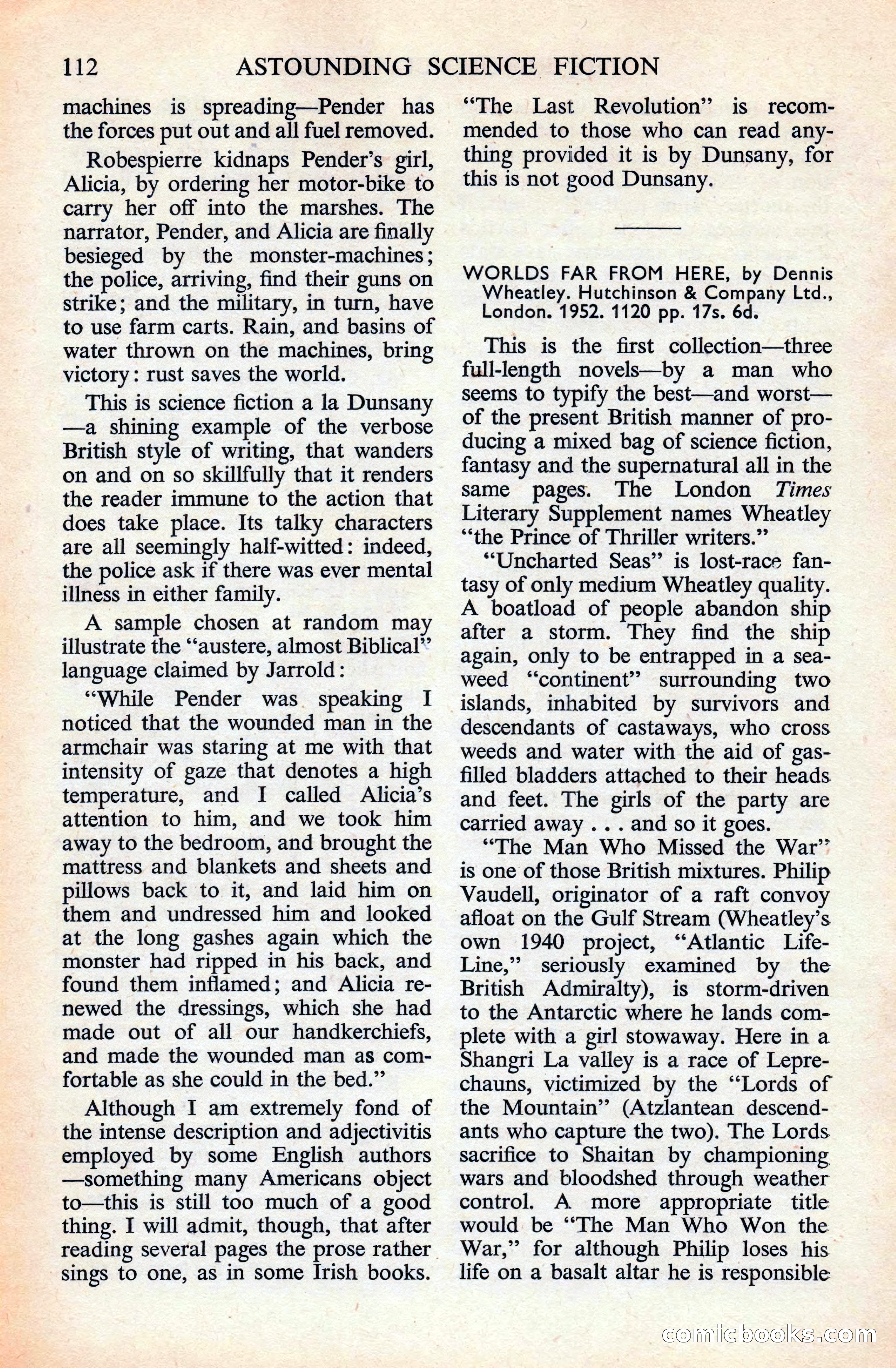
A restored page from Pulp Fiction, 1954. Page through the whole issue in the reader above.
📄 Transcribed text from this page (OCR, searchable)
Machine-transcribed from the original scan — historical spelling and the odd misread are preserved.
112 machines is spreading—Pender has the forces put out and all fuel removed. Robespierre kidnaps Pender’s girl, Alicia, by ordering her motor-bike to carry her off into the marshes. The narrator, Pender, and Alicia are finally besieged by the monster-machines ; the police, arriving, find their guns on strike; and the military, in turn, have to use farm carts. Rain, and basins of water thrown on the machines, bring victory : rust saves the world. This is science fiction a la Dunsany —a shining example of the verbose British style of writing, that wanders on and on so skillfully that it renders the reader immune to the action that does take place. Its talky characters are all seemingly half-witted: indeed, the police ask if there was ever mental illness in either family. A sample chosen at random may illustrate the ‘“‘austere, almost Biblical”’ language claimed by Jarrold: “While Pender was speaking I noticed that the wounded man in the armchair was staring at me with that intensity of gaze that denotes a high temperature, and I called Alicia’s attention to him, and we took him away to the bedroom, and brought the mattress and blankets and sheets and pillows back to it, and laid him on them and undressed him and looked at the long gashes again which the monster had ripped in his back, and found them inflamed; and Alicia re- newed the dressings, which she had made out of all our handkerchiefs, and made the wounded man as com- fortable as she could in the bed.” Although I am extremely fond of the intense description and adjectivitis employed by some English authors —something many Americans object to—this is still too much of a good thing. I will admit, though, that after reading several pages the prose rather sings to one, as in some Irish books. ASTOUNDING SCIENCE FICTION “The Last Revolution” is recom- mended to those who can read any- thing provided it is by Dunsany, for this is not good Dunsany. WORLDS FAR FROM HERE, by Dennis Wheatley. Hutchinson & Company Ltd., London. 1952. 1120 pp. 17s. 6d. This is the first collection—three full-length novels—by a man who seems to typify the best—and worst— of the present British manner of pro- ducing a mixed bag of science fiction, fantasy and the supernatural all in the same pages. The London Times Literary Supplement names Wheatley “‘the Prince of Thriller writers.” “Uncharted Seas’’ is lost-race fan- tasy of only medium Wheatley quality. A boatload of people abandon ship after a storm. They find the ship again, only to be entrapped in a sea- weed “continent” surrounding two islands, inhabited by survivors and descendants of castaways, who cross weeds and water with the aid of gas- filled bladders attached to their heads and feet. The girls of the party are carried away .. . and So it goes. “The Man Who Missed the War’’ is one of those British mixtures. Philip Vaudell, originator of a raft convoy afloat on the Gulf Stream (Wheatley’s own 1940 project, “Atlantic Life- Line,”’ seriously examined by the British Admiralty), is storm-driven to the Antarctic where he lands com- plete with a girl stowaway. Here in a Shangri La valley is a race of Lepre- chauns, victimized by the “Lords of the Mountain” (Atzlantean descend- ants who capture the two). The Lords sacrifice to Shaitan by championing wars and bloodshed through weather control. A more appropriate title would be “The Man Who Won the War,” for although Philip loses his life on a basalt altar he is responsible connicloookks.c© nl