
Pulp Fiction, 1954 · page 113 of 132
Astounding Science Fiction, British Edition — page 113: what you’re looking at
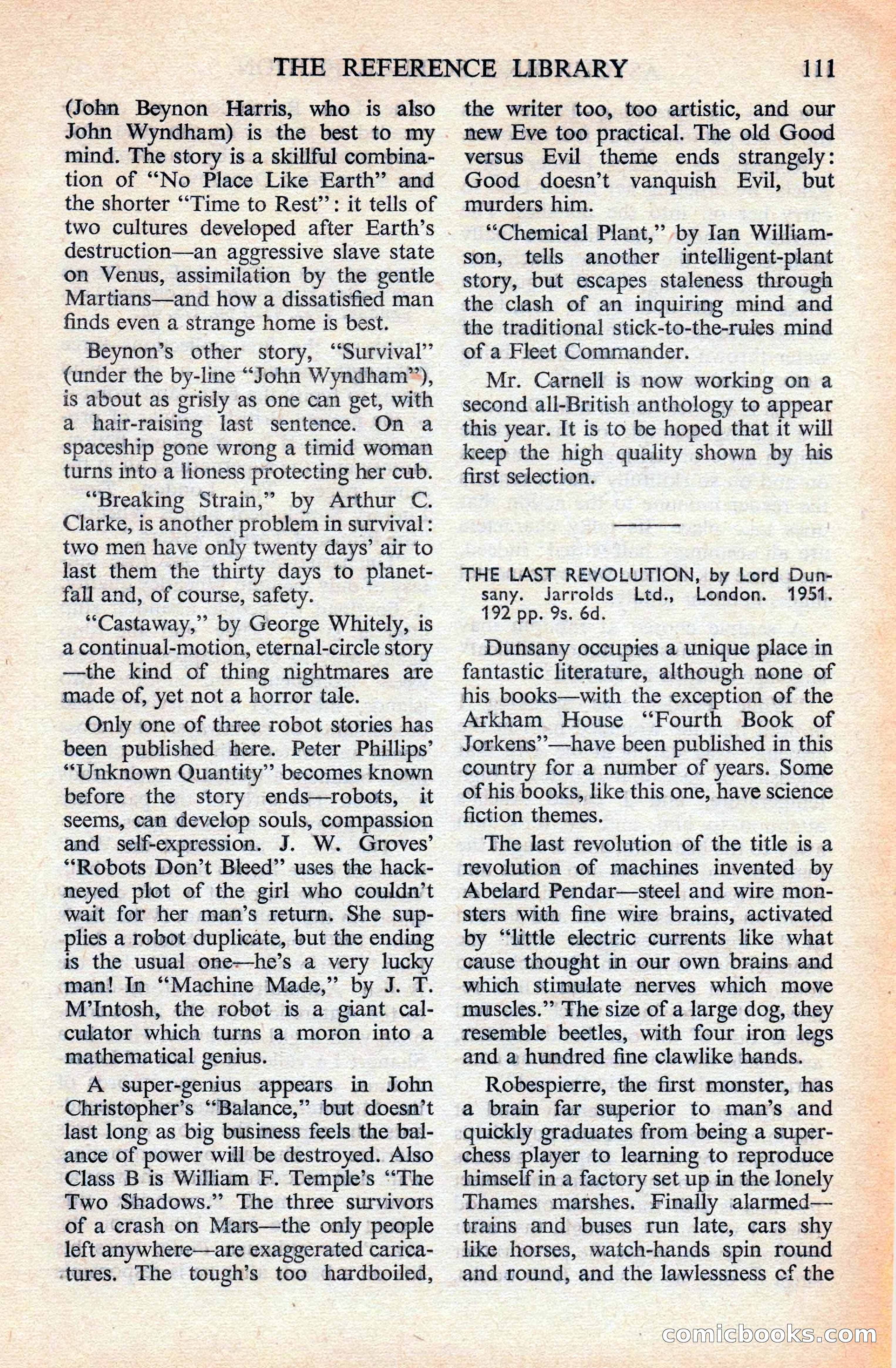
A restored page from Pulp Fiction, 1954. Page through the whole issue in the reader above.
📄 Transcribed text from this page (OCR, searchable)
Machine-transcribed from the original scan — historical spelling and the odd misread are preserved.
THE REFERENCE LIBRARY (John Beynon Harris, who is also John Wyndham) is the best to my mind. The story is a skillful combina- tion of ““No Place Like Earth’ and the shorter ‘“‘Time to Rest”’: it tells of two cultures developed after Earth’s . destruction—an aggressive slave state on Venus, assimilation by the gentle Martians—and how a dissatisfied man finds even a strange home is best. Beynon’s other story, “Survival” (under the by-line “John Wyndham”), is about as grisly as one can get, with a hair-raising last sentence. On a spaceship gone wrong a timid woman turns into a lioness protecting her cub. “Breaking Strain,” by Arthur C. Clarke, is another problem in survival: two men have only twenty days’ air to last them the thirty days to planet- fall and, of course, safety. “Castaway,” by George Whitely, is a continual-motion, eternal-circle story —the kind of thing nightmares are made of, yet not a horror tale. Only one of three robot stories has been published here. Peter Phillips’ “Unknown Quantity” becomes known before the story ends—robois, it seems, can develop souls, compassion and self-expression. J. W. Groves’ “Robots Don’t Bleed” uses the hack- neyed plot of the girl who couldn’t wait for her man’s return. She sup- plies a robot duplicate, but the ending is the usual one—he’s a very lucky man! In “Machine Made,” by J. T. M’Intosh, the robot is a giant cal- culator which turns a moron into a mathematical genius. A super-genius appears in John Christopher’s “Balance,” but doesn’t last long as big business feels the bal- ance of power will be destroyed. Also Class B is William F. Temple’s “The Two Shadows.” The three survivors of a crash on Mars—the only people left anywhere—are exaggerated carica- ‘tures. The tough’s too hardboiled, lil the writer too, too artistic, and our new Eve too practical. The old Good versus Evil theme ends strangely: Good doesn’t vanquish Evil, but murders him. “Chemical Plant,” by Ian William- son, tells another intelligent-plant story, but escapes staleness through the clash of an inquiring mind and the traditional stick-to-the-rules mind of a Fleet Commander. Mr. Carnell is now working on a second all-British anthology to appear this year. It is to be hoped that it will keep the high quality shown by his first selection. THE LAST REVOLUTION, by Lord Dun- sany. Jarrolds Ltd., London. 1951, 192 pp. 9s. 6d. Dunsany occupies a unique place in fantastic literature, although none of his books—with the exception of the Arkham. House “Fourth Book of Jorkens’’—have been published in this country for a number of years. Some of his books, like this one, have science fiction themes. The last revolution of the title is a revolution of machines invented by Abelard Pendar—steel and wire mon- sters with fine wire brains, activated by “‘little electric currents like what cause thought in our own brains and which stimulate nerves which move muscles.”” The size of a large dog, they resemble beetles, with four iron legs and a hundred fine clawlike hands. Robespierre, the first monster, has a brain far superior to man’s and quickly graduates from being a super- chess player to learning to reproduce himself in a factory set up in the lonely Thames marshes. Finally alarmed— trains and buses run late, cars shy like horses, watch-hands spin round and round, and the lawlessness cf the CoOmichooksnco