
Pulp Fiction, 1954 · page 112 of 132
Astounding Science Fiction, British Edition — page 112: what you’re looking at
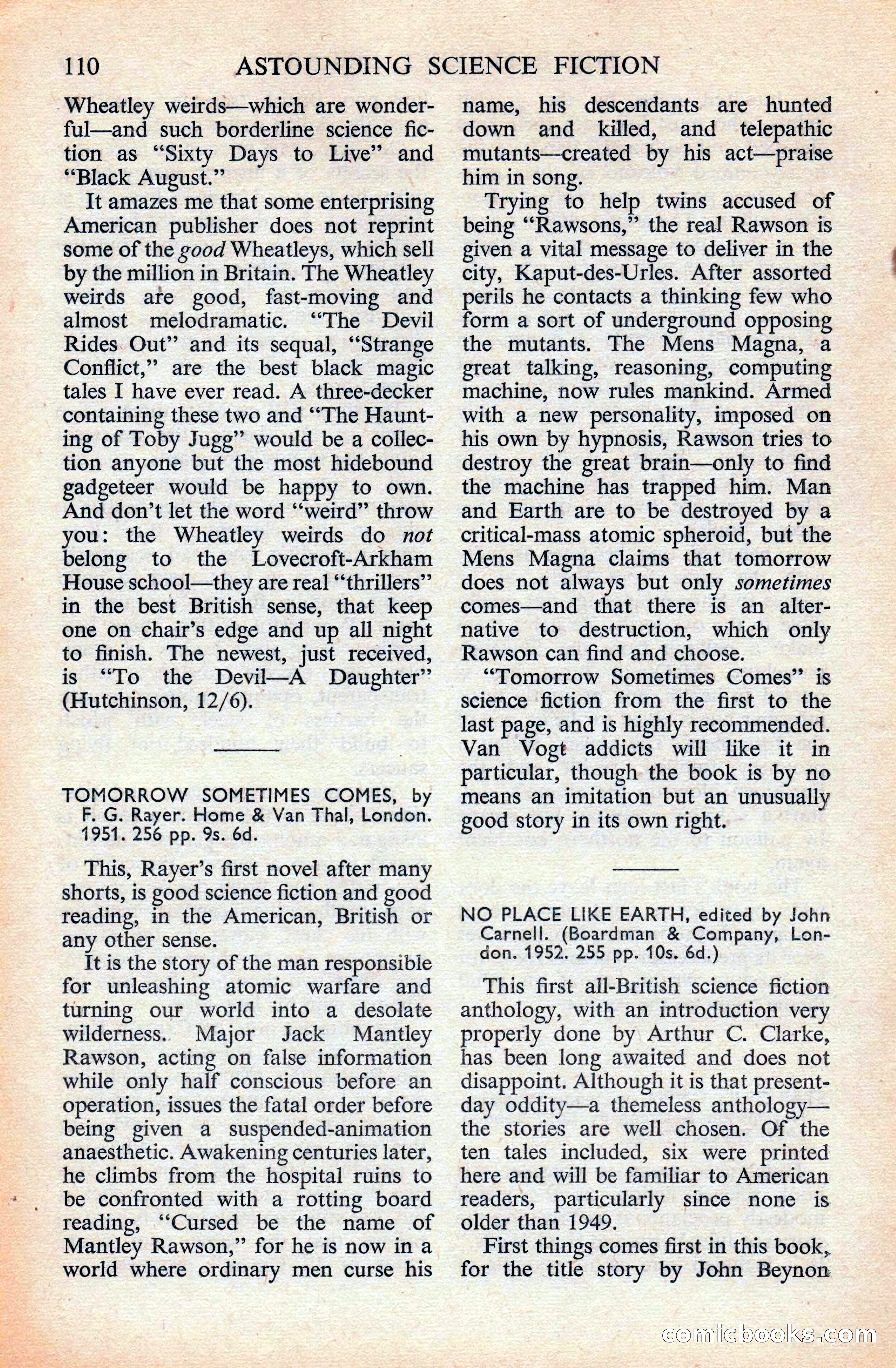
A restored page from Pulp Fiction, 1954. Page through the whole issue in the reader above.
📄 Transcribed text from this page (OCR, searchable)
Machine-transcribed from the original scan — historical spelling and the odd misread are preserved.
110 ASTOUNDING SCIENCE FICTION Wheatley weirds—which are wonder- ful—and such borderline science fic- tion as “Sixty Days to Live” and “Black August.” It amazes me that some enterprising American publisher does not reprint some of the good Wheatleys, which sell by the million in Britain. The Wheatley weirds are good, fast-moving and almost melodramatic. “The Devil Rides. Out” and its sequal, ‘Strange Conflict,” are the best black magic tales I have ever read. A three-decker containing these two and “The Haunt- ing of Toby Jugg” would be a collec- tion anyone but the most hidebound gadgeteer would be happy to own. And don’t let the word “‘weird” throw you: the Wheatley weirds do not belong to the Lovecroft-Arkham House school—they are real “‘thrillers”’ in the best British sense, that keep one on chair’s edge and up all night to finish. The newest, just received, is “To the Devil—A Daughter” (Hutchinson, 12/6). TOMORROW SOMETIMES COMES, by F. G. Rayer. Home & Van Thal, London. 1951. 256 pp. 9s. 6d. This, Rayer’s first novel after many shorts, is good science fiction and good reading, in the American, British or any other sense. It is the story of the man responsible for unleashing atomic warfare and turning our world into a desolate wilderness. Major Jack Mantley Rawson, acting on false information while only half conscious before an operation, issues the fatal order before being given a suspended-animation anaesthetic. Awakening centuries later, he climbs from the hospital ruins to be confronted with a rotting board reading, “Cursed be the name of Mantley Rawson,” for he is now in a world where ordinary men curse his name, his descendants are hunted down and killed, and _ telepathic mutants—created by his act—praise him in song. Trying to help twins accused of being “‘Rawsons,” the real Rawson is given a vital message to deliver in the city, Kaput-des-Urles. After assorted perils he contacts a thinking few who form a sort of underground opposing the mutants. The Mens Magna, a great talking, reasoning, computing machine, now rules mankind. Armed with a new personality, imposed on his own by hypnosis, Rawson tries to destroy the great brain—only to find the machine has trapped him. Man and Earth are to be destroyed by a critical-mass atomic spheroid, but the Mens Magna claims that tomorrow does not always but only sometimes comes—and that there is an alter- native to destruction, which only Rawson can find and choose. “Tomorrow Sometimes Comes” is science fiction from the first to the last page, and is highly recommended. Van Vogt addicts will like it in particular, though the book is by no means an imitation but an unusually good story in its own right. NO PLACE LIKE EARTH, edited by John Carnell. (Boardman & Company, Lon- don. 1952. 255 pp. 10s. 6d.) This first all-British science fiction anthology, with an introduction very properly done by Arthur C. Clarke, has been long awaited and does not disappoint. Although it is that present- day oddity—a themeless anthology— the stories are well chosen. Of the ten tales included, six were printed here and will be familiar to American readers, particularly since none is older than 1949. First things comes first in this book, for the title story by John Beynon conniclooolkks.c© im