
Pulp Fiction, 1954 · page 111 of 132
Astounding Science Fiction, British Edition — page 111: what you’re looking at
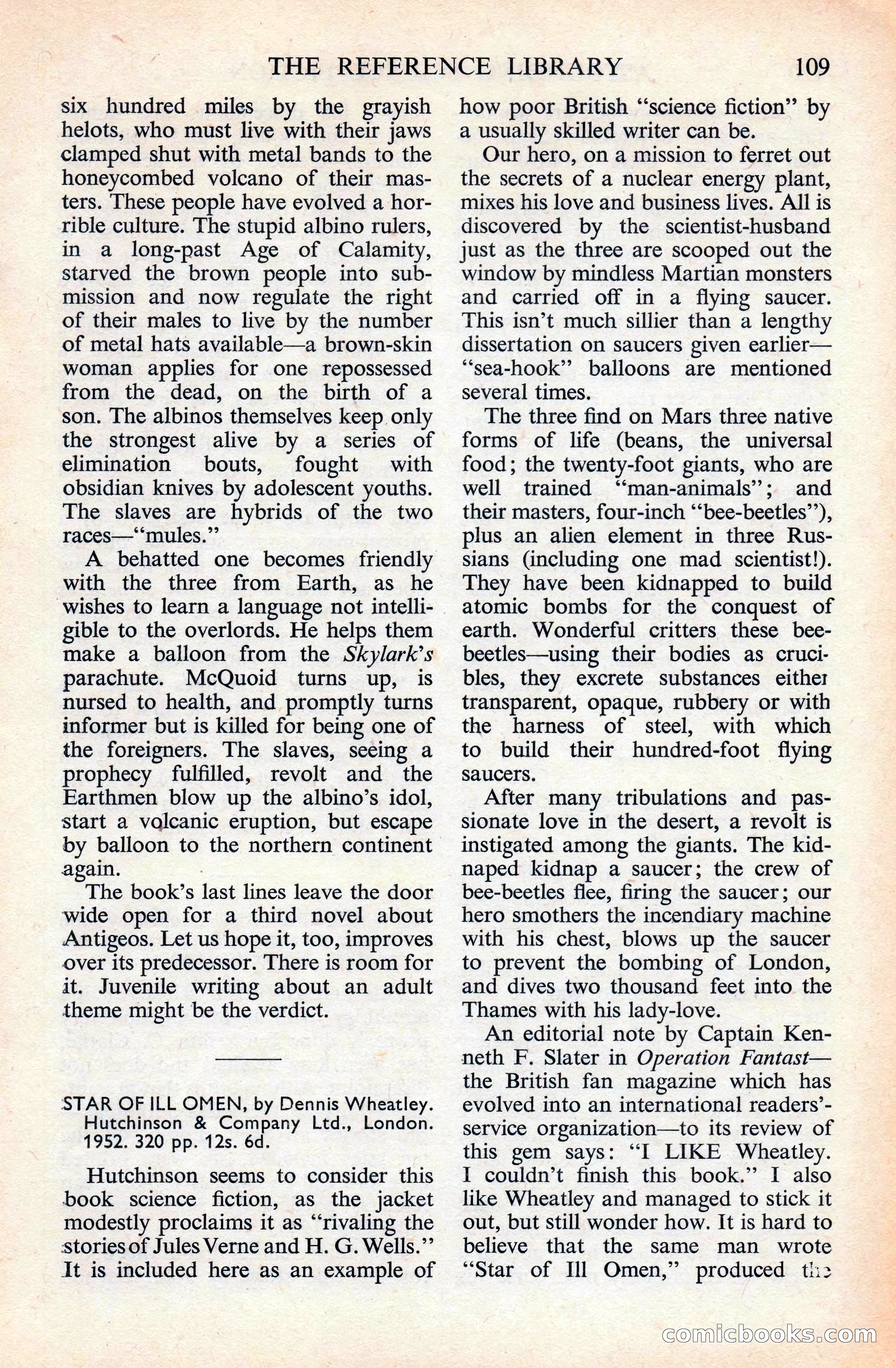
A restored page from Pulp Fiction, 1954. Page through the whole issue in the reader above.
📄 Transcribed text from this page (OCR, searchable)
Machine-transcribed from the original scan — historical spelling and the odd misread are preserved.
THE REFERENCE LIBRARY six hundred miles by the grayish helots, who must live with their jaws clamped shut with metal bands to the honeycombed volcano of their mas- ters. These people have evolved a hor- rible culture. The stupid albino rulers, in a long-past Age of Calamity, starved the brown people into sub- mission and now regulate the right of their males to live by the number of metal hats available—a brown-skin woman applies for one repossessed from the dead, on the birth of a son. The albinos themselves keep only the strongest alive by a series of elimination bouts, fought with obsidian knives by adolescent youths. The slaves are hybrids of the two races—*‘mules.”’ A behatted one becomes friendly with the three from Earth, as he ‘wishes to learn a language not intelli- gible to the overlords. He helps them make a balloon from the Skylark’s parachute. McQuoid turns up, is nursed to health, and promptly turns informer but is killed for being one of the foreigners. The slaves, seeing a prophecy fulfilled, revolt and the Earthmen blow up the albino’s idol, start a valcanic eruption, but escape by balloon to the northern continent again. : The book’s last lines leave the door wide open for a third novel about Antigeos. Let us hope it, too, improves over its predecessor. There is room for it. Juvenile writing about an adult theme might be the verdict. STAR OF ILL OMEN, by Dennis Wheatley. Hutchinson & Company Ltd., London. 1952. 320 pp. 12s. 6d. Hutchinson seems to consider this book science fiction, as the jacket modestly proclaims it as “rivaling the Stories of Jules Verne and H. G. Wells.”’ It is included here as an example of 109 how poor British “‘science fiction” by a usually skilled writer can be. Our hero, on a mission to ferret out the secrets of a nuclear energy plant, mixes his love and business lives. All is discovered by the scientist-husband just as the three are scooped out the window by mindless Martian monsters and carried off in a flying saucer. This isn’t much sillier than a lengthy dissertation on saucers given earlier— “sea-hook’’ balloons are mentioned several times. The three find on Mars three native forms of life (beans, the universal food; the twenty-foot giants, who are well trained ‘‘man-animals’’; and their masters, four-inch ‘“‘bee-beetles’’), plus an alien element in three Rus- sians (including one mad scientist!). They have been kidnapped to build atomic bombs for the conquest of earth. Wonderful critters these bee- beetles—using their bodies as cruci- bles, they excrete substances either transparent, opaque, rubbery or with the harness of steel, with which to build their hundred-foot flying saucers. After many tribulations and pas- sionate love in the desert, a revolt is instigated among the giants. The kid- naped kidnap a saucer; the crew of bee-beetles flee, firing the saucer; our hero smothers the incendiary machine with his chest, blows up the saucer to prevent the bombing of London, and dives two thousand feet into the Thames with his lady-love. An editorial note by Captain Ken- neth F. Slater in Operation Fantast— the British fan magazine which has evolved into an international readers’- service organization—to its review of this gem says: “I LIKE Wheatley. I couldn’t finish this book.” I also like Wheatley and managed to stick it out, but still wonder how. It is hard to believe that the same man wrote “Star of Ill Omen,” produced ti> connicloooks.c© im