
Pulp Fiction, 1954 · page 110 of 132
Astounding Science Fiction, British Edition — page 110: what you’re looking at
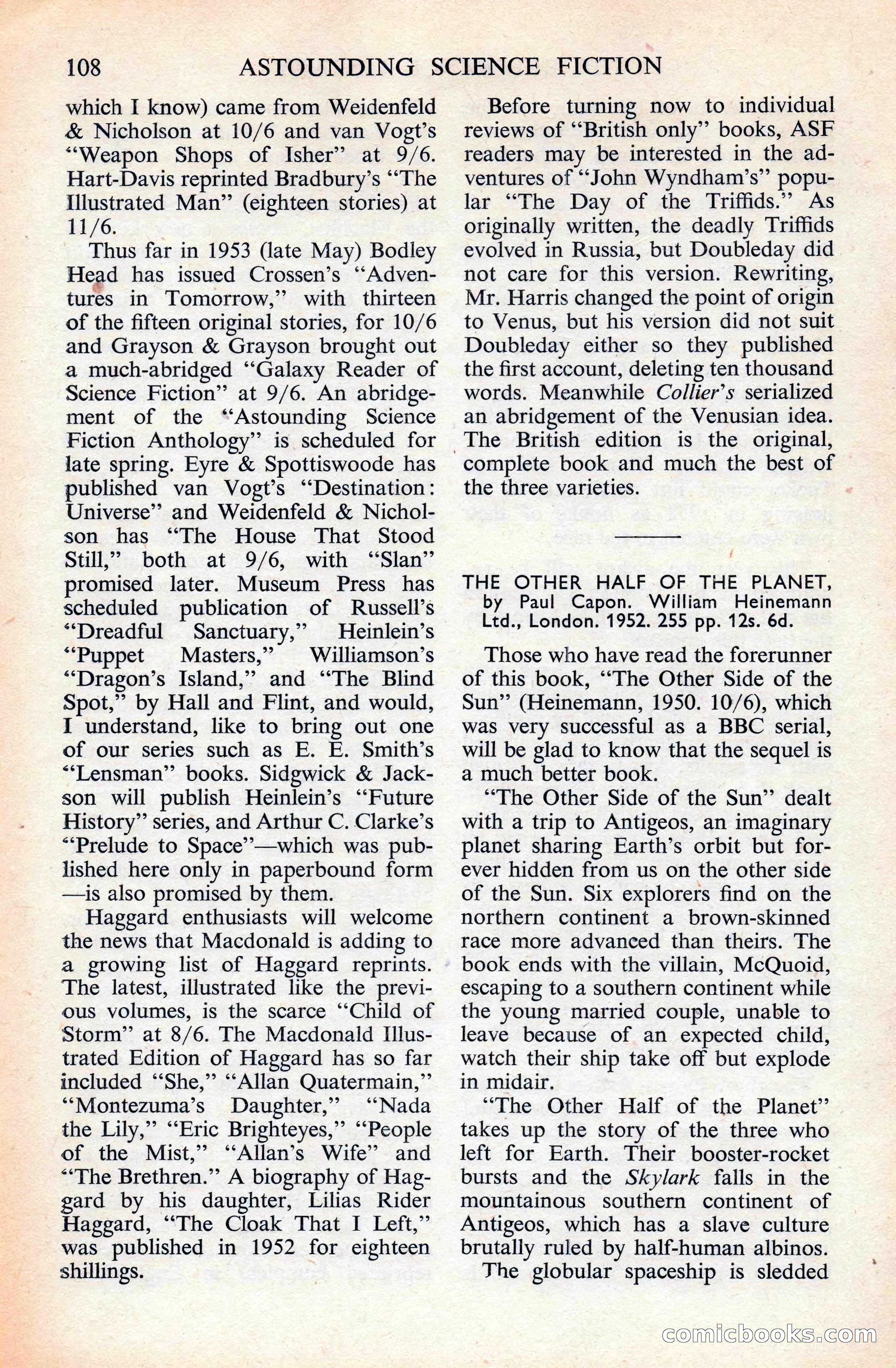
A restored page from Pulp Fiction, 1954. Page through the whole issue in the reader above.
📄 Transcribed text from this page (OCR, searchable)
Machine-transcribed from the original scan — historical spelling and the odd misread are preserved.
108 which I know) came from Weidenfeld & Nicholson at 10/6 and van Vogt’s “Weapon Shops of Isher’ at 9/6. Hart-Davis reprinted Bradbury’s ““The Illustrated Man’”’ (eighteen stories) at 11/6. Thus far in 1953 (late May) Bodley Head has issued Crossen’s “Adven- tures in Tomorrow,” with thirteen of the fifteen original stories, for 10/6 and Grayson & Grayson brought out a much-abridged “Galaxy Reader of Science Fiction’? at 9/6. An abridge- ment of the “Astounding Science Fiction Anthology” is scheduled for late spring. Eyre & Spottiswoode has published van Vogt’s “Destination: Universe” and Weidenfeld & Nichol- son has “The House That Stood Stil,” both at 9/6, with ‘“‘Slan”’ promised later. Museum Press has scheduled publication of Russell’s “Dreadful Sanctuary,” Heinlein’s “Puppet Masters,” Williamson’s ““Dragon’s Island,” and ‘The Blind Spot,” by Hall and Flint, and would, I understand, like to bring out one of our series such as E. E. Smith’s *“Lensman”’ books. Sidgwick & Jack- son will publish Heinlein’s ‘Future History” series, and Arthur C. Clarke’s “Prelude to Space’—which was pub- lished here only in paperbound form —1is also promised by them. Haggard enthusiasts will welcome the news that Macdonald is adding to a growing list of Haggard reprints. The latest, illustrated like the previ- ous volumes, is the scarce ‘“‘Child of Storm” at 8/6. The Macdonald Ilus- trated Edition of Haggard has so far included ‘“‘She,” “‘Allan Quatermain,”’ ““Montezuma’s Daughter,” “Nada the Lily,” “Eric Brighteyes,’ ‘“‘People of the Mist,” ‘‘Allan’s Wife’ and “The Brethren.” A biography of Hag- gard by his daughter, Lilias Rider Haggard, “The Cloak That I Left,” was published in 1952 for eighteen shillings. ASTOUNDING SCIENCE FICTION Before turning now to individual reviews of “British only’ books, ASF readers may be interested in the ad- ventures of “John Wyndham’s” popu- lar “The Day of the Triffids.” As originally written, the deadly Triffids evolved in Russia, but Doubleday did not care for this version. Rewriting, Mr. Harris changed the point of origin to Venus, but his version did not suit Doubleday either so they published the first account, deleting ten thousand words. Meanwhile Collier’s serialized an abridgement of the Venusian idea. The British edition is the original, complete book and much the best of the three varieties. —— THE OTHER HALF OF THE PLANET, by Paul Capon. William Heinemann Ltd., London. 1952. 255 pp. 12s. 6d. Those who have read the forerunner of this book, ““‘The Other Side of the Sun”? (Heinemann, 1950. 10/6), which was very successful as a BBC serial, will be glad to know that the sequel is a much better book. “The Other Side of the Sun’’ dealt with a trip to Antigeos, an imaginary planet sharing Earth’s orbit but for- ever hidden from us on the other side of the Sun. Six explorers find on the northern continent a brown-skinned race more advanced than theirs. The book ends with the villain, McQuoid, escaping to a southern continent while the young married couple, unable to leave because of an expected child, watch their ship take off but explode in midair. . “The Other Half of the Planet’ takes up the story of the three who left for Earth. Their booster-rocket bursts and the Skylark falls in the mountainous southern continent of Antigeos, which has a slave culture brutally ruled by half-human albinos. The globular spaceship is sledded comiicloooks.c© nn