
Pulp Fiction, 1954 · page 109 of 132
Astounding Science Fiction, British Edition — page 109: what you’re looking at
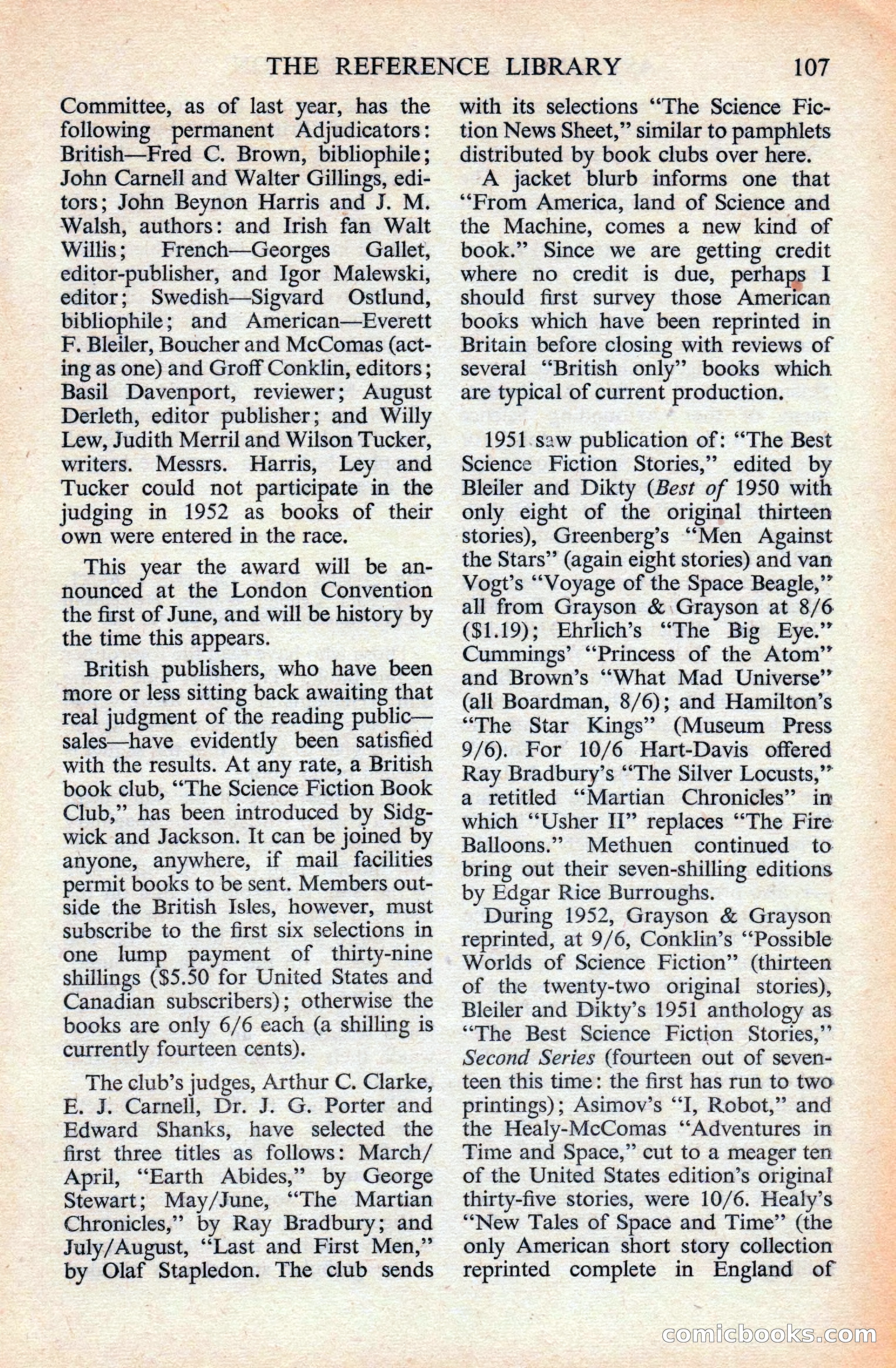
A restored page from Pulp Fiction, 1954. Page through the whole issue in the reader above.
📄 Transcribed text from this page (OCR, searchable)
Machine-transcribed from the original scan — historical spelling and the odd misread are preserved.
THE REFERENCE LIBRARY 107 Committee, as of last year, has the following permanent Adjudicators: British—Fred C. Brown, bibliophile; John Carnell and Walter Gillings, edi- tors; John Beynon Harris and J. M. Walsh, authors: and Irish fan Walt Willis; | French—Georges Gallet, editor-publisher, and Igor Malewski, editor; Swedish—Sigvard Ostlund, bibliophile; and American—Everett F. Bleiler, Boucher and McComas (act- ing as one) and Groff Conklin, editors ; Basil Davenport, reviewer; August Derleth, editor publisher; and Willy Lew, Judith Merril and Wilson Tucker, writers. Messrs. Harris, Ley and Tucker could not participate in the judging in 1952 as books of their own were entered in the race. This year the award will be an- nounced at the London Convention the first of June, and will be history by the time this appears. British publishers, who have been more or less sitting back awaiting that real judgment of the reading public— sales—have evidently been satisfied with the results. At any rate, a British book club, ‘“The Science Fiction Book Club,” has been introduced by Sidg- wick and Jackson. It can be joined by anyone, anywhere, if mail facilities permit books to be sent. Members out- side the British Isles, however, must subscribe to the first six selections in one lump payment of thirty-nine shillings ($5.50 for United States and Canadian subscribers); otherwise the books are only 6/6 each (a shilling is currently fourteen cents). The club’s judges, Arthur C. Clarke, E. J. Carnell, Dr. J. G. Porter and Edward Shanks, have selected the first three titles as follows: March/ April, “Earth Abides,” by George Stewart; May/June, “The Martian Chronicles,” by Ray Bradbury; and July/August, “Last and First Men,” by Olaf Stapledon. The club sends with its selections “The Science Fic- tion News Sheet,” similar to pamphlets distributed by book clubs over here. A jacket blurb informs one that “From America, land of Science and the Machine, comes a new kind of book.” Since we are getting credit where no credit is due, perhaps I should first survey those American books which have been reprinted in Britain before closing with reviews of several “British only’ books which are typical of current production. 1951.saw publication of: “The Best Science Fiction Stories,” edited by Bleiler and Dikty (Best of 1950 with only eight of the original thirteen Stories), Greenberg’s “Men Against the Stars” (again eight stories) and van Vogt’s “Voyage of the Space Beagle,”’ all from Grayson & Grayson at 8/6 ($1.19); Ehrlich’s “The Big Eye.” Cummings’ “Princess of the Atom” and Brown’s “What Mad Universe” (all Boardman, 8/6); and Hamilton’s “The Star Kings” (Museum Press 9/6). For 10/6 Hart-Davis offered Ray Bradbury’s ““The Silver Locusts,” a retitled “Martian Chronicles” in which ‘Usher I” replaces “‘The Fire Balloons.” Methuen continued to bring out their seven-shilling editions by Edgar Rice Burroughs. During 1952, Grayson & Grayson reprinted, at 9/6, Conklin’s “‘Possible Worlds of Science Fiction” (thirteen of the twenty-two original stories), Bleiler and Dikty’s 1951 anthology as “The Best Science Fiction Stories,” Second Series (fourteen out of seven- teen this time: the first has run to two printings); Asimov’s “I, Robot,” and the Healy-McComas “Adventures in Time and Space,” cut to a meager ten of the United States edition’s original thirty-five stories, were 10/6. Healy’s “New Tales of Space and Time’’ (the only American short story collection reprinted complete in England of conmicloooks.e@