
Pulp Fiction, 1954 · page 108 of 132
Astounding Science Fiction, British Edition — page 108: what you’re looking at
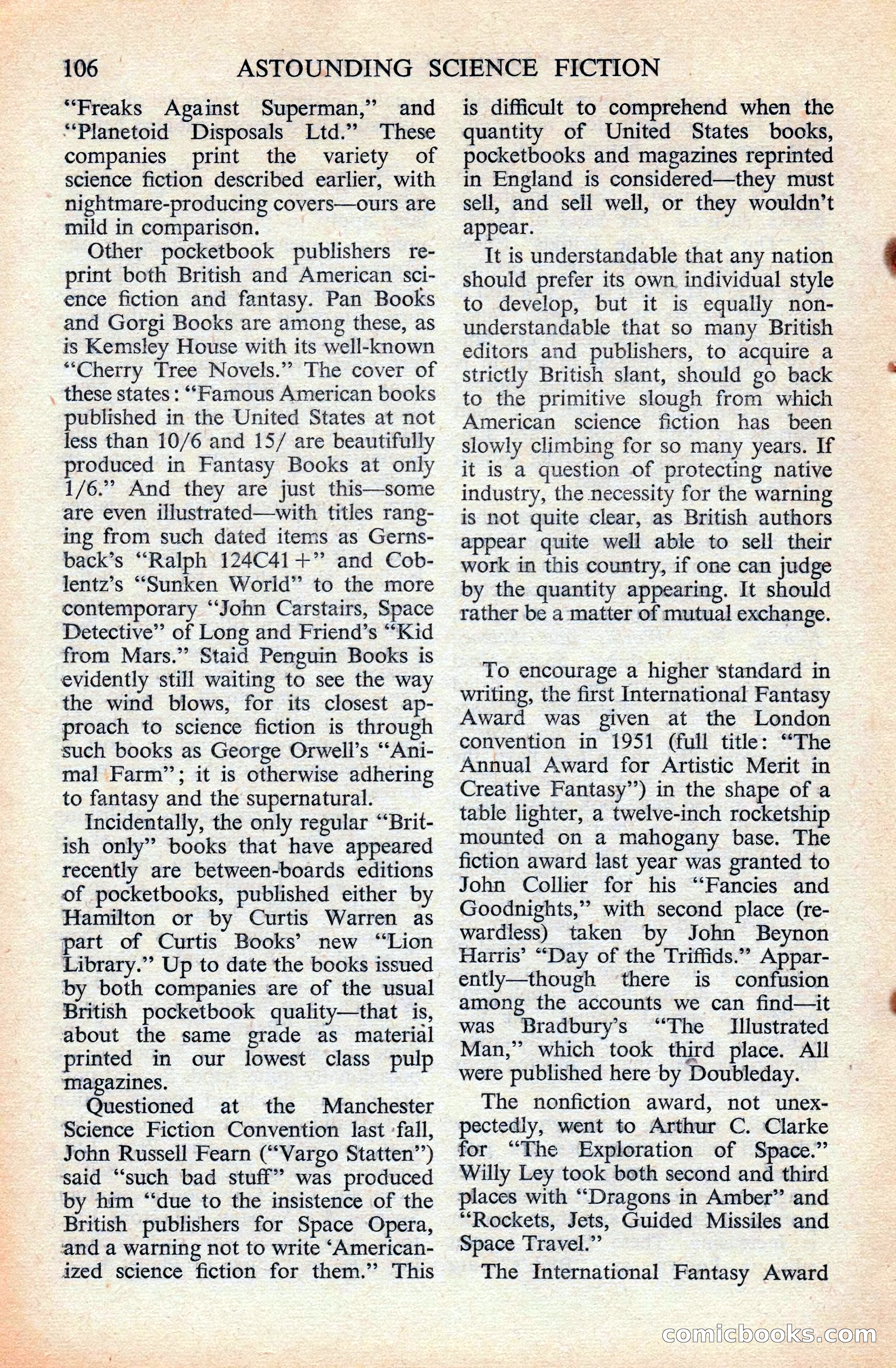
A restored page from Pulp Fiction, 1954. Page through the whole issue in the reader above.
📄 Transcribed text from this page (OCR, searchable)
Machine-transcribed from the original scan — historical spelling and the odd misread are preserved.
106 “Freaks Against Superman,” and “Planetoid Disposals Ltd.” These companies print the variety of science fiction described earlier, with nightmare-producing covers—ours are mild in comparison. Other pocketbook publishers re- print both British and American sci- ence fiction and fantasy. Pan Books and Gorgi Books are among these, as is Kemsley House with its well-known “Cherry Tree Novels.” The cover of these states : ““Famous American books published in the United States at not less than 10/6 and 15/ are beautifully produced in Fantasy Books at only 1/6.”” And they are just this—some are even illustrated—with titles rang- ing from such dated items as Gerns- back’s “Ralph 124C41+” and Cob- lentz’s “Sunken World” to the more contemporary “John Carstairs, Space Detective’? of Long and Friend’s “Kid from Mars.” Staid Penguin Books is evidently still waiting to see the way the wind blows, for its closest ap- proach to science fiction is through such books as George Orwell’s ““Ani- mal Farm’’; it is otherwise adhering to fantasy and the supernatural. Incidentally, the only regular “‘Brit- ish only” books that have appeared recently are between-boards editions of pocketbooks, published either by Hamilton or by Curtis Warren as part of Curtis Books’ new “Lion Library.”’ Up to date the books issued by both companies are of the usual British pocketbook quality—that is, about the same grade as material printed in our lowest class pulp magazines. Questioned at the Manchester Science Fiction Convention last ‘fall, John Russell Fearn (“Vargo Statten’’) said “such bad stuff’ was produced by him “due to the insistence of the British publishers for Space Opera, and a warning not to write “American- ized science fiction for them.” This ASTOUNDING SCIENCE FICTION is difficult to comprehend when the quantity of United States books, pocketbooks and magazines reprinted in England is considered—they must sell, and sell well, or they wouldn’t appear. It is understandable that any nation should prefer its own individual style to develop, but it is equally non- understandable that so many British editors and publishers, to acquire a strictly British slant, should go back to the primitive slough from which American science fiction has been slowly climbing for so many years. If it is a question of protecting native industry, the necessity for the warning is not quite clear, as British authors appear quite well able to sell their work in this country, if one can judge by the quantity appearing. It should rather be a matter of mutual exchange. To encourage a higher ‘standard in writing, the first International Fantasy Award was given at the London convention in 1951 (full title: “The Annual Award for Artistic Merit in Creative Fantasy”) in the shape of a table lighter, a twelve-inch rocketship mounted on a mahogany base. The fiction award last year was granted to John Collier for his “Fancies and Goodnights,”” with second place (re- wardless) taken by John Beynon Harris’ “Day of the Triffids.” Appar- ently—though ‘there is confusion among the accounts we can find—it was Bradbury’s “The Illustrated Man,” which took third place. All were published here by Doubleday. The nonfiction award, not unex- pectedly, went to Arthur C. Clarke for “The Exploration of Space.” Willy Ley took both second and third places with “Dragons in Amber” and *“Rockets, Jets, Guided Missiles and Space Travel.” The International Fantasy Award conmicloooks.c© im