
Pulp Fiction, 1954 · page 122 of 132
Astounding Science Fiction (British edition) — page 122: what you’re looking at
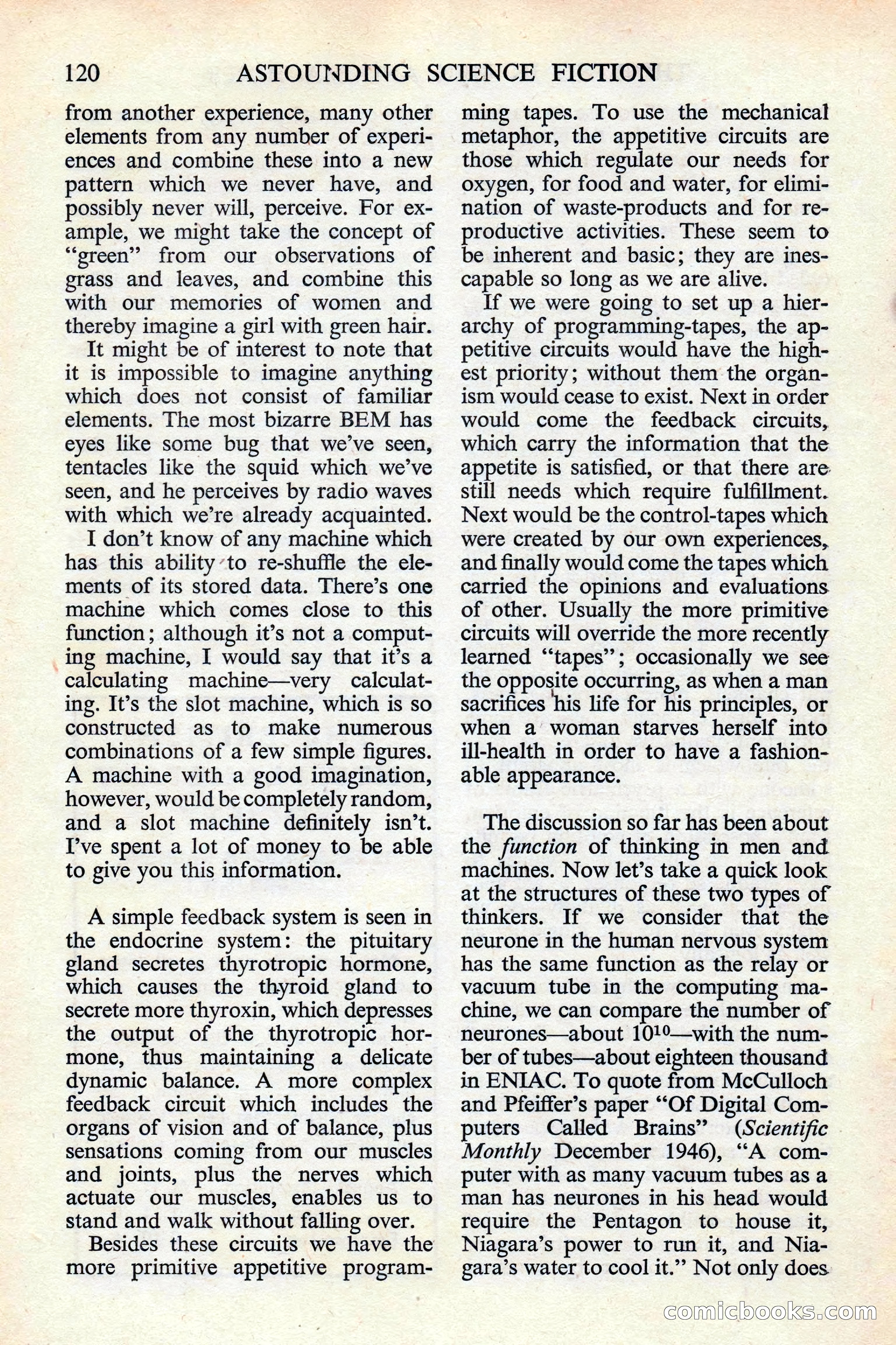
A restored page from Pulp Fiction, 1954. Page through the whole issue in the reader above.
📄 Transcribed text from this page (OCR, searchable)
Machine-transcribed from the original scan — historical spelling and the odd misread are preserved.
120 ASTOUNDING SCIENCE FICTION from another experience, many other elements from any number of experi- ences and combine these into a new pattern which we never have, and possibly never will, perceive. For ex- ample, we might take the concept of “sreen” from our observations of grass and leaves, and combine this with our memories of women and thereby imagine a girl with green hair. It might be of interest to note that it is impossible to imagine anything which does not consist of familiar elements. The most bizarre BEM has eyes like some bug that we’ve seen, tentacles like the squid which we’ve seen, and he perceives by radio waves with which we’re already acquainted. I don’t know of any machine which has this ability’to re-shuffle the ele- ments of its stored data. There’s one machine which comes close to this function ; although it’s not a comput- ing machine, I would say that it’s a calculating machine—very calculat- ing. It’s the slot machine, which is so constructed as to make numerous combinations of a few simple figures. A machine with a good imagination, however, would be completely random, and a slot machine definitely isn’t. I’ve spent a lot of money to be able to give you this information. A simple feedback system is seen in the endocrine system: the pituitary gland secretes thyrotropic hormone, which causes the thyroid gland to secrete more thyroxin, which depresses the output of the thyrotropic hor- mone, thus maintaining a delicate dynamic balance. A more complex feedback circuit which includes the organs of vision and of balance, plus sensations coming from our muscles and joints, plus the nerves which actuate our muscles, enables us to stand and walk without falling over. Besides these circuits we have the more primitive appetitive program- ming tapes. To use the mechanical metaphor, the appetitive circuits are those which regulate our needs for oxygen, for food and water, for elimi- nation of waste-products and for re- productive activities. These seem to be inherent and basic; they are ines- capable so long as we are alive. If we were going to set up a hier- archy of programming-tapes, the ap- petitive circuits would have the high- est priority; without them the organ- ism would cease to exist. Next in order would come the feedback circuits, which carry the information that the appetite is satisfied, or that there are still needs which require fulfillment. Next would be the control-tapes which were created by our own experiences, and finally would come the tapes which carried the opinions and evaluations of other. Usually the more primitive circuits will override the more recently learned “tapes”; occasionally we see the opposite occurring, as when a man sacrifices his life for his principles, or when a woman starves herself into ill-health in order to have a fashion- able appearance. The discussion so far has been about the function of thinking in men and machines. Now let’s take a quick look at the structures of these two types of thinkers. If we consider that the neurone in the human nervous system has the same function as the relay or vacuum tube in the computing ma- chine, we can compare the number of neurones—about 10!°—with the num- ber of tubes—about eighteen thousand in ENIAC. To quote from McCulloch and Pfeiffer’s paper “Of Digital Com- puters Called Brains” (Scientific Monthly December 1946), “A com- puter with as many vacuum tubes as a man has neurones in his head would require the Pentagon to house it, Niagara’s power to run it, and Nia- gara’s water to cool it.”” Not only does connicloookks.c© nl