
Pulp Fiction, 1954 · page 121 of 132
Astounding Science Fiction (British edition) — page 121: what you’re looking at
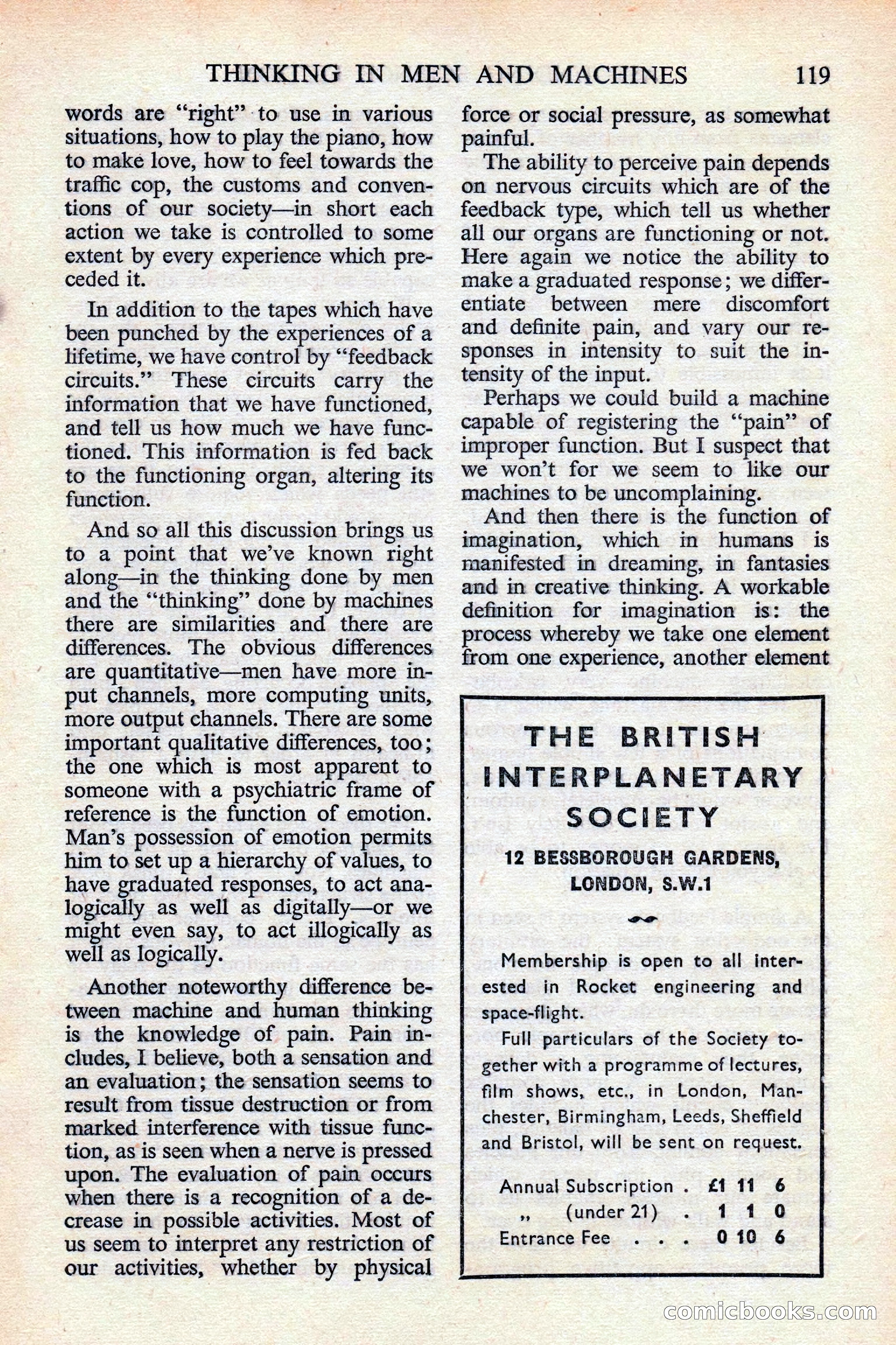
A restored page from Pulp Fiction, 1954. Page through the whole issue in the reader above.
📄 Transcribed text from this page (OCR, searchable)
Machine-transcribed from the original scan — historical spelling and the odd misread are preserved.
THINKING IN MEN AND MACHINES words are “right” to use in various situations, how to play the piano, how to make love, how to feel towards the traffic cop, the customs and conven- tions of our society—in short each action we take is controlled to some extent by every experience which pre- ceded it. In addition to the tapes which have _ been punched by the experiences of a lifetime, we have control by “feedback circuits.” ‘These circuits carry the information that we have functioned, and tell us how much we have func- tioned. This information is fed back to the functioning organ, altering its function. And so all this discussion brings us to a point that we’ve known right along—in the thinking done by men and the “thinking” done by machines there are similarities and there are differences. The obvious differences are quantitative—men have more in- put channels, more computing units, more output channels. There are some important qualitative differences, too; the one which is most apparent to someone with a psychiatric frame of reference is the function of emotion. Man’s possession of emotion permits him to set up a hierarchy of values, to have graduated responses, to act ana- logically as well as digitally—or we might even say, to act illogically as well as logically. Another noteworthy difference be- tween machine and human thinking is the knowledge of pain. Pain in- cludes, I believe, both a sensation and an evaluation; the sensation seems to result from tissue destruction or from marked interference with tissue func- tion, as is seen when a nerve is pressed upon. The evaluation of pain occurs when there is a recognition of a de- crease in possible activities. Most of us seem to interpret any restriction of our activities, whether by physical 119 force or social pressure, as somewhat painful. The ability to perceive pain depends on nervous circuits which are of the feedback type, which tell us whether all our organs are functioning or not. Here again we notice the ability to make a graduated response; we differ- entiate between mere discomfort and definite pain, and vary our re- sponses in intensity to suit the in- tensity of the input. Perhaps we could build a machine capable of registering the “pain” of improper function. But I suspect that we won’t for we seem to like our machines to be uncomplaining. And then there is the function of imagination, which im humans is manifested in dreaming, in fantasies and in creative thinking. A workable definition for imagination is: the process whereby we take one element from one experience, another element THE BRITISH ENTERPLANETARY SOCIETY 12 BESSBOROUGH GARDENS, LONDON, S.W.1 Par Membership is open to all inter- ested in Rocket engineering and space-flight. Full particulars of the Society to- gether with a programme of lectures, film shows, etc., in London, Man- chester, Birmingham, Leeds, Sheffield and Bristol, will be sent on request. Annual Subscription . pe (under 21) Entrance Fee connicloooks.conrn