
Pulp Fiction, 1954 · page 120 of 132
Astounding Science Fiction (British edition) — page 120: what you’re looking at
A restored page from Pulp Fiction, 1954. Page through the whole issue in the reader above.
📄 Transcribed text from this page (OCR, searchable)
Machine-transcribed from the original scan — historical spelling and the odd misread are preserved.
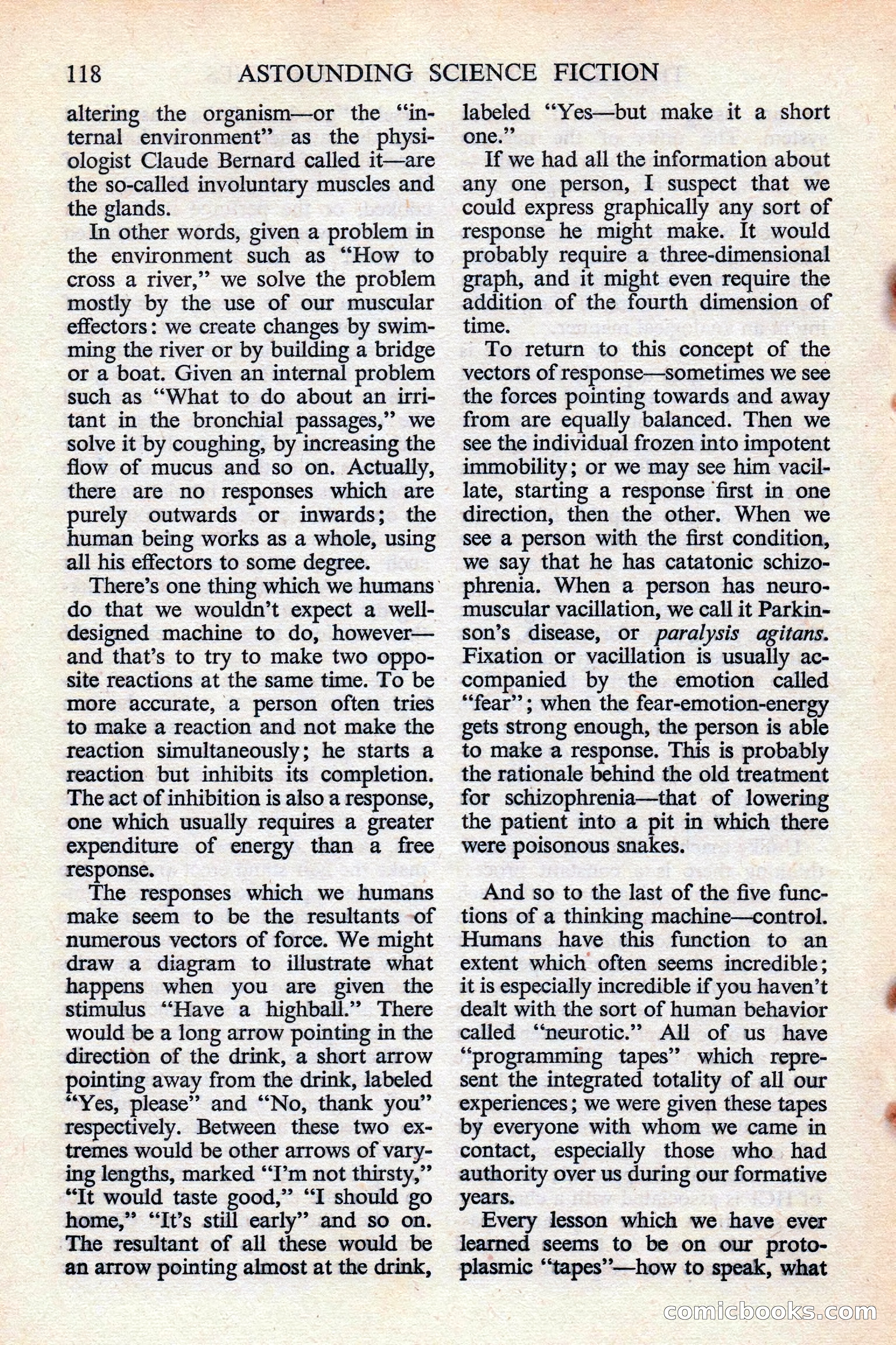
118 altering the organism—or the “‘in- ternal environment” as the physi- ologist Claude Bernard called it—are the so-called involuntary muscles and the glands. In other words, given a problem in the environment such as “How to cross a river,” we solve the problem mostly by the use of our muscular effectors: we create changes by swim- ming the river or by building a bridge or a boat. Given an internal problem such as “What to do about an irri- tant in the bronchial passages,” we solve it by coughing, by increasing the flow of mucus and so on. Actually, there are no responses which are purely outwards or inwards; the human being works as a whole, using all his effectors to some degree. There’s one thing which we humans’ do that we wouldn’t expect a well- designed machine to do, however— and that’s to try to make two oppo- site reactions at the same time. To be more accurate, a person often tries to make a reaction and not make the reaction simultaneously; he starts a reaction but inhibits its completion. The act of inhibition is also a response, one which usually requires a greater expenditure of energy than a free response. | : The responses which we humans make seem to be the resultants -of numerous vectors of force. We might draw a diagram to illustrate what happens when you are given the stimulus “Have a highball.” There would be a long arrow pointing in the direction of the drink, a short arrow pointing away from the drink, labeled “Yes, please’ and “‘No, thank you” respectively. Between these two ex- tremes would be other arrows of vary- ing lengths, marked “I’m not thirsty,” “It would taste good,” “I should go home,” “It’s still early’ and so on. The resultant of all these would be an atrow pointing almost at the drink, ASTOUNDING SCIENCE FICTION labeled ““Yes—but make it a short one.” If we had all the information about any one person, I suspect that we could express graphically any sort of response he might make. It would probably require a three-dimensional graph, and it might even require the addition of the fourth dimension of time. To return to this concept of the vectors of response—sometimes we see the forces pointing towards and away from are equally balanced. Then we see the individual frozen into impotent immobility; or we may see him vacil- late, starting a response first in one direction, then the other. When we see a person with the first condition, we say that he has catatonic schizo- phrenia. When a person has neuro- muscular vacillation, we call it Parkin~ son’s disease, or paralysis agitans. Fixation or vacillation is usually ac- companied by the emotion called ‘fear’; when the fear-emotion-energy gets strong enough, the person is able to make a response. This is probably the rationale behind the old treatment for schizophrenia—that of lowering the patient into a pit in which there were poisonous snakes. And so to the last of the five func- tions of a thinking machine—control. Humans have this function to an extent which often seems incredible; it is especially incredible if you haven’t dealt with the sort of human behavior called ‘‘neurotic.” All of us have “programming tapes’ which repre- sent the integrated totality of all our experiences ; we were given these tapes by everyone with whom we came in contact, especially those who. had authority over us during our formative years. Every lesson which we have ever learned seems to be on our proto- plasmic “‘tapes’”—how to speak, what connicloooks.€© im