
Pulp Fiction, 1954 · page 119 of 132
Astounding Science Fiction (British edition) — page 119: what you’re looking at
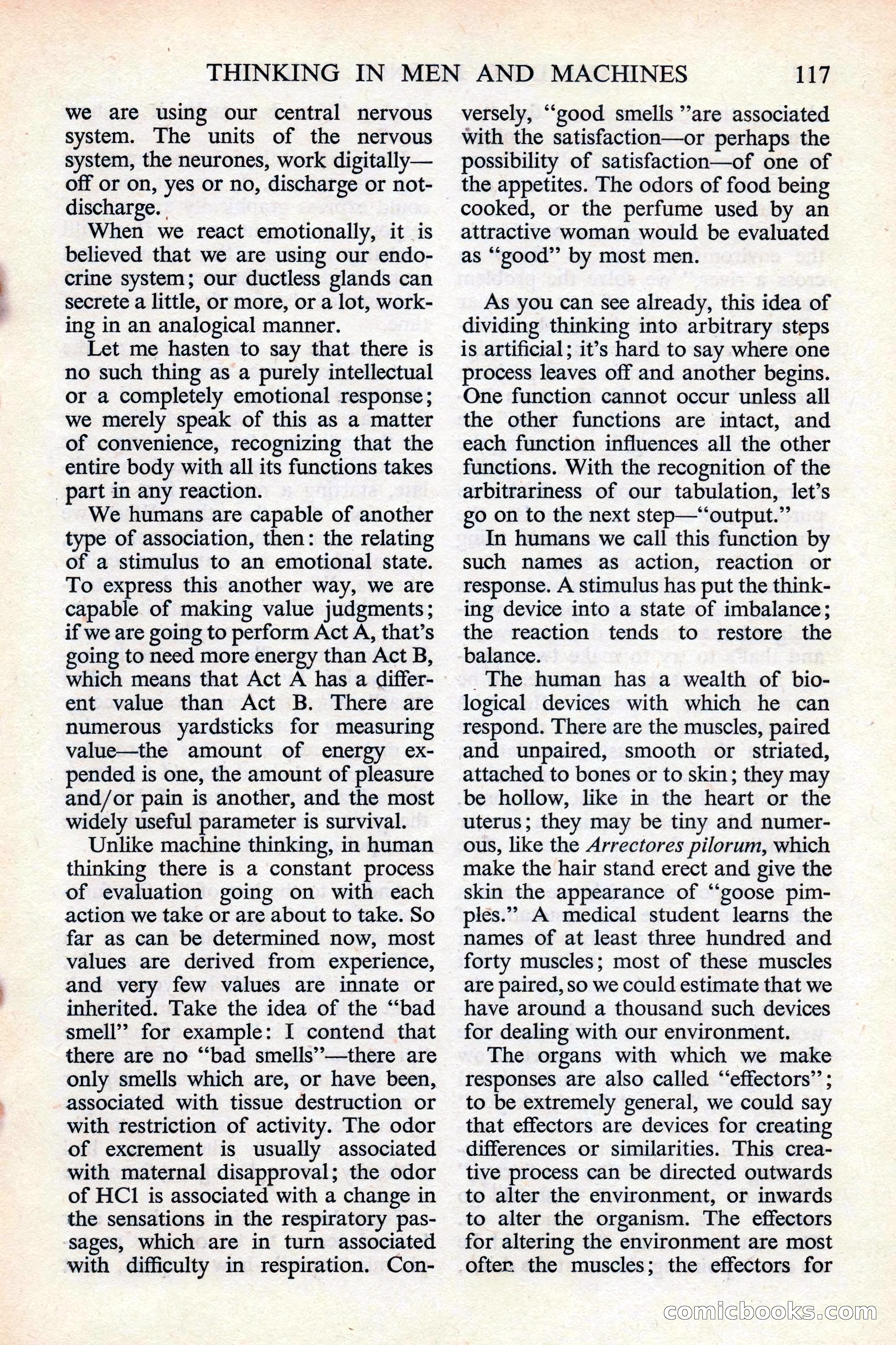
A restored page from Pulp Fiction, 1954. Page through the whole issue in the reader above.
📄 Transcribed text from this page (OCR, searchable)
Machine-transcribed from the original scan — historical spelling and the odd misread are preserved.
THINKING IN MEN AND MACHINES we are using our central nervous system. The units of the nervous system, the neurones, work digitally— off or on, yes or no, discharge or not- discharge. When we react emotionally, it is believed that we are using our endo- crine system; our ductless glands can secrete a little, or more, or a lot, work- ing in an analogical manner. Let me hasten to say that there is no such thing as a purely intellectual or a completely emotional response; we merely speak of this as a matter of convenience, recognizing that the entire body with all its functions takes part in any reaction. We humans are capable of another type of association, then: the relating of a stimulus to an emotional state. To express this another way, we are capable of making value judgments; if we are going to perform Act A, that’s going to need more energy than Act B, which means that Act A has a differ- ent value than Act B. There are numerous yardsticks for measuring value—the amount of energy ex- pended is one, the amount of pleasure and/or pain is another, and the most widely useful parameter is survival. Unlike machine thinking, in human thinking there is a constant process of evaluation going on with each action we take or are about to take. So far as can be determined now, most values are derived from experience, and very few values are innate or inherited. Take the idea of the “bad smell’? for example: I contend that there are no “‘bad smells”—there are only smells which are, or have been, associated with tissue destruction or with restriction of activity. The odor of excrement is usually associated with maternal disapproval; the odor of HCl is associated with a change in the sensations in the respiratory pas- sages, which are in turn associated with difficulty in respiration. Con- 117 versely, “good smells ’are associated with the satisfaction—or perhaps the possibility of satisfaction—of one of the appetites. The odors of food being cooked, or the perfume used by an attractive woman would be evaluated as “good” by most men. As you can see already, this idea of dividing thinking into arbitrary steps is artificial; it’s hard to say where one process leaves off and another begins. One function cannot occur unless all the other functions are intact, and each function influences all the other functions. With the recognition of the arbitrariness of our tabulation, let’s go on to the next step—“‘output.” In humans we call this function by such names as action, reaction or response. A stimulus has put the think- ing device into a state of imbalance; the reaction tends to restore the balance. The human has a wealth of bio- logical devices with which he can respond. There are the muscles, paired and unpaired, smooth or striated, attached to bones or to skin; they may be hollow, like in the heart or the uterus; they may be tiny and numer- ous, like the Arrectores pilorum, which make the hair stand erect and give the skin the appearance of “goose pim- ples.”” A medical student learns the names of at least three hundred and forty muscles; most of these muscles are paired, so we could estimate that we have around a thousand such devices for dealing with our environment. The organs with which we make responses are also called “effectors” ; to be extremely general, we could say that effectors are devices for creating differences or similarities. This crea- tive process can be directed outwards to alter the environment, or inwards to alter the organism. The effectors for altering the environment are most ofter. the muscles; the effectors for conniicloookks.con