
Pulp Fiction, 1954 · page 118 of 132
Astounding Science Fiction (British edition) — page 118: what you’re looking at
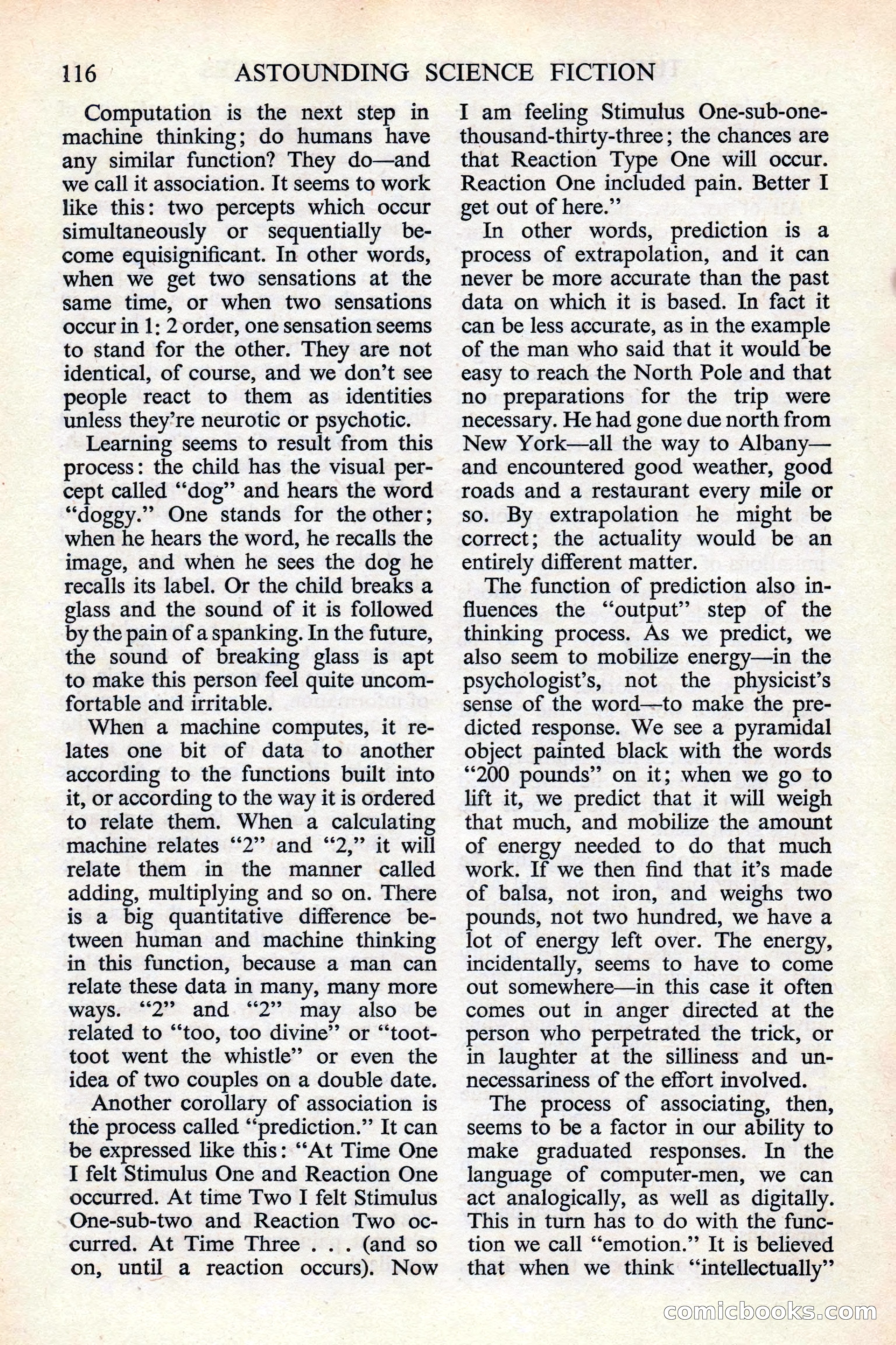
A restored page from Pulp Fiction, 1954. Page through the whole issue in the reader above.
📄 Transcribed text from this page (OCR, searchable)
Machine-transcribed from the original scan — historical spelling and the odd misread are preserved.
116 Computation is the next step in machine thinking; do humans have any similar function? They do—and we call it association. It seems to work like this: two percepts which occur simultaneously or sequentially be- come equisignificant. In other words, when we get two sensations at the same time, or when two sensations occur in 1: 2 order, one sensation seems to stand for the other. They are not identical, of course, and we don’t see people react to them as identities unless they’re neurotic or psychotic. Learning seems to result from this process: the child has the visual per- cept called “dog” and hears the word “doggy.” One stands for the other; when he hears the word, he recalls the image, and when he sees the dog he recalls its label. Or the child breaks a glass and the sound of it is followed by the pain of a spanking. In the future, the sound of breaking glass is apt to make this person feel quite uncom- fortable and irritable. When a machine computes, it re- lates one bit of data to another according to the functions built into it, or according to the way it is ordered to relate them. When a calculating machine relates “‘2’’ and “2,” it will relate them in the manner called adding, multiplying and so on. There is a big quantitative difference be- tween human and machine thinking in this function, because a man can relate these data in many, many more ways. “2” and “2” may also be related to “too, too divine’’ or ‘“‘toot- toot went the whistle” or even the idea of two couples on a double date. Another corollary of association is the process called “‘prediction.” It can be expressed like this: ““At Time One I felt Stimulus One and Reaction One occurred. At time Two I felt Stimulus One-sub-two and Reaction Two oc- curred. At Time Three . . . (and so on, until a reaction occurs). Now ASTOUNDING SCIENCE FICTION I am feeling Stimulus One-sub-one- thousand-thirty-three; the chances are that Reaction Type One will occur. Reaction One included pain. Better I get out of here.”’ In other words, prediction is a process of extrapolation, and it can never be more accurate than the past data on which it is based. In fact it can be less accurate, as in the example of the man who said that it would be easy to reach the North Pole and that no preparations for the trip were necessary. He had gone due north from New York—all the way to Albany— and encountered good weather, good roads and a restaurant every mile or so. By extrapolation he might be correct; the actuality would be an entirely different matter. The function of prediction also in- fluences the “output” step of the thinking process. As we predict, we also seem to mobilize energy—in the psychologist’s, not the physicist’s sense of the word—to make the pre- dicted response. We see a pyramidal object painted black with the words “200 pounds” on it; when we go to lift it, we predict that it will weigh that much, and mobilize the amount of energy needed to do that much work. If we then find that it’s made of balsa, not iron, and weighs two pounds, not two hundred, we have a lot of energy left over. The energy, incidentally, seems to have to come out somewhere—in this case it often comes out in anger directed at the person who perpetrated the trick, or in laughter at the silliness and un- necessariness of the effort involved. The process of associating, then, seems to be a factor in our ability to make graduated responses. In the language of computer-men, we can act analogically, as well as digitally. This in turn has to do with the func- tion we call “emotion.” It is believed that when we think “intellectually” conniiclooolks.conn