
Pulp Fiction, 1954 · page 117 of 132
Astounding Science Fiction (British edition) — page 117: what you’re looking at
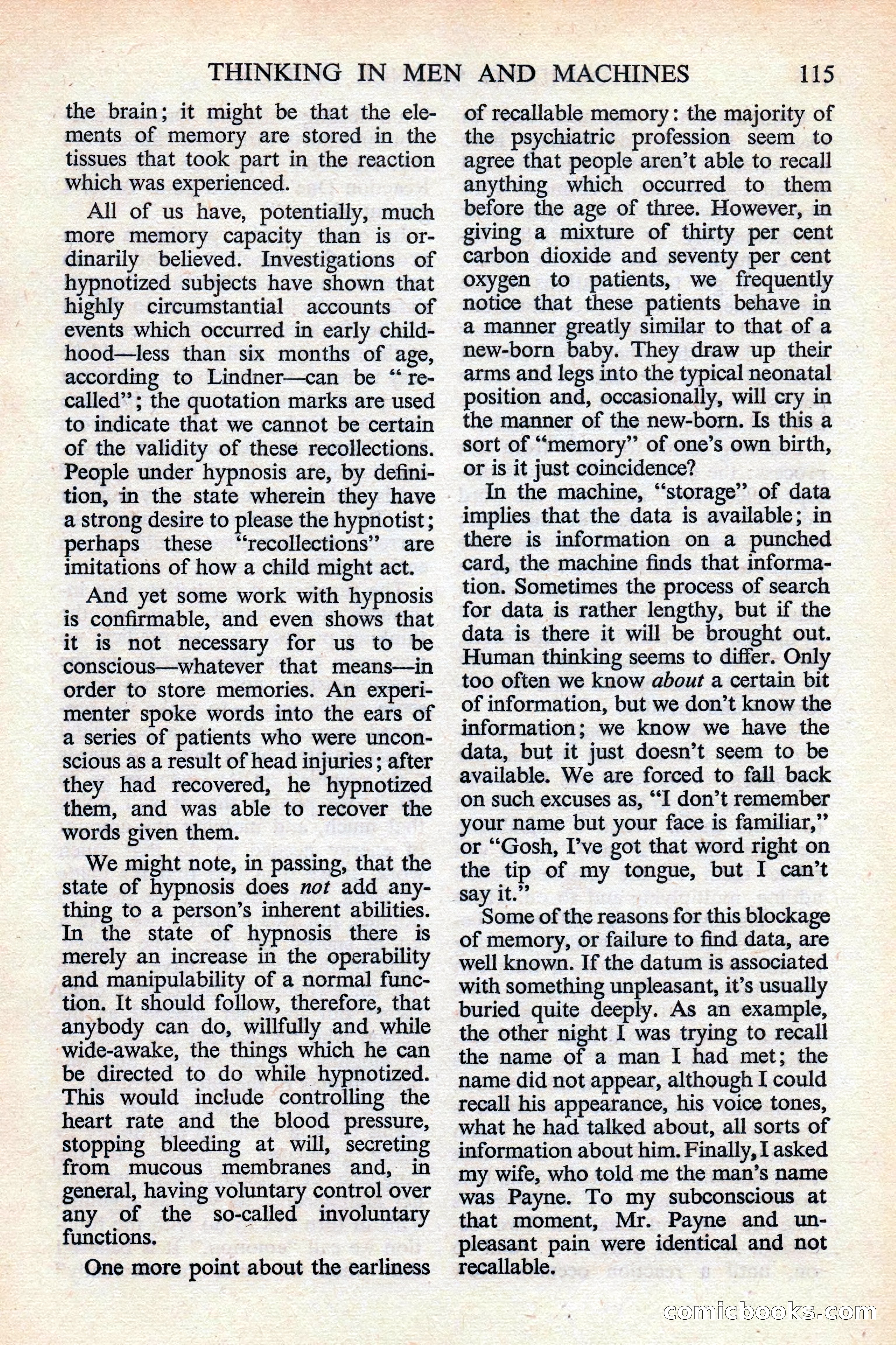
A restored page from Pulp Fiction, 1954. Page through the whole issue in the reader above.
📄 Transcribed text from this page (OCR, searchable)
Machine-transcribed from the original scan — historical spelling and the odd misread are preserved.
THINKING IN MEN AND MACHINES the brain; it might be that the ele- ments of memory are stored in the tissues that took part in the reaction which was experienced. All of us have, potentially, much more memory capacity than is or- dinarily believed. Investigations of hypnotized subjects have shown that highly circumstantial accounts of events which occurred in early child- hood—less than six months of age, according to Lindner—can be “ re- called’’; the quotation marks are used to indicate that we cannot be certain of the validity of these recollections. People under hypnosis are, by defini- tion, in the state wherein they have a strong desire to please the hypnotist ; perhaps these “recollections” are imitations of how a child might act. And yet some work with hypnosis is confirmable, and even shows that it is not necessary for us to be conscious—whatever that means—in order to store memories. An experi- menter spoke words into the ears of a series of patients who were uncon- scious as a result of head injuries; after they had recovered, he hypnotized them, and was able to recover the words given them. We might note, in passing, that the state of hypnosis does not add any- thing to a person’s inherent abilities. In the state of hypnosis there is merely an increase in the operability and manipulability of a normal func- tion. It should follow, therefore, that anybody can do, willfully and while wide-awake, the things which he can be directed to do while hypnotized. This would include controlling the heart rate and the blood pressure, stopping bleeding at will, secreting from mucous membranes and, in general, having voluntary control over any of the so-called involuntary functions, One more point about the earliness 115 of recallable memory: the majority of the psychiatric profession seem to agree that people aren’t able to recall anything which occurred to them before the age of three. However, in giving a mixture of thirty per cent carbon dioxide and seventy per cent oxygen to patients, we frequently notice that these patients behave in a manner greatly similar to that of a new-born baby. They draw up their arms and legs into the typical neonatal position and, occasionally, will cry in the manner of the new-born. Is this a sort of “memory’’ of one’s own birth, or is it just coincidence? In the machine, “‘storage”’ of data implies that the data is available; in there is information on a punched card, the machine finds that informa- tion. Sometimes the process of search for data is rather lengthy, but if the data is there it will be brought out. Human thinking seems to differ. Only too often we know about a certain bit of information, but we don’t know the information; we know we have the data, but it just doesn’t seem to be available. We are forced to fall back on such excuses as, “I don’t remember your name but your face is familiar,” or “Gosh, I’ve got that word right on the tip of my tongue, but I can’t say it.” Some of the reasons for this blockage of memory, or failure to find data, are well known. If the datum is associated with something unpleasant, it’s usually buried quite deeply. As an example, the other night I was trying to recall the name of a man I had met; the name did not appear, although I could recall his appearance, his voice tones, what he had talked about, all sorts of information about him. Finally, I asked my wife, who told me the man’s name was Payne. To my subconscious at that moment, Mr. Payne and un- pleasant pain were identical and not recallable. | conniclooolks.conn