
Pulp Fiction, 1954 · page 116 of 132
Astounding Science Fiction (British edition) — page 116: what you’re looking at
A restored page from Pulp Fiction, 1954. Page through the whole issue in the reader above.
📄 Transcribed text from this page (OCR, searchable)
Machine-transcribed from the original scan — historical spelling and the odd misread are preserved.
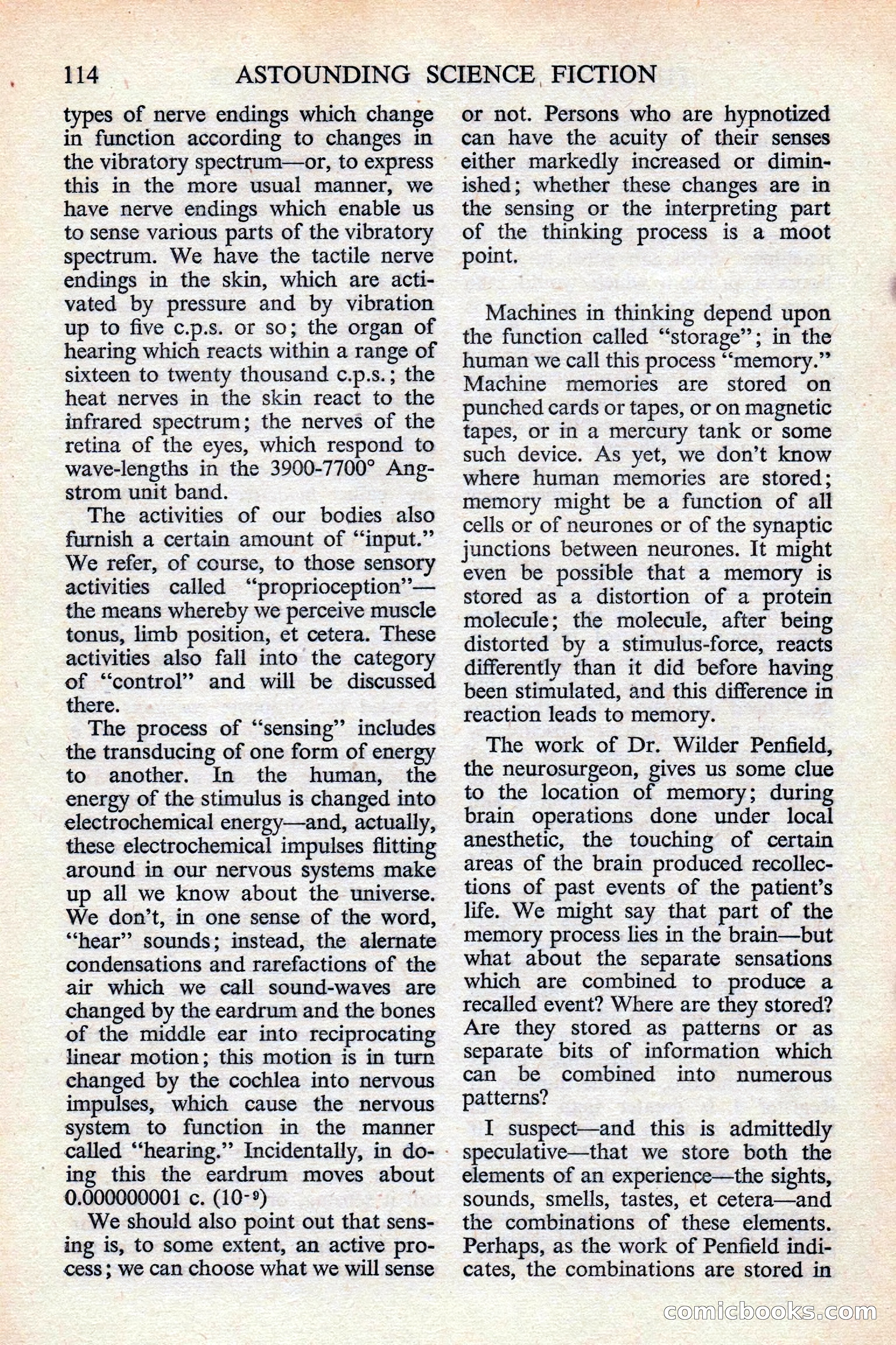
114 types of nerve endings which change in function according to changes in the vibratory spectrum—or, to express — this in the more usual manner, we have nerve endings which enable us to sense various parts of the vibratory spectrum. We have the tactile nerve endings in the skin, which are acti- vated by pressure and by vibration up to five c.p.s. or so; the organ of hearing which reacts within a range of sixteen to twenty thousand c.p.s.; the heat nerves in the skin react to the infrared spectrum; the nerves of the retina of the eyes, which respond to wave-lengths in the 3900-7700° Ang- strom unit band. The activities of our bodies also furnish a certain amount of “input.” We refer, of course, to those sensory activities called “proprioception” — the means whereby we perceive muscle tonus, limb position, et cetera. These activities also fall into the category of “control” and will be discussed there. The process of “sensing” includes the transducing of one form of energy to another. In the human, the energy of the stimulus is changed into electrochemical energy—and, actually, these electrochemical impulses flitting around in our nervous systems make up all we know about the universe. We don’t, in one sense of the word, ‘“*hear’’ sounds; instead, the alernate condensations and rarefactions of the air which we call sound-waves are changed by the eardrum and the bones of the middle ear into reciprocating linear motion; this motion is in turn changed by the cochlea into nervous impulses, which cause the nervous system to function in the manner called “‘hearing.”’ ing this the eardrum moves about 0.000000001 c. (10-*) We should also point out that sens- ing is, to some extent, an active pro- cess ; we can choose what we will sense Incidentally, in do- - ASTOUNDING SCIENCE, FICTION or not. Persons who are hypnotized can have the acuity of their senses either markedly increased or dimin- ished; whether these changes are in the sensing or the interpreting part of the thinking process is a moot point. Machines in thinking depend upon the function called “storage”; in the human we call this process ““memory.” Machine memories are stored on punched cards or tapes, or on magnetic tapes, or in a mercury tank or some such device. As yet, we don’t know where human memories are stored; memory might be a function of all cells or of neurones or of the synaptic junctions between neurones. It might even be possible that a memory is stored as a distortion of a protein molecule; the molecule, after being distorted by a stimulus-force, reacts differently than it did before having been stimulated, and this difference in reaction leads to memory. The work of Dr. Wilder Penfield, the neurosurgeon, gives us some clue to the location of memory; during brain operations done under local anesthetic, the touching of certain areas of the brain produced recollec- tions of past events of the patient’s life. We might say that part of the memory process lies in the brain—but what about the separate sensations which are combined to produce a recalled event? Where are they stored? Are they stored as patterns or as separate bits of information which can be combined into numerous patterns? I suspect—and this is admittedly speculative—that we store both the elements of an experience—the sights, sounds, smells, tastes, et cetera—and the combinations of these elements. Perhaps, as the work of Penfield indi- cates, the combinations are stored in connicloooks.conn