
Pulp Fiction, 1954 · page 115 of 132
Astounding Science Fiction (British edition) — page 115: what you’re looking at
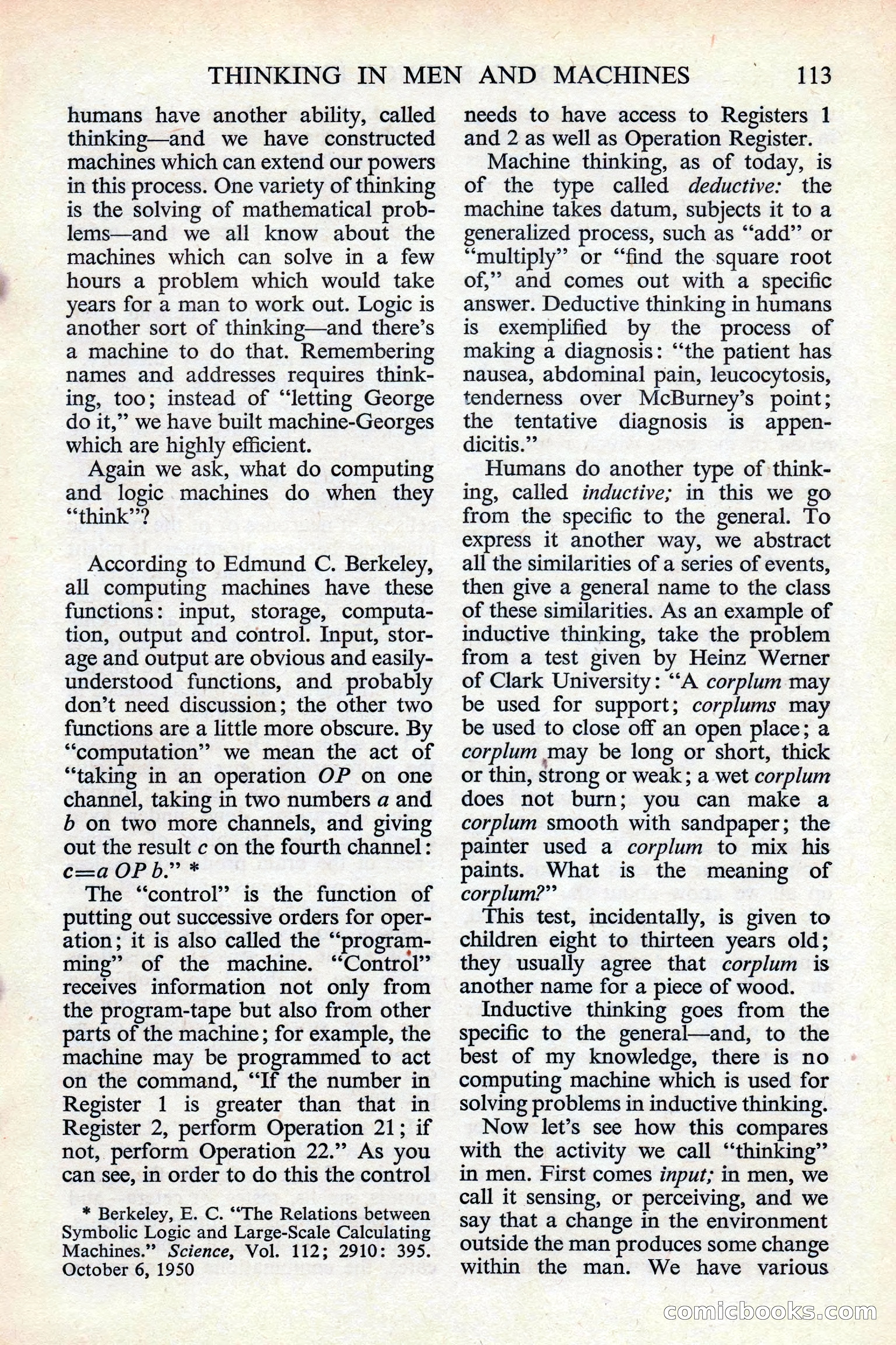
A restored page from Pulp Fiction, 1954. Page through the whole issue in the reader above.
📄 Transcribed text from this page (OCR, searchable)
Machine-transcribed from the original scan — historical spelling and the odd misread are preserved.
THINKING IN MEN AND MACHINES humans have another ability, called thinking—and we have constructed machines which can extend our powers in this process. One variety of thinking is the solving of mathematical prob- lems—and we all know about the machines which can solve in a few hours a problem which would take years for a man to work out. Logic is another sort of thinking—and there’s a machine to do that. Remembering names and addresses requires think- ing, too; instead of “letting George do it,” we have built machine-Georges which are highly efficient. Again we ask, what do computing and logic machines do when they “think’’? According to Edmund C. Berkeley, all computing machines have these functions: input, storage, computa- tion, output and control. Input, stor- age and output are obvious and easily- understood functions, and probably don’t need discussion; the other two functions are a little more obscure. By “computation”” we mean the act of “taking in an operation OP on one channel, taking in two numbers a and 5 on two more channels, and giving out the result c on the fourth channel: c=a OP b.” * The “control” is the function of putting out successive orders for oper- ation; it is also called the ““program- ming” of the machine. “Control” receives information not only from the program-tape but also from other parts of the machine; for example, the machine may be programmed to act on the command, “If the number in Register 1 is greater than that in Register 2, perform Operation 21; if not, perform Operation 22.” As you can see, in order to do this the control * Berkeley, E. C. *“The Relations between Symbolic Logic and Large-Scale Calculating Machines.” Science, Vol. 112; 2910: 395. October 6, 1950 113 needs to have access to Registers 1 and 2 as well as Operation Register. Machine thinking, as of today, is of the type called deductive: the machine takes datum, subjects it to a generalized process, such as “‘add’’ or “multiply” or “find the square root of,” and comes out with a specific answer. Deductive thinking in humans is exemplified by the process of making a diagnosis: “‘the patient has nausea, abdominal pain, leucocytosis, tenderness over McBurney’s point; the tentative diagnosis is appen- dicitis.”” Humans do another type of think- ing, called inductive; in this we go from the specific to the general. To express it another way, we abstract all the similarities of a series of events, then give a general name to the class of these similarities. As an example of inductive thinking, take the problem from a test given by Heinz Werner of Clark University: “A corplum may be used for support; corplums may be used to close off an open place; a corplum may be long or short, thick or thin, strong or weak; a wet corplum does not burn; you can make a corplum smooth with sandpaper; the painter used a corplum to mix his paints. What is the meaning of corplum?”” This test, incidentally, is given to children eight to thirteen years old; they usually agree that corplum is another name for a piece of wood. Inductive thinking goes from the specific to the general—and, to the best of my knowledge, there is no computing machine which is used for solving problems in inductive thinking. Now let’s see how this compares with the activity we call “thinking” in men. First comes input; in men, we call it sensing, or perceiving, and we say that a change in the environment outside the man produces some change within the man. We have various conniclooolks.cornn