
Pulp Fiction, 1954 · page 114 of 132
Astounding Science Fiction (British edition) — page 114: what you’re looking at
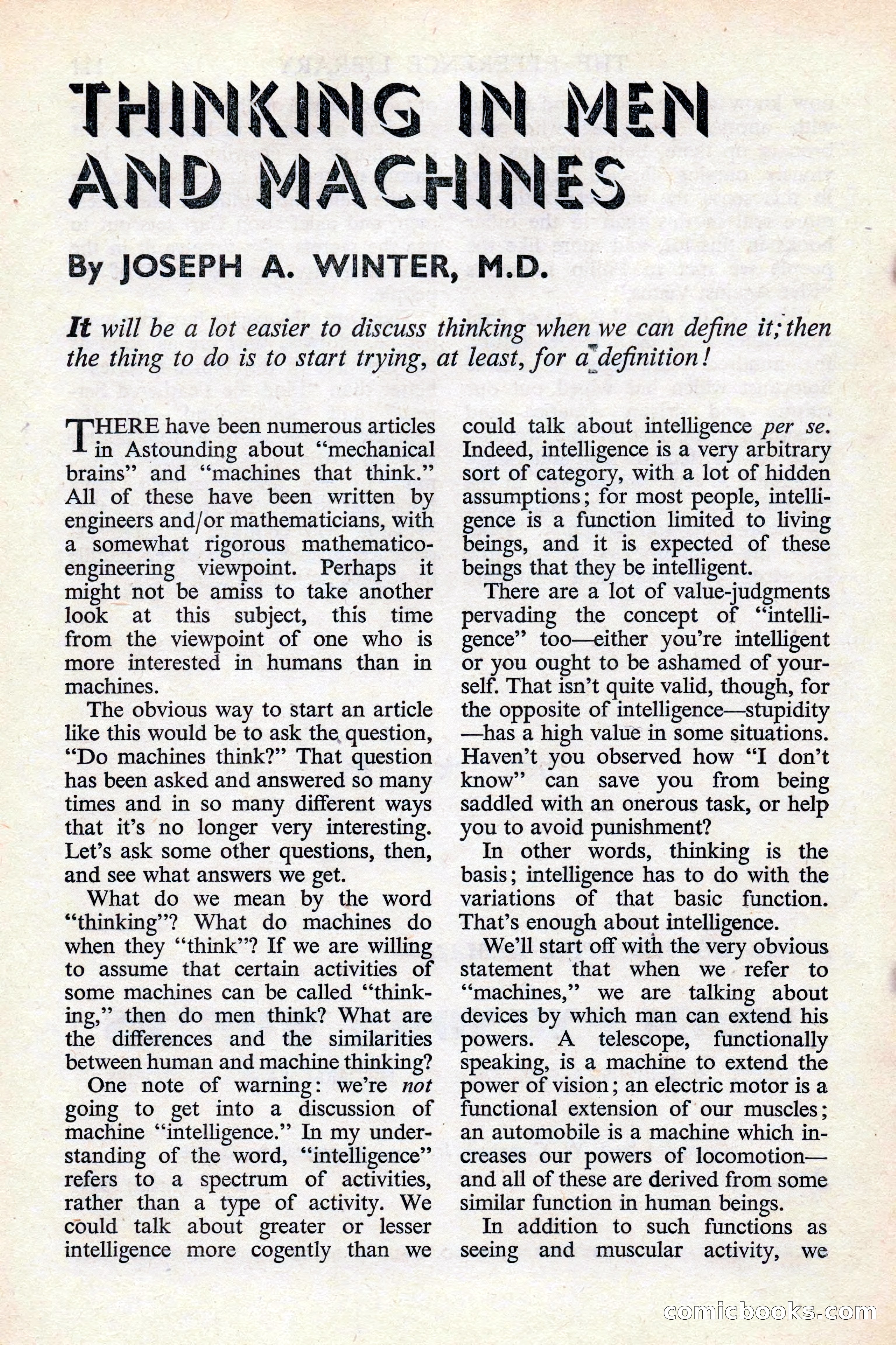
A restored page from Pulp Fiction, 1954. Page through the whole issue in the reader above.
📄 Transcribed text from this page (OCR, searchable)
Machine-transcribed from the original scan — historical spelling and the odd misread are preserved.
TrUNACING IN MEN AND MACFUNES By JOSEPH A. WINTER, M.D. Tt will be a lot easier to discuss thinking when we can define it; then the thing to do is to start trying, at least, for a definition! HERE have been numerous articles in Astounding about “mechanical brains” and “‘machines that think.” All of these have been written by engineers and/or mathematicians, with a somewhat rigorous mathematico- engineering viewpoint. Perhaps it might not be amiss to take another look at this subject, this time from the viewpoint of one who is more interested in humans than in machines. The obvious way to Start an article like this would be to ask the, question, “Do machines think?” That question has been asked and answered so many times and in so many different ways that it’s no longer very interesting. Let’s ask some other questions, then, and see what answers we get. What do we mean by the word ‘thinking’? What do machines do when they “think’’? If we are willing to assume that certain activities of some machines can be called “‘think- ing,” then do men think? What are the differences and the similarities between human and machine thinking? One note of warning: we’re not going to get into a discussion of machine “‘intelligence.”” In my under- standing of the word, “‘intelligence”’ refers to a spectrum of activities, rather than a type of activity. We could talk about greater or lesser intelligence more cogently than we could talk about intelligence per se. Indeed, intelligence is a very arbitrary sort of category, with a lot of hidden assumptions ; for most people, intelli- gence is a function limited to living beings, and it is expected of these beings that they be intelligent. There are a lot of value-judgments pervading the concept of “‘intelli- gence’”’ too—either you’re intelligent or you ought to be ashamed of your- self. That isn’t quite valid, though, for the opposite of intelligence—stupidity —has a high value in some situations. Haven’t you observed how “I don’t know” can save you from being saddled with an onerous task, or help you to avoid punishment? In other words, thinking is the basis; intelligence has to do with the variations of that basic function. That’s enough about intelligence. We'll start off with the very obvious statement that when we refer to “machines,” we are talking about devices by which man can extend his powers. A_ telescope, functionally speaking, is a machine to extend the power of vision; an electric motor is a functional extension of our muscles; an automobile is a machine which in- creases Our powers of locomotion— and all of these are derived from some similar function in human beings. In addition to such functions as seeing and muscular activity, we connicloooks.c© nn