
Pulp Fiction, 1954 · page 110 of 132
Astounding Science Fiction (British edition) — page 110: what you’re looking at
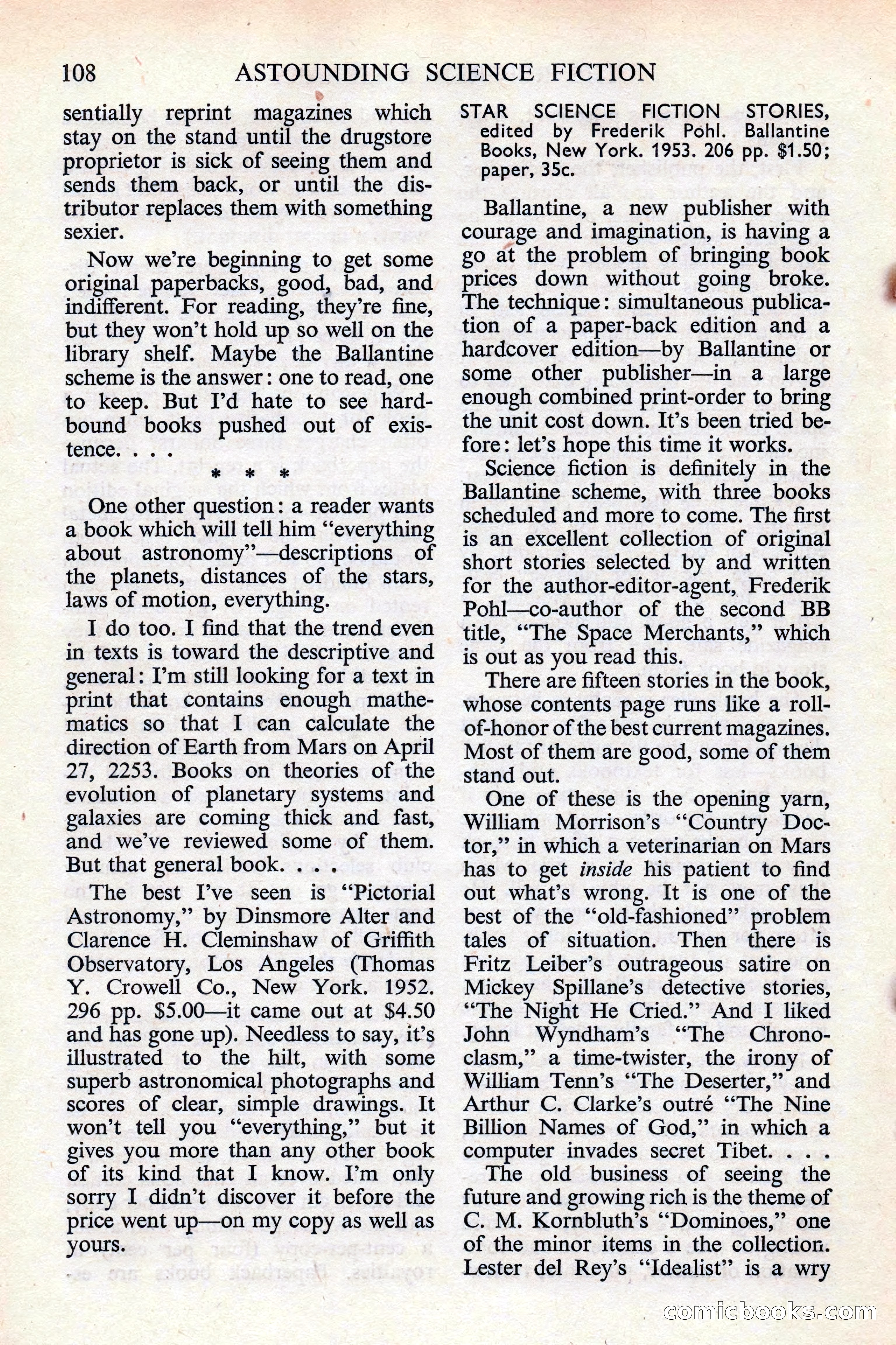
A restored page from Pulp Fiction, 1954. Page through the whole issue in the reader above.
📄 Transcribed text from this page (OCR, searchable)
Machine-transcribed from the original scan — historical spelling and the odd misread are preserved.
108 sentially reprint magazines which stay on the stand until the drugstore proprietor is sick of seeing them and sends them back, or until the dis- tributor replaces them with something sexier. Now we’re beginning to get some original paperbacks, good, bad, and indifferent. For reading, they’re fine, but they won’t hold up so well on the library shelf. Maybe the Ballantine scheme is the answer: one to read, one to keep. But I’d hate to see hard- bound books pushed out of exis- tence. ... x * # One other question: a reader wants a book which will tell him “everything about astronomy’’—descriptions of the planets, distances of the stars, laws of motion, everything. I do too. I find that the trend even in texts is toward the descriptive and general: I’m still looking for a text in print that contains enough mathe- matics so that I can calculate the direction of Earth from Mars on April 27, 2253. Books on theories of the evolution of planetary systems and galaxies are coming thick and fast, and we’ve reviewed some of them. But that general book... . The best I’ve seen is “Pictorial Astronomy,” by Dinsmore Alter and Clarence H. Cleminshaw of Griffith Observatory, Los Angeles (Thomas Y. Crowell Co., New York. 19532. 296 pp. $5.00—it came out at $4.50 and has gone up). Needless to say, it’s illustrated to the hilt, with some superb astronomical photographs and scores of clear, simple drawings. It won’t tell you “everything,” but it ives you more than any other book of its kind that I know. I’m only sorry I didn’t discover it before the price went up—on my copy as well as yours. ASTOUNDING SCIENCE FICTION STAR SCIENCE FICTION STORIES, edited by Frederik Pohl. Ballantine Books, New York. 1953. 206 pp. $1.50; paper, 35c. Ballantine, a new publisher with courage and imagination, is having a go at the problem of bringing book prices down without going broke. The technique: simultaneous publica- tion of a paper-back edition and a hardcover edition—by Ballantine or some other publisher—in a large enough combined print-order to bring the unit cost down. It’s been tried be- fore: let’s hope this time it works. Science fiction is definitely in the Ballantine scheme, with three books scheduled and more to come. The first is an excellent collection of original short stories selected by and written for the author-editor-agent, Frederik Pohl—co-author of the second BB title, ““The Space Merchants,” which is out as you read this. There are fifteen stories in the book, whose contents page runs like a roll- of-honor of the best current magazines. Most of them are good, some of them stand out. One of these is the opening yarn, William Morrison’s “Country Doc- tor,” in which a veterinarian on Mars has to get inside his patient to find out what’s wrong. It is one of the best of the “‘old-fashioned’’ problem tales of situation. Then there is Fritz Leiber’s outrageous satire on Mickey Spillane’s detective stories, “The Night He Cried.” And I liked John Wyndham’s “The Chrono- clasm,’”’ a time-twister, the irony of William Tenn’s ““The Deserter,” and Arthur C. Clarke’s outré ‘The Nine Billion Names of God,” in which a computer invades secret Tibet. . . The old business of seeing the future and growing rich is the theme of C. M. Kornbluth’s ‘““Dominoes,”’ one of the minor items in the collection. Lester del Rey’s “Idealist” is a wry Comicboooks. conn