
Pulp Fiction, 1954 · page 109 of 132
Astounding Science Fiction (British edition) — page 109: what you’re looking at
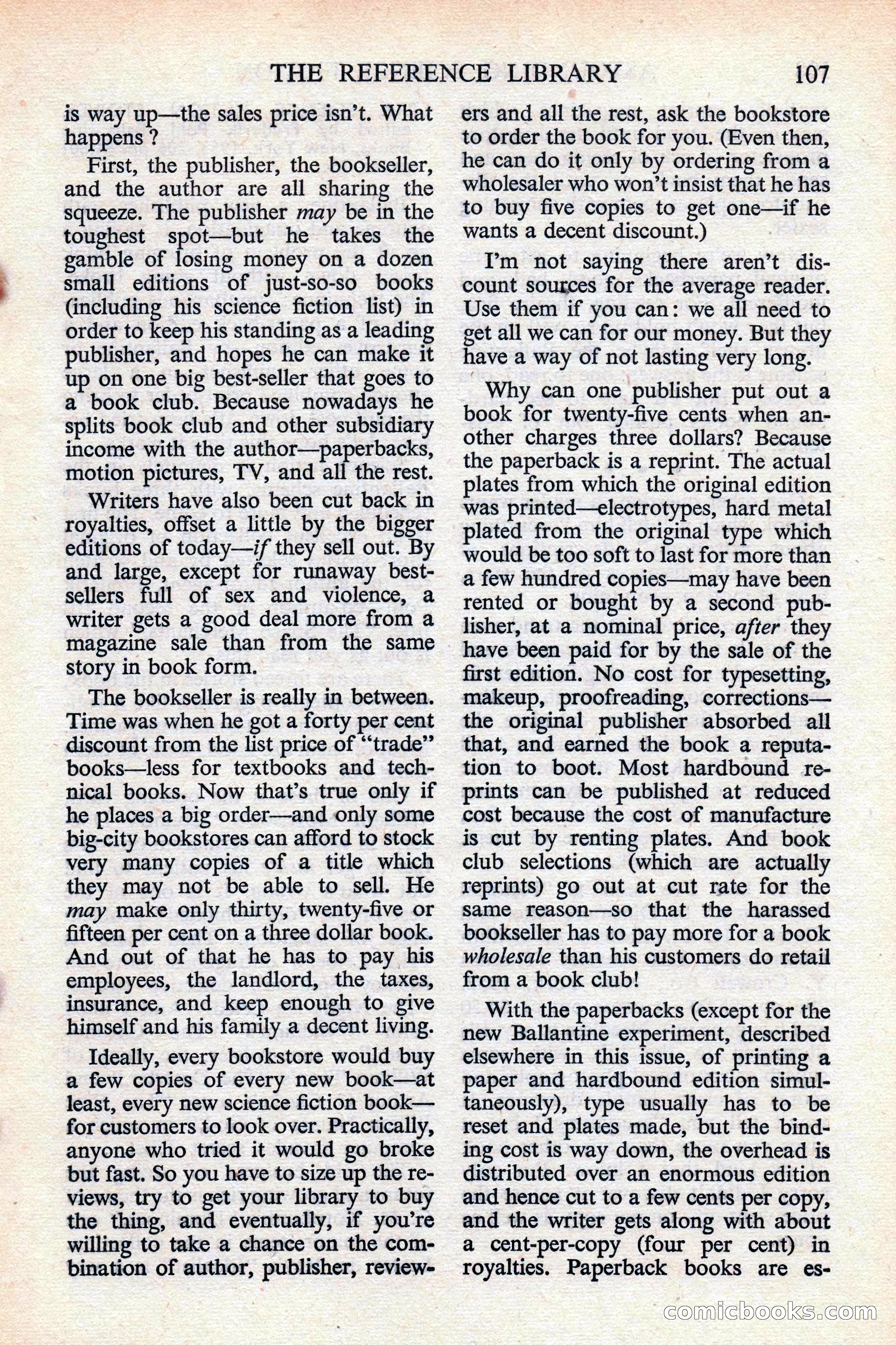
A restored page from Pulp Fiction, 1954. Page through the whole issue in the reader above.
📄 Transcribed text from this page (OCR, searchable)
Machine-transcribed from the original scan — historical spelling and the odd misread are preserved.
THE REFERENCE LIBRARY is way up—the sales price isn’t. What happens ? First, the publisher, the bookseller, and the author are all sharing the squeeze. The publisher may be in the toughest spot—but he takes the gamble of losing money on a dozen small editions of just-so-so books (including his science fiction list) in order to keep his standing as a leading publisher, and hopes he can make it up on one big best-seller that goes to a book club. Because nowadays he splits book club and other subsidiary income with the author—paperbacks, motion pictures, TV, and all the rest. Writers have also been cut back in royalties, offset a little by the bigger editions of today—if they sell out. By and large, except for runaway best- sellers full of sex and violence, a writer gets a good deal more from a magazine sale than from the same story in book form. The bookseller is really in between. Time was when he got a forty per cent discount from the list price of “trade” books—less for textbooks and tech- nical books. Now that’s true only if he places a big order—and only some big-city bookstores can afford to stock very many copies of a title which they may not be able to sell. He may make only thirty, twenty-five or fifteen per cent on a three dollar book. And out of that he has to pay his employees, the landlord, the taxes, insurance, and keep enough to give himself and his family a decent living. Ideally, every bookstore would buy a few copies of every new book—at least, every new science fiction book— for customers to look over. Practically, anyone who tried it would go broke but fast. So you have to size up the re- views, try to get your library to buy the thing, and eventually, if you're willing to take a chance on the com- bination of author, publisher, review- 107 ers and all the rest, ask the bookstore to order the book for you. (Even then, he can do it only by ordering from a wholesaler who won’t insist that he has to buy five copies to get one—if he wants a decent discount.) I’m not saying there aren’t dis- count sources for the average reader. Use them if you can: we all need to get all we can for our money. But they have a way of not lasting very long. Why can one publisher put out a book for twenty-five cents when an- other charges three dollars? Because the paperback is a reprint. The actual plates from which the original edition was printed—electrotypes, hard metal plated from the original type which would be too soft to last for more than a few hundred copies—may have been rented or bought by a second pub- lisher, at a nominal price, after they have been paid for by the sale of the first edition. No cost for typesetting, makeup, proofreading, corrections— the original publisher absorbed all that, and earned the book a reputa- tion to boot. Most hardbound re- prints can be published at reduced cost because the cost of manufacture is cut by renting plates. And book club selections (which are actually reprints) go out at cut rate for the same reason—so that the harassed bookseller has to pay more for a book wholesale than his customers do retail from a book club! With the paperbacks (except for the new Ballantine experiment, described elsewhere in this issue, of printing a paper and hardbound edition simul- taneously), type usually has to be reset and plates made, but the bind- ing cost is way down, the overhead is distributed over an enormous edition and hence cut to a few cents per copy, and the writer gets along with about a cent-per-copy (four per cent) in royalties. Paperback books are es- connicloooks.c© inn