
Pulp Fiction, 1954 · page 111 of 132
Astounding Science Fiction (British edition) — page 111: what you’re looking at
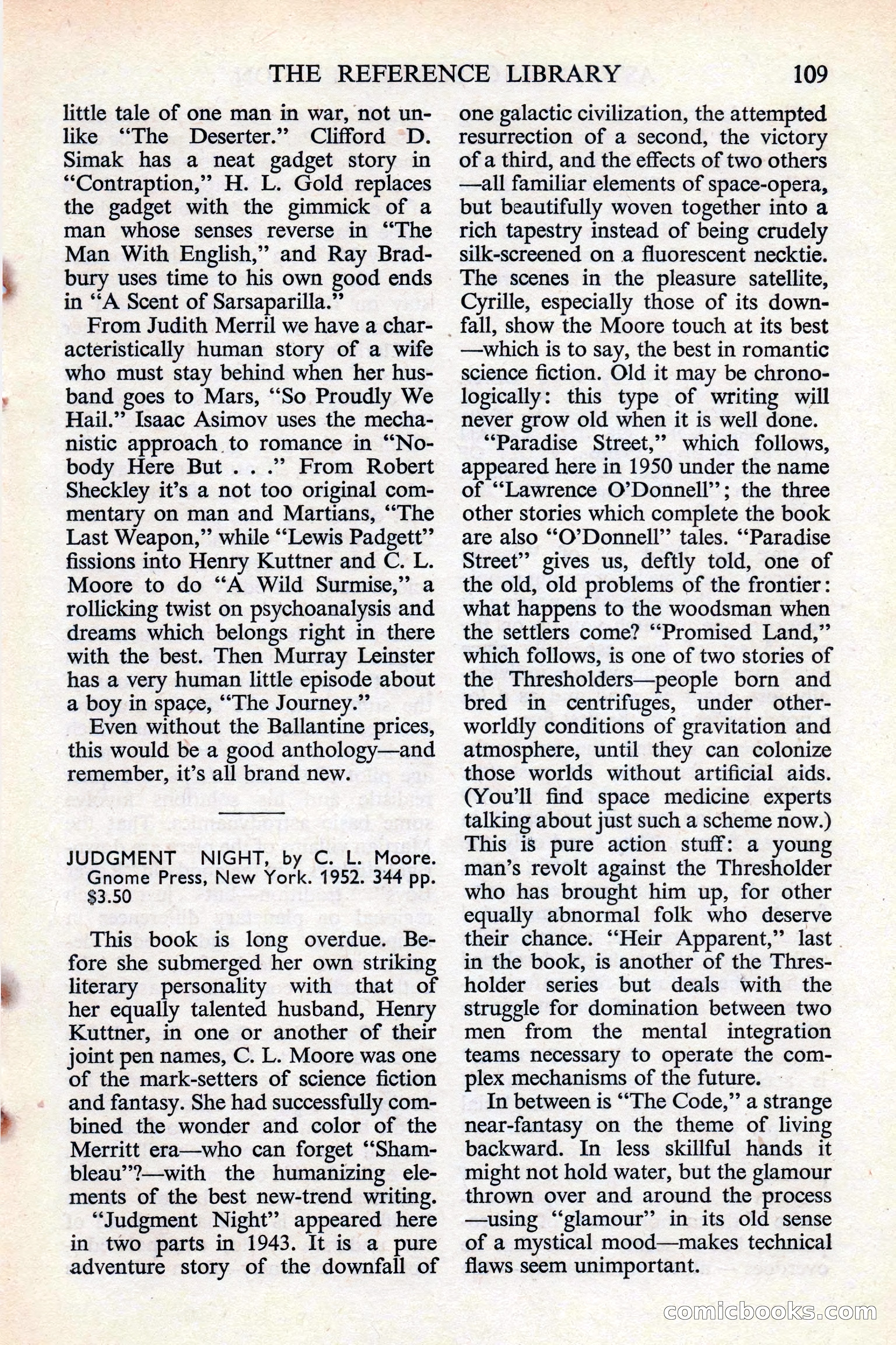
A restored page from Pulp Fiction, 1954. Page through the whole issue in the reader above.
📄 Transcribed text from this page (OCR, searchable)
Machine-transcribed from the original scan — historical spelling and the odd misread are preserved.
THE REFERENCE LIBRARY little tale of one man in war, not un- like ‘The Deserter.” Clifford D. Simak has a neat gadget story in “Contraption,” H. L. Gold replaces the gadget with the gimmick of a man whose senses reverse in “The Man With English,” and Ray Brad- bury uses time to his own good ends in “A Scent of Sarsaparilla.” From Judith Merril we have a char- acteristically human story of a wife who must stay behind when her hus- band goes to Mars, “So Proudly We Hail.” Isaac Asimov uses the mecha- nistic approach to romance in “No- body Here But...” From Robert ' Sheckley it’s a not too original com- mentary on man and Martians, ““The Last Weapon,”’ while “Lewis Padgett”’ fissions into Henry Kuttner and C. L. Moore to do “‘A Wild Surmise,” a rollicking twist on psychoanalysis and dreams which belongs right in there with the best. Then Murray Leinster has a very human little episode about a boy in space, ““The Journey.” Even without the Ballantine prices, this would be a good anthology—and remember, it’s all brand new. JUDGMENT NIGHT, by C. L. Moore. Gnome Press, New York. 1952. 344 pp. $3.50 This book is long overdue. Be- fore she submerged her own striking literary personality with that of her equally talented husband, Henry Kuttner, in one or another of their joint pen names, C. L. Moore was one of the mark-setters of science fiction and fantasy. She had successfully com- bined the wonder and color of the Merritt era—who can forget “‘Sham- bleau’’?—-with the humanizing ele- ments of the best new-trend writing. “Judgment Night’ appeared here in two parts in 1943. It is a pure adventure story of the downfall of 109 one galactic civilization, the attempted resurrection of a second, the victory of a third, and the effects of two others —all familiar elements of space-opera, but beautifully woven together into a rich tapestry instead of being crudely silk-screened on a fluorescent necktie. The scenes in the pleasure satellite, Cyrille, especially those of its down- fall, show the Moore touch at its best —which is to say, the best in romantic science fiction. Old it may be chrono- logically: this type of writing will never grow old when it is well done. “Paradise Street,’’ which follows, appeared here in 1950 under the name of ‘‘Lawrence O’Donnell’’; the three other stories which complete the book are also “O’Donnell”’ tales. “Paradise Street’’ gives us, deftly told, one of the old, old problems of the frontier: what happens to the woodsman when the settlers come? ‘‘Promised Land,” which follows, is one of two stories of the Thresholders—people born and bred in centrifuges, under other- worldly conditions of gravitation and atmosphere, until they can colonize those worlds without artificial aids. (You'll find space medicine experts talking about just such a scheme now.) This is pure action stuff: a youn man’s revolt against the Thresholder who has brought him up, for other equally abnormal folk who deserve their chance. “Heir Apparent,”’ last . in the book, is another of the Thres- holder series but deals with the struggle for domination between two men from the mental integration teams necessary to operate the com- plex mechanisms of the future. In between is ““The Code,”’ a strange near-fantasy on the theme of living backward. In less skillful hands it might not hold water, but the glamour thrown over and around the process —using “‘glamour’’ in its old sense of a mystical mood—makes technical flaws seem unimportant. connicloooks.conn