
Pulp Fiction, 1954 · page 108 of 132
Astounding Science Fiction (British edition) — page 108: what you’re looking at
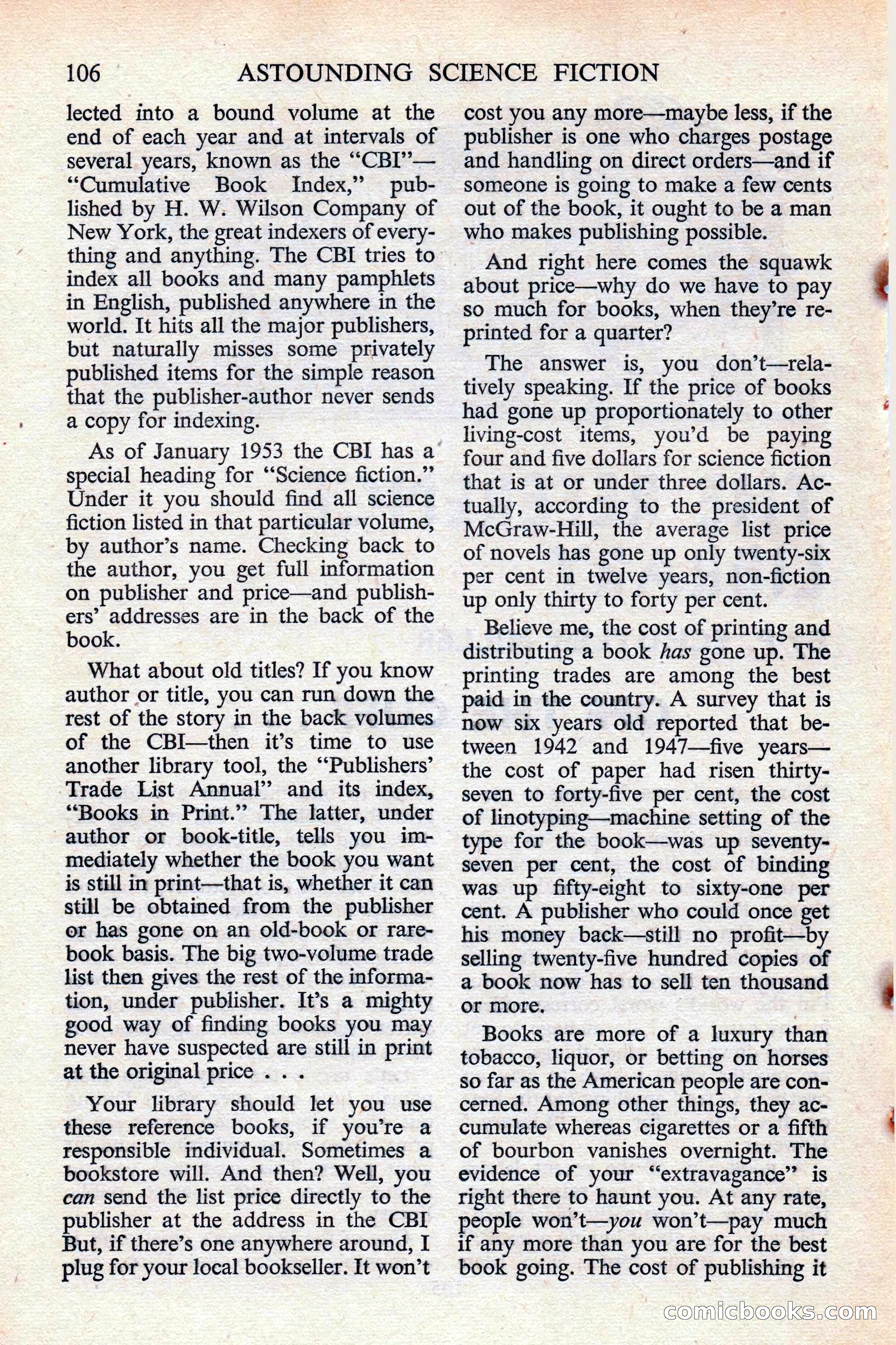
A restored page from Pulp Fiction, 1954. Page through the whole issue in the reader above.
📄 Transcribed text from this page (OCR, searchable)
Machine-transcribed from the original scan — historical spelling and the odd misread are preserved.
106 lected into a bound volume at the end of each year and at intervals of several years, known as the “CBI”’— “Cumulative Book Index,” pub- lished by H. W. Wilson Company of New York, the great indexers of every- thing and anything. The CBI tries to’ index all books and many pamphlets in English, published anywhere in the world. It hits all the major publishers, but naturally misses some privately published items for the simple reason that the publisher-author never sends a copy for indexing. As of January 1953 the CBI has a’ special heading for “Science fiction.” Under it you should find all science fiction listed in that particular volume, by author’s name. Checking back to the author, you get full information on publisher and price—and publish- ers’ addresses are in the back of the book. What about old titles? If you know author or title, you can run down the rest of the story in the back volumes of the CBI—then it’s time to use another library tool, the ‘‘Publishers’ Trade List Annual” and its index, “Books in Print.’’ The latter, under author or book-title, tells you im- mediately whether the book you want is still in print—that is, whether it can still be obtained from the publisher or has gone on an old-book or rare- book basis. The big two-volume trade list then gives the rest of the informa- tion, under publisher. It’s a mighty good way of finding books you may never have suspected are still in print at the original price .. . Your library should let you use these reference books, if you’re a responsible individual. Sometimes a bookstore will. And then? Well, you can send the list price directly to the publisher at the address in the CBI But, if there’s one anywhere around, I plug for your local bookseller. It won’t ASTOUNDING SCIENCE FICTION cost you any more—maybe less, if the publisher is one who charges postage and handling on direct orders—and if someone is going to make a few cents out of the book, it ought to be a man who makes publishing possible. And right here comes the squawk about price—why do we have to pay so much for books, when they’re re- printed for a quarter? The answer is, you don’t—rela- tively speaking. If the price of books had gone up proportionately to other living-cost items, you’d be paying four and five dollars for science fiction that is at or under three dollars. Ac- tually, according to the president of McGraw-Hill, the average list price of novels has gone up only twenty-six per cent in twelve years, non-fiction up only thirty to forty per cent. Believe me, the cost of printing and distributing a book has gone up. The printing trades are among the best paid in the country. A survey that is now six years old reported that be- tween 1942 and 1947—five years— the cost of paper had risen thirty- seven to forty-five per cent, the cost of linotyping—machine setting of the type for the book—was up seventy- seven per cent, the cost of binding was up fifty-eight to sixty-one per cent. A publisher who could once get his money back—still no profit—by selling twenty-five hundred copies of a book now has to sell ten thousand or more. . Books are more of a luxury than tobacco, liquor, or betting on horses so far as the American people are con- cerned. Among other things, they ac- cumulate whereas cigarettes or a fifth of bourbon vanishes overnight. The evidence of your “‘extravagance”’ is right there to haunt you. At any rate, people won’t—you won’t—pay much if any more than you are for the best book going. The cost of publishing it Connicloooks.c© nA