
Pulp Fiction, 1953 · page 9 of 132
Astounding Science Fiction, British Edition — page 9: what you’re looking at
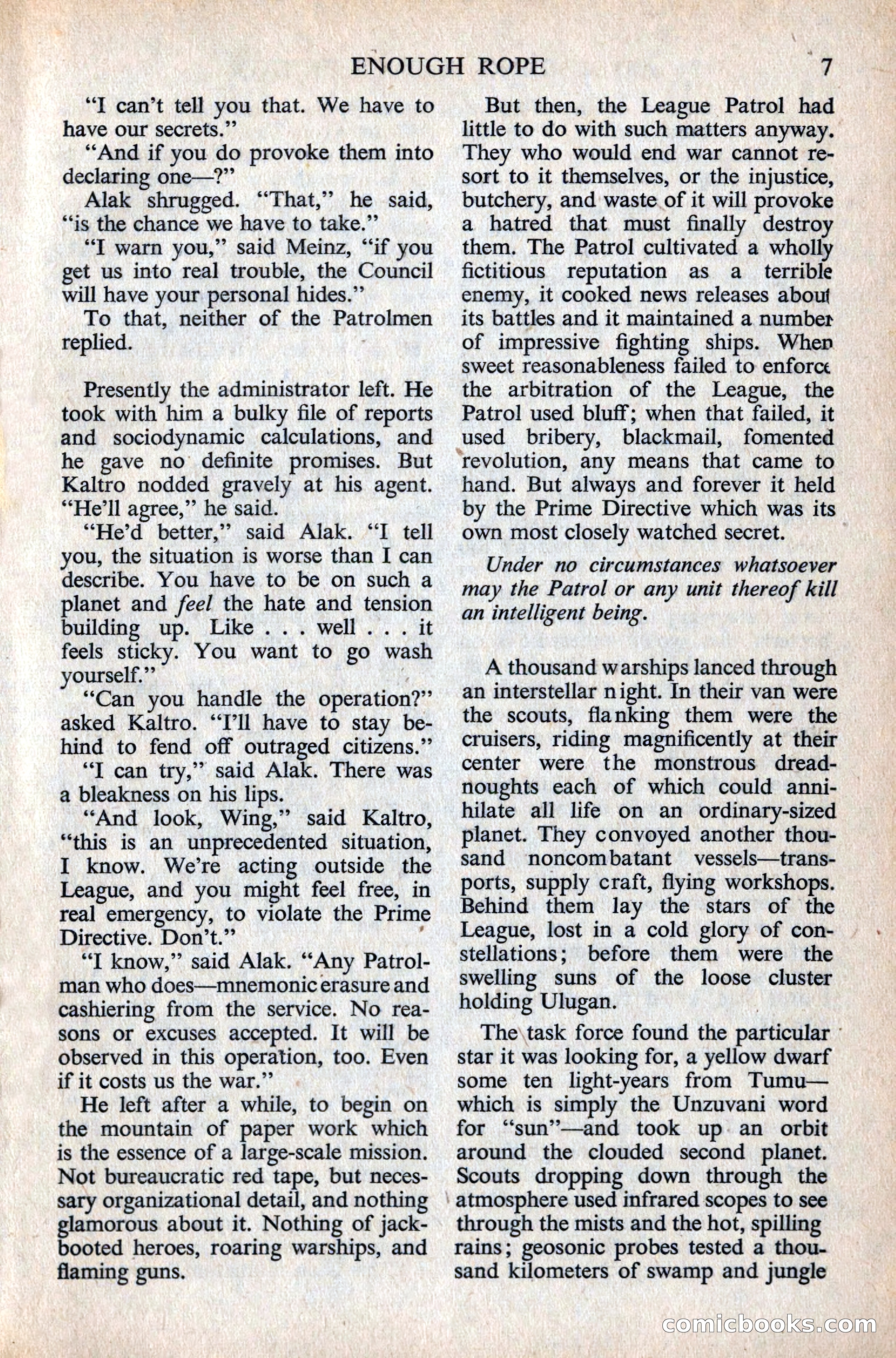
A restored page from Pulp Fiction, 1953. Page through the whole issue in the reader above.
📄 Transcribed text from this page (OCR, searchable)
Machine-transcribed from the original scan — historical spelling and the odd misread are preserved.
ENOUGH ROPE oa “T can’t tell you that. We have to have our secrets.” “And if you do provoke them into declaring one—?” Alak shrugged. “That,” he said, “is the chance we have to take.” “IT warn you,” said Meinz, “if you get us into real trouble, the Council will have your personal hides.” To that, neither of the Patrolmen replied. Presently the administrator left. He took with him a bulky file of reports and sociodynamic calculations, and he gave no definite promises. But Kaltro nodded gravely at his agent. “He'll agree,” he said. *‘He’d better,’’ said Alak. “I tell you, the situation is worse than I can describe. You have to be on such a planet and feel the hate and tension building up. Like... well... it feels sticky. You want to go wash yourself.” “Can you handle the operation?” asked Kaltro. “Tl have to stay be- hind to fend off outraged citizens.” “T can try,” said Alak. There was a bleakness on his lips. “And look, Wing,” said Kaltro, “this is an unprecedented situation, I know. We're acting outside the League, and you might feel free, in real emergency, to violate the Prime Directive. Don’t.” “I know,” said Alak. “Any Patrol- man who does—mnemonic erasure and cashiering from the service. No rea- sons or excuses accepted. It will be observed in this operation, too. Even if it costs us the war.” He left after a while, to begin on the mountain of paper work which is the essence of a large-scale mission. Not bureaucratic red tape, but neces- sary organizational detail, and nothing glamorous about it. Nothing of jack- booted heroes, roaring warships, and flaming guns. But then, the League Patrol had little to do with such matters anyway. They who would end war cannot re- sort to it themselves, or the injustice, butchery, and waste of it will provoke a hatred that must finally destroy them. The Patrol cultivated a wholly fictitious reputation as a_ terrible enemy, it cooked news releases about its battles and it maintained a number of impressive fighting ships. When sweet reasonableness failed to enforce the arbitration of the League, the Patrol used bluff; when that failed, it used bribery, blackmail, fomented ‘revolution, any means that came to hand. But always and forever it held by the Prime Directive which was its own most closely watched secret. Under no circumstances whatsoever may the Patrol or any unit thereof kill an intelligent being. A thousand warships lanced through an interstellar night. In their van were the scouts, flanking them were the cruisers, riding magnificently at their center were the monstrous dread- noughts each of which could anni- hilate all life on an ordinary-sized planet. They convoyed another thou- sand noncombatant vessels—trans- ports, supply craft, flying workshops. Behind them lay the stars of the League, lost in a cold glory of con- stellations; before them were the swelling suns of the loose cluster holding Ulugan. The\task force found the particular star it was looking for, a yellow dwarf some ten light-years from Tumu— which is simply the Unzuvani word for “sun’—and took up. an orbit around the clouded second planet. Scouts dropping down through the ‘atmosphere used infrared scopes to see through the mists and the hot, spilling rains; geosonic probes tested a thou- sand kilometers of swamp and jungle COMiGdooksico im