
Pulp Fiction, 1953 · page 8 of 132
Astounding Science Fiction, British Edition — page 8: what you’re looking at
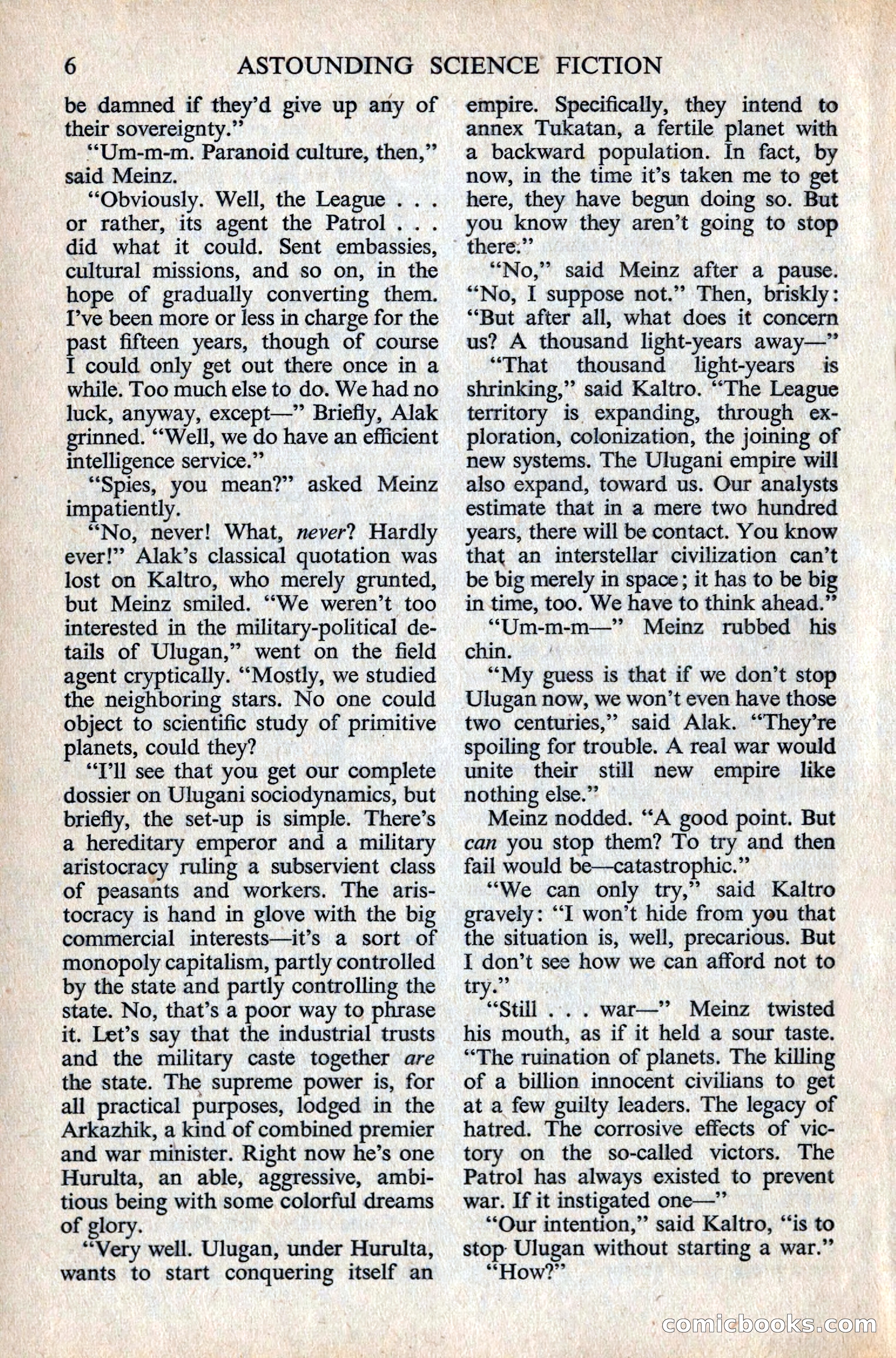
A restored page from Pulp Fiction, 1953. Page through the whole issue in the reader above.
📄 Transcribed text from this page (OCR, searchable)
Machine-transcribed from the original scan — historical spelling and the odd misread are preserved.
6 ASTOUNDING SCIENCE FICTION be damned if they’d give up any of their sovereignty.” *“Um-m-m. Paranoid culture, then,”’ said Meinz. “Obviously. Well, the League... or rather, its agent the Patrol... did what it could. Sent embassies, cultural missions, and so on, in the hope of gradually converting them. I’ve been more or less in charge for the past fifteen years, though of course I could only get out there once in a while. Too much else to do. We had no luck, anyway, except—” Briefly, Alak grinned. ““Well, we do have an efficient intelligence service.” “Spies, you mean?” asked Meinz impatiently. “No, never! What, never? Hardly ever!” Alak’s classical quotation was lost on Kaltro, who merely grunted, but Meinz smiled. ““We weren’t too interested in the military-political de- tails of Ulugan,” went on the field agent cryptically. ““Mostly, we studied the neighboring stars. No one could object to scientific study of primitive planets, could they? “T’ll see that you get our complete dossier on Ulugani sociodynamics, but briefly, the set-up is simple. There’s a hereditary emperor and a military aristocracy ruling a subservient class of peasants and workers. The aris- tocracy is hand in glove with the big commercial interests—it’s a sort of monopoly capitalism, partly controlled by the state and partly controlling the state. No, that’s a poor way to phrase it. Let’s say that the industrial trusts and the military caste together are the state. The supreme power is, for all practical purposes, lodged in the Arkazhik, a kind of combined premier and war minister. Right now he’s one Hurulta, an able, aggressive, ambi- tious being with some colorful dreams of glory. “Very well. Ulugan, under Hurulta, wants to start conquering itself an empire. Specifically, they intend to annex Tukatan, a fertile planet with a backward population. In fact, by now, in the time it’s taken me to get here, they have begun doing so. But you know they aren’t going to stop there:”’ “No,” said Meinz after a pause. “No, I suppose not.” Then, briskly: “But after all, what does it concern us? A thousand light-years away—” “That thousand light-years is shrinking,” said Kaltro. “The Lea territory is expanding, through ex- ploration, colonization, the joining of new systems. The Ulugani empire will also expand, toward us. Our analysts estimate that in a mere two hundred years, there will be contact. You know that an interstellar civilization can’t be big merely in space; it has to be big in time, too. We have to think ahead.” | Omens" Meinz rubbed his chin. “My guess is that if we don’t stop Ulugan now, we won’t even have those two centuries,” said Alak. “They’re spoiling for trouble. A real war would unite their still new empire like nothing else.” | Meinz nodded. “A good point. But can you stop them? To try and then fail would be—catastrophic.” “We can only try,” said Kaltro gravely: “I won’t hide from you that the situation is, well, precarious. But I don’t see how we can afford not to try.” Stil .. . war—”’ Meinz twisted his mouth, as if it held a sour taste. “The ruination of planets. The killing of a billion innocent civilians to get at a few guilty leaders. The legacy of hatred. The corrosive effects of vic- tory on the so-called victors. The Patrol has always existed to prevent war. If it instigated one—” “Our intention,” said Kaltro, “‘is to stop: Ulugan without starting a war.” “HH ow?’’ ACOMIGIOOKSHGO im