
Pulp Fiction, 1953 · page 128 of 132
Astounding Science Fiction, British Edition — page 128: what you’re looking at
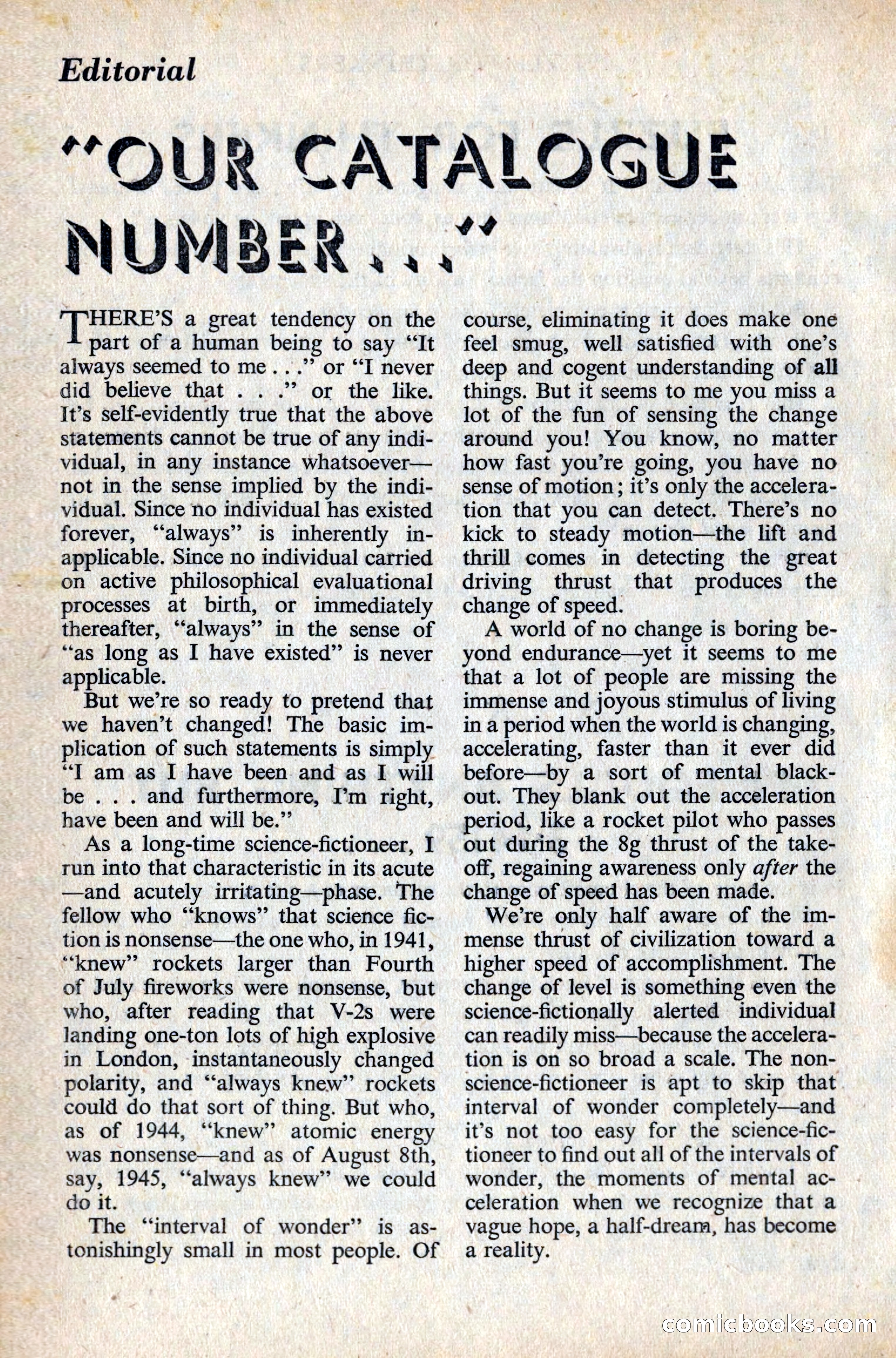
A restored page from Pulp Fiction, 1953. Page through the whole issue in the reader above.
📄 Transcribed text from this page (OCR, searchable)
Machine-transcribed from the original scan — historical spelling and the odd misread are preserved.
Editorial “OUR CATALOGUE NUMBER...” A We ce S a great tendency on the part of a human being to say “It always seemed to me. or “I never did believe that . . ° or the like. It’s self-evidently true that the above statements cannot be true of any indi- vidual, in any instance whatsoever— not in the sense implied by the indi- vidual. Since no individual has existed forever, “always” is inherently in- applicable. Since no individual carried on active philosophical evaluational processes at birth, or immediately thereafter, “always” in the sense of - “as long as I have existed’ is never applicable. But we’re so ready to pretend that we haven’t changed! The basic im- plication of such statements is simply “IT am as I have been and as I will be . . . and furthermore, I’m right, have been and will be.”’ _ As a long-time science-fictioneer, I run into that characteristic in its acute —and acutely irritating—phase. The fellow who “knows’’ that science fic- tion is nonsense—the one who, in 1941, “knew” rockets larger than Fourth of July fireworks were nonsense, but who, after reading that V-2s were landing one-ton lots of high explosive in London, instantaneously changed polarity, and “‘always knew’’ rockets could do that sort of thing. But who, as of 1944, “knew” atomic energy was nonsense—and as of August 8th, say, 1945, “always knew’ we could do it. The “interval of wonder” is as- tonishingly small in most people. Of course, eliminating it does make one feel smug, well satisfied with one’s deep and cogent understanding of all things. But it seems to me you miss a lot of the fun of sensing the change around you! You know, no matter how fast you’re going, you have no sense of motion; it’s only the accelera- tion that you can detect. There’s no kick to steady motion—the lift and thrill comes in detecting the great driving thrust that produces the change of speed. A world of no change is boring be- yond endurance—yet it seems to me that a lot of people are missing the immense and joyous stimulus of living in a period when the world is changing, accelerating, faster than it ever did before—by a sort of mental black- out. They blank out the acceleration period, like a rocket pilot who passes out during the 8g thrust of the take- off, regaining awareness only after the change of speed has been made. We're only half aware of the im- mense thrust of civilization toward a higher speed of accomplishment. The change of level is something even the science-fictionally alerted individual can readily miss—because the accelera- tion is on so broad a scale. The non- science-fictioneer is apt to skip that interval of wonder completely—and it’s not too easy for the science-fic- tioneer to find out all of the intervals of wonder, the moments of mental ac- celeration when we recognize that a vague hope, a half-dream, has become a reality. COMIC OOKS36O iim