
Pulp Fiction, 1953 · page 129 of 132
Astounding Science Fiction, British Edition — page 129: what you’re looking at
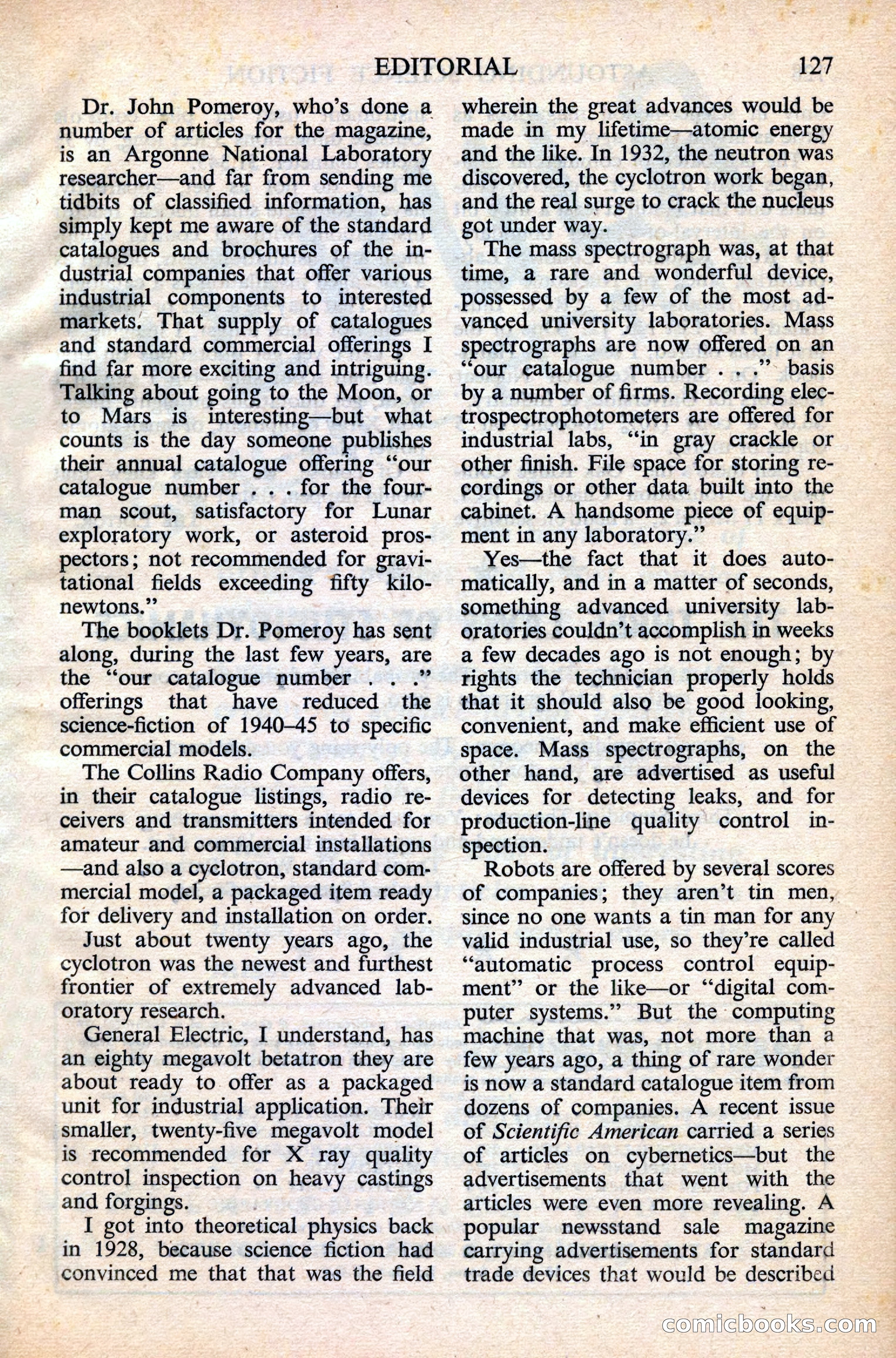
A restored page from Pulp Fiction, 1953. Page through the whole issue in the reader above.
📄 Transcribed text from this page (OCR, searchable)
Machine-transcribed from the original scan — historical spelling and the odd misread are preserved.
EDITORIAL Dr. John Pomeroy, who’s done a number of articles for the magazine, is an Argonne National Laboratory researcher—and far from sending me tidbits of classified information, has simply kept me aware of the standard catalogues and brochures of the in- dustrial companies that offer various industrial components to interested markets. That supply of catalogues and standard commercial offerings I find far more exciting and intriguing. Talking about going to the Moon, or to Mars is interesting—but what counts is the day someone publishes their annual catalogue offering “our catalogue number . . . for the four- man scout, satisfactory for Lunar exploratory work, or asteroid pros- pectors; not recommended for gravi- tational fields exceeding fifty kilo- newtons.”’ The booklets Dr. Pomeroy has sent along, during the last few years, are the “our catalogue number .. .” offerings that have reduced the science-fiction of 1940-45 to specific commercial models. The Collins Radio Company offers, in their catalogue listings, radio re- ceivers and transmitters intended for amateur and commercial installations —and also a cyclotron, standard com- mercial model, a packaged item ready for delivery and installation on order. Just about twenty years ago, the cyclotron was the newest and furthest frontier of extremely advanced lab- oratory research. General Electric, I understand, has an eighty megavolt betatron they are about ready to offer as a packaged unit for industrial application. Their smaller, twenty-five megavolt model is recommended for X ray quality control inspection on heavy castings and forgings. 7 I got into theoretical physics back in 1928, because science fiction had convinced me that that was the field 127 wherein the great advances would be made in my lifetime—atomic energy and the like. In 1932, the neutron was discovered, the cyclotron work began, and the real surge to crack the nucleus got under way. The mass spectrograph was, at that time, a rare and wonderful device, possessed by a few of the most ad- vanced university laboratories. Mass spectrographs are now Offered on an “our catalogue number...” basis by a number of firms. Recording elec- trospectrophotometers are offered for industrial labs, “in gray crackle or other finish. File space for storing re- cordings or other data built into the cabinet. A handsome piece of equip- ment in any laboratory.” Yes—the fact that it does auto- matically, and in a matter of seconds, something advanced university lab- oratories couldn’t accomplish in weeks a few decades ago is not enough; by rights the technician properly holds that it should also be good looking, convenient, and make efficient use of space. Mass spectrographs, on the other hand, are advertised as useful devices for detecting leaks, and for production-line quality control in- spection. Robots are offered by several scores of companies; they aren’t tin men, since no one wants a tin man for any valid industrial use, so they’re called “automatic process control equip- ment” or the like—or “digital com- puter systems.” But the computing machine that was, not more than a few years ago, a thing of rare wonder is now a standard catalogue item from dozens of companies. A recent issue of Scientific American carried a series of articles on cybernetics—but the advertisements that went with the articles were even more revealing. A popular newsstand sale magazine carrying advertisements for standard trade devices that would be described Conmicloooks.€c© m