
Pulp Fiction, 1953 · page 127 of 132
Astounding Science Fiction, British Edition — page 127: what you’re looking at
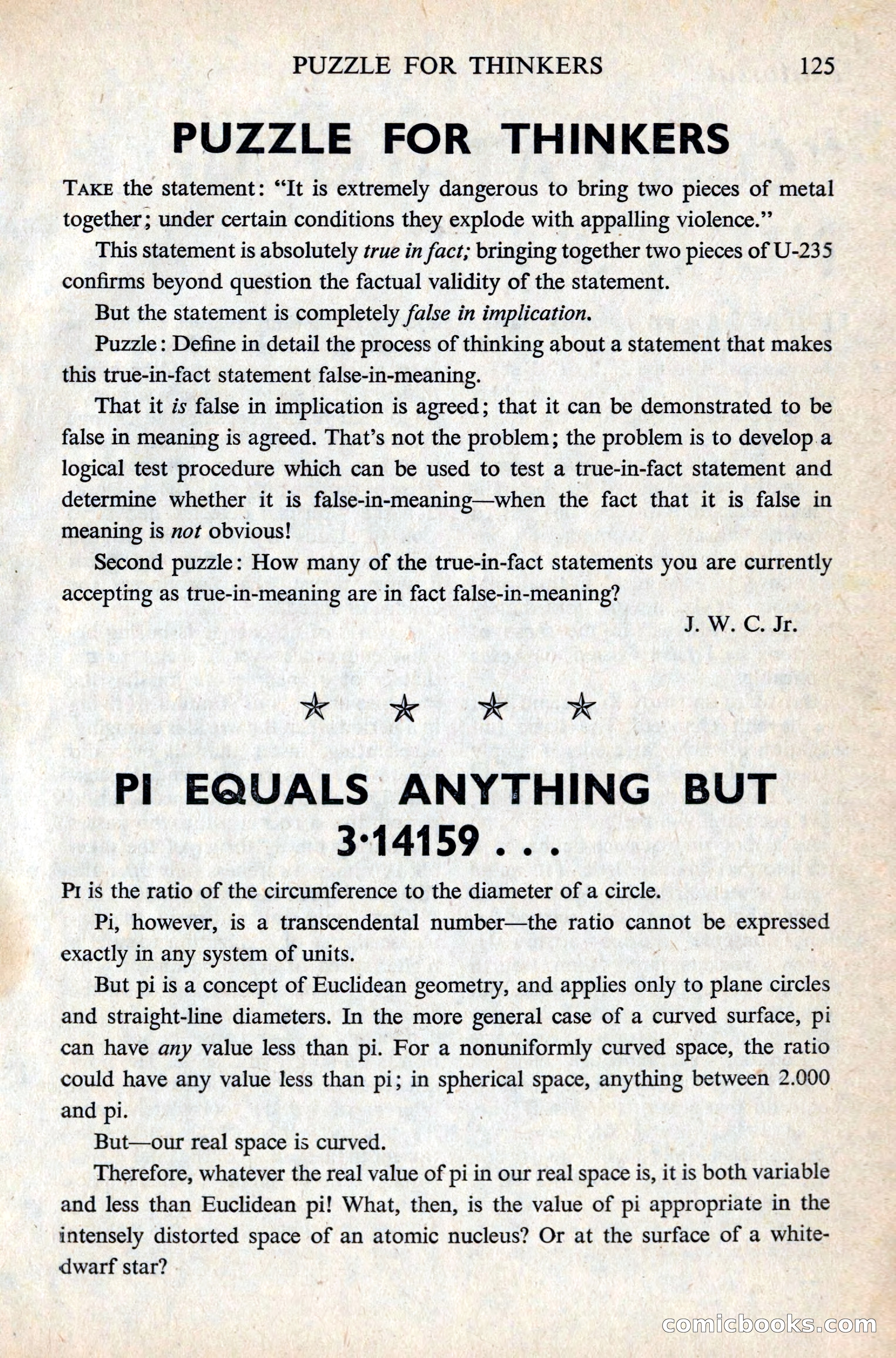
A restored page from Pulp Fiction, 1953. Page through the whole issue in the reader above.
📄 Transcribed text from this page (OCR, searchable)
Machine-transcribed from the original scan — historical spelling and the odd misread are preserved.
PUZZLE FOR THINKERS 125 PUZZLE FOR THINKERS TAKE the statement: “It is extremely dangerous to bring two pieces of metal together; under certain conditions they explode with appalling violence.” This statement is absolutely true in fact; bringing together two pieces of U-235 confirms beyond question the factual validity of the statement. But the statement is completely false in implication. Puzzle: Define in detail the process of thinking about a statement that makes this true-in-fact statement false-in-meaning. That it is false in implication is agreed; that it can be demonstrated to be false in meaning is agreed. That’s not the problem; the problem is to develop.a logical test procedure which can be used to test a true-in-fact statement and determine whether it is false-in-meaning—when the fact that it is false in meaning is not obvious! Second puzzle: How many of the true-in- fact statements you are currently accepting as true-in-meaning are in fact false-in-meaning? J. W. C. Jr. ete OR Pi EQUALS ANYTHING BUT 3°14159... Pi is the ratio of the circumference to the diameter of a circle. Pi, however, is a transcendental number—the ratio cannot be ee iy 2 exactly in any system of units. 3 But pi is a concept of Euclidean geometry, and applies only to plane circles and straight-line diameters. In the more general case of a curved surface, pi can have any value less than pi. For a nonuniformly curved space, the ratio could have any value less than pi; in spherical space, anything between 2.000 and pi. But—our real space is curved. Therefore, whatever the real value of pi in our real space is, it is both variable and less than Euclidean pi! What, then, is the value of pi appropriate in the intensely distorted space of an atomic nucleus? Or at the surface of a white- dwarf star? Cconniicloookks.c© im