
Pulp Fiction, 1953 · page 89 of 132
Astounding Science Fiction, British Edition — page 89: what you’re looking at
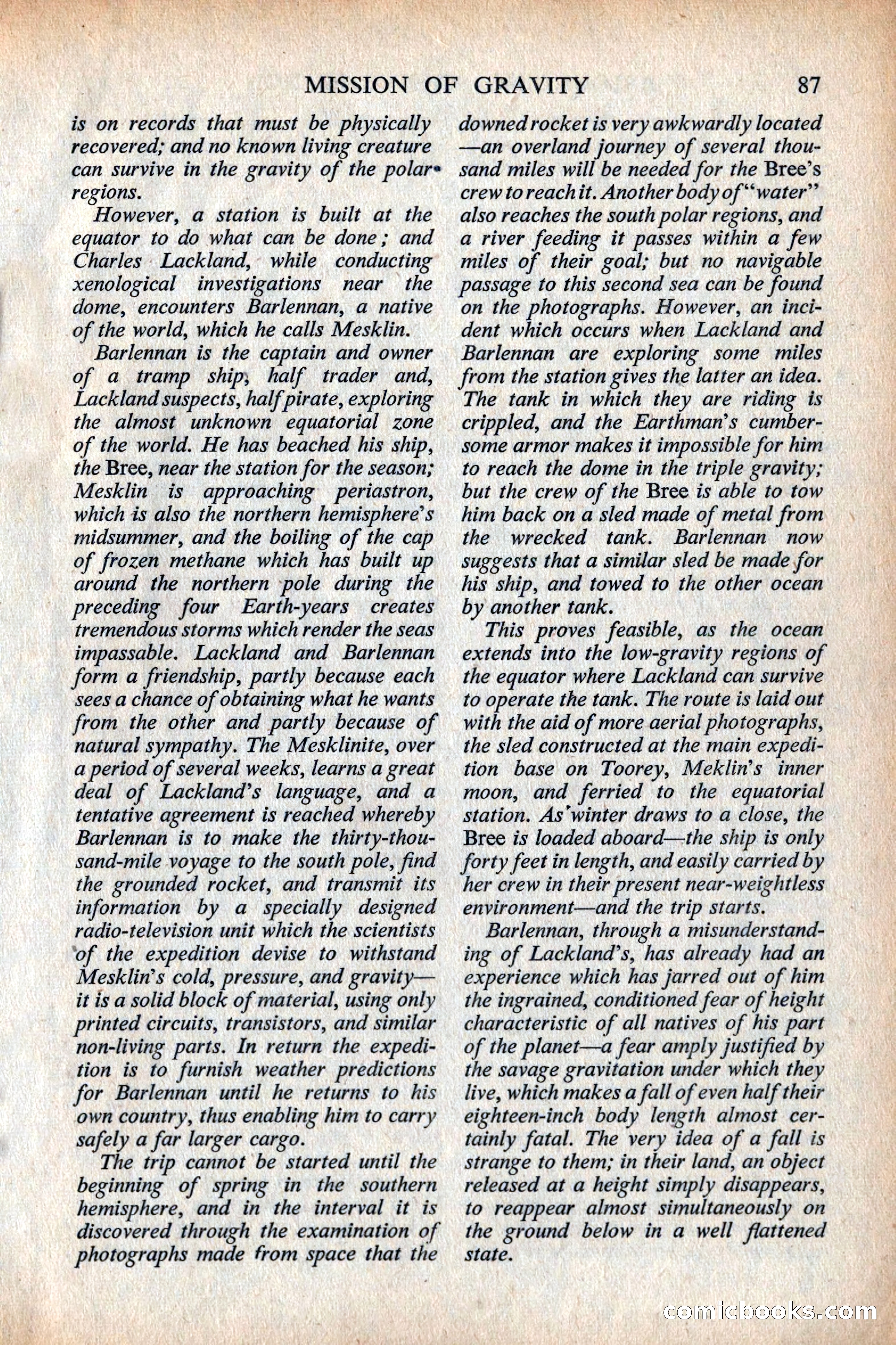
A restored page from Pulp Fiction, 1953. Page through the whole issue in the reader above.
📄 Transcribed text from this page (OCR, searchable)
Machine-transcribed from the original scan — historical spelling and the odd misread are preserved.
MISSION OF GRAVITY 87 is on records that must be physically recovered; and no known living creature can survive in the gravity of the polar regions. However, a station is built at the equator to do what can be done; and Charles Lackland, while conducting xenological investigations near the dome, encounters Barlennan, a native of the world, which he calls Mesklin. Barlennan is the captain and owner of a tramp ship; half trader and, Lackland suspects, half pirate, exploring the almost unknown equatorial zone of the world. He has beached his ship, the Bree, near the station for the season; Mesklin is approaching periastron, which is also the northern hemisphere’s midsummer, and the boiling of the cap of frozen methane which has built up around the northern pole during the preceding four Earth-years creates tremendous storms which render the seas impassable. Lackland and Barlennan form a friendship, partly because each sees a chance of obtaining what he wants from the other and partly because of natural sympathy. The Mesklinite, over a period of several weeks, learns a great deal of Lackland’s language, and a tentative agreement is reached whereby Barlennan is to make the thirty-thou- sand-mile voyage to the south pole, find the grounded rocket, and transmit its information by a specially designed radio-television unit which the scientists ‘of the expedition devise to withstand Mesklin’s cold, pressure, and gravity— it is a solid block of material, using only printed circuits, transistors, and similar non-living parts. In return the expedi- tion is to furnish weather predictions for Barlennan until he returns to his own country, thus enabling him to carry safely a far larger cargo. The trip cannot be started until the beginning of spring in the southern hemisphere, and in the interval it is discovered through the examination of photographs made from space that the downed rocket is very awkwardly located —an overland journey of several thou- sand miles will be needed for the Bree’s crew toreachit. Another body of “water” also reaches the south polar regions, and a river feeding it passes within a few miles of their goal; but no navigable passage to this second sea can be found on the photographs. However, an inci- dent which occurs when Lackland and Barlennan are exploring some miles from the station gives the latter an idea. The tank in which they are riding is crippled, and the Earthman’s cumber- some armor makes it impossible for him to reach the dome in the triple gravity; but the crew of the Bree is able to tow him back on a sled made of metal from the wrecked tank. Barlennan now suggests that a similar sled be made for his ship, and towed to the other ocean by another tank. This proves feasible, as the ocean extends into the low-gravity regions of the equator where Lackland can survive to operate the tank. The route is laid out with the aid of more aerial photographs, the sled constructed at the main expedi- tion base on Toorey, Meklin’s inner moon, and ferried to the equatorial station. As'winter draws to a close, the Bree is loaded aboard—the ship is only forty feet in length, and easily carried by her crew in their present near-weightless environment—and the trip starts. Barlennan, through a misunderstand- ing of Lackland’s, has already had an experience which has jarred out of him the ingrained, conditioned fear of height characteristic of all natives of his part of the planet—a fear amply justified by the savage gravitation under which they live, which makes a fall of even half their eighteen-inch body length almost cer- tainly fatal. The very idea of a fall is strange to them; in their land, an object released at a height simply disappears, to reappear almost simultaneously on the ground below in a well flattened state. ee Arr CoOMmiIcoookstcom