
Pulp Fiction, 1953 · page 88 of 132
Astounding Science Fiction, British Edition — page 88: what you’re looking at
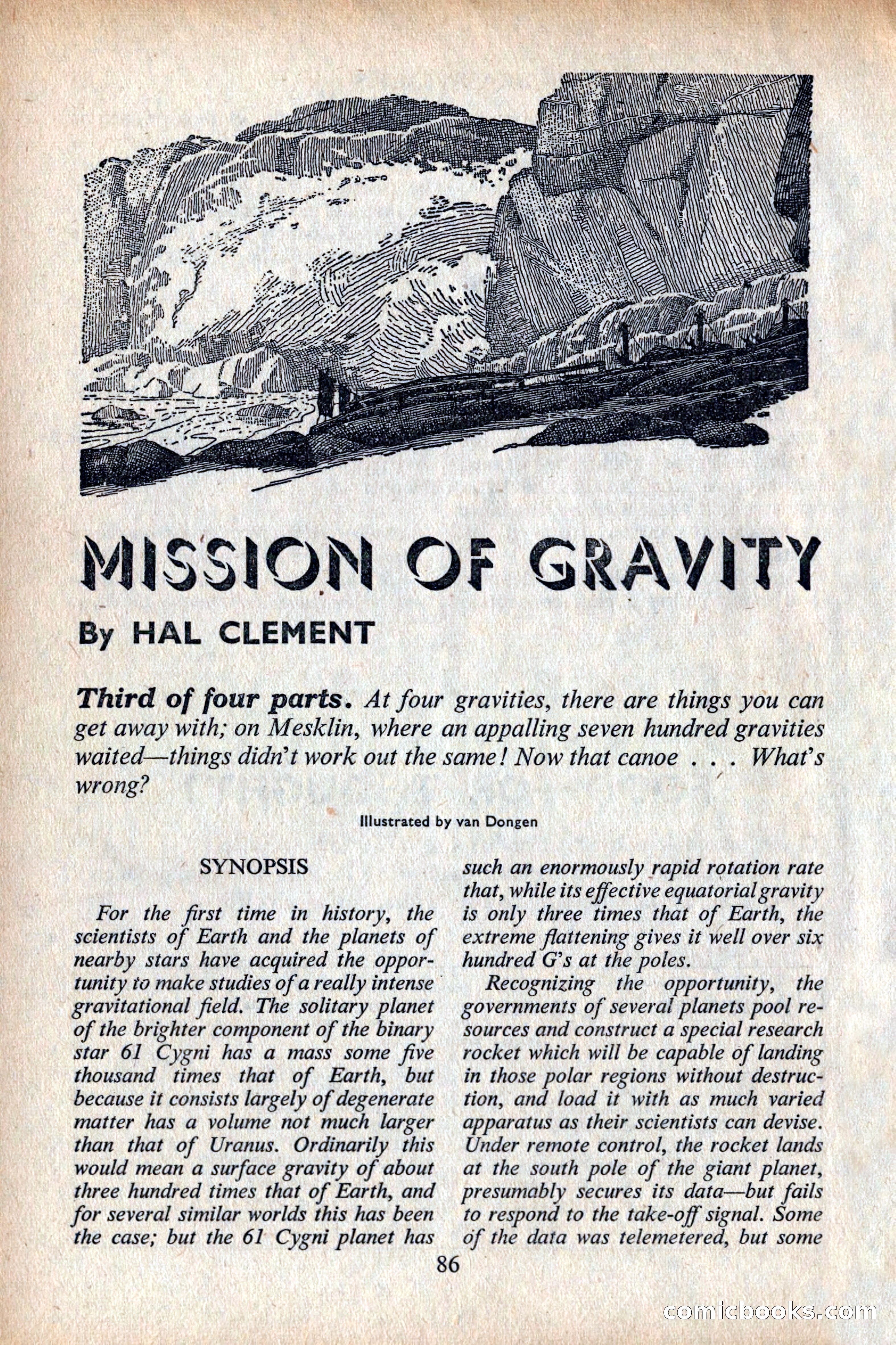
A restored page from Pulp Fiction, 1953. Page through the whole issue in the reader above.
📄 Transcribed text from this page (OCR, searchable)
Machine-transcribed from the original scan — historical spelling and the odd misread are preserved.
‘Bh ; : Ma wut bal ac, \) \\ —-—- — >= “ee he ey ee DS ee. VEET® 2. Sa A ees oe > OER ie OO fy aE ibe . vs eee eds is “ * Peer Se) Het EY: 4% AV 2) MISSION OF GRAVITY By HAL CLEMENT Third of four parts. At four gravities, there are things you can get away with; on Mesklin, where an appalling seven hundred gravities waited—things didn’t work out the same! Now that canoe... What's wrong? / Illustrated by van Dongen SYNOPSIS For the first time in history, the scientists of Earth and the planets of nearby stars have acquired the oppor- tunity to make studies of a really intense gravitational field. The solitary planet of the brighter component of the binary star 61 Cygni has a mass some five thousand times that of Earth, but because it consists largely of degenerate matter has a volume not much larger than that of Uranus. Ordinarily this would mean a surface gravity of about three hundred times that of Earth, and for several similar worlds this has been the case; but the 61 Cygni planet has 86 such an enormously rapid rotation rate that, while its effective equatorial gravity is only three times that of Earth, the extreme flattening gives it well over six hundred G’s at the poles. Recognizing the opportunity, the governments of several planets pool re- sources and construct a special research rocket which will be capable of landing in those polar regions without destruc- tion, and load it with as much varied apparatus as their scientists can devise. Under remote control, the rocket lands at the south pole of the giant planet, presumably secures its data—but fails to respond to the take-off signal. Some of the data was telemetered, but some CoOnniclaooks % ; ’ com