
Pulp Fiction, 1953 · page 90 of 132
Astounding Science Fiction, British Edition — page 90: what you’re looking at
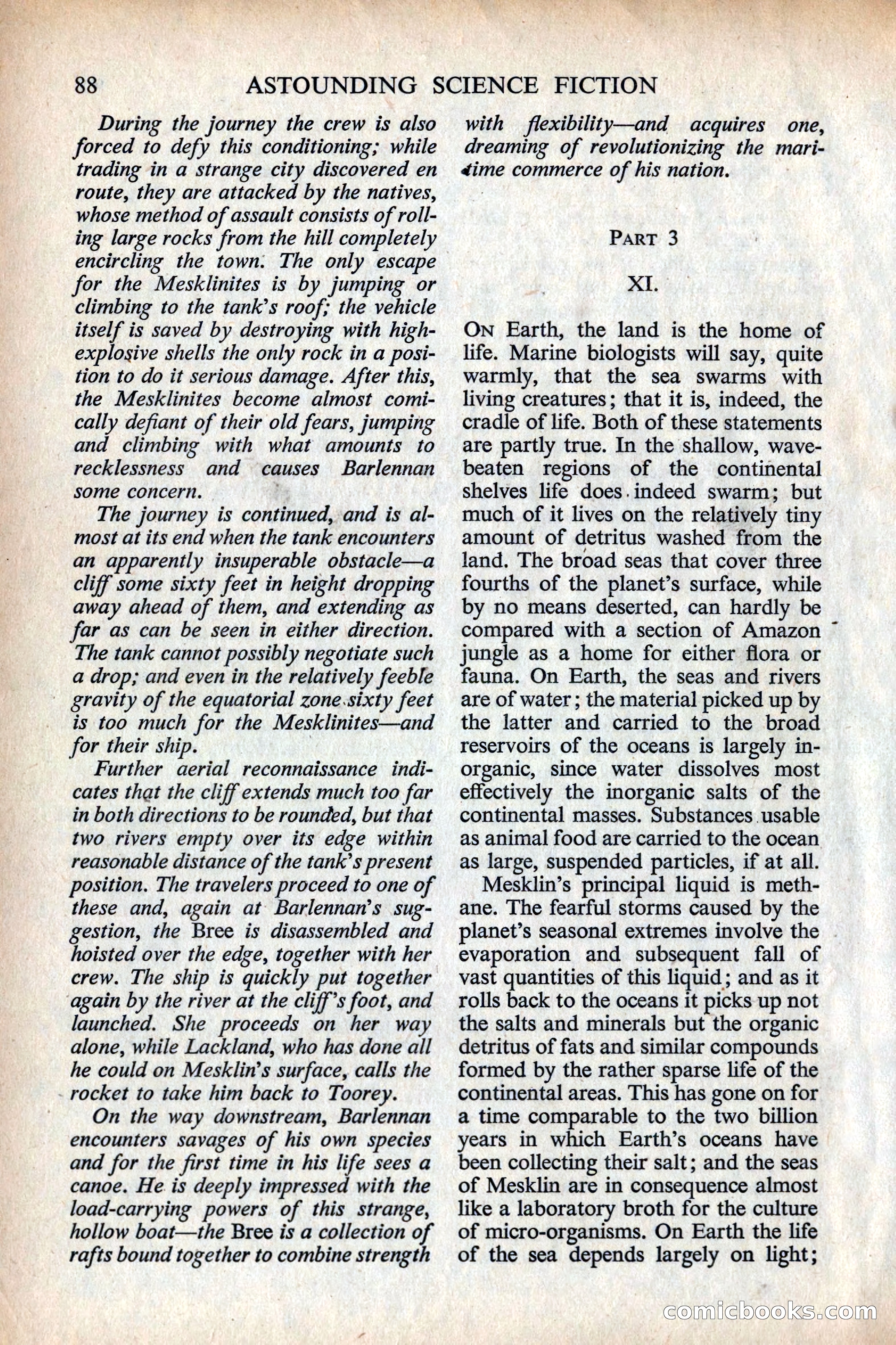
A restored page from Pulp Fiction, 1953. Page through the whole issue in the reader above.
📄 Transcribed text from this page (OCR, searchable)
Machine-transcribed from the original scan — historical spelling and the odd misread are preserved.
88 During the journey the crew is also forced to defy this conditioning; while trading in a strange city discovered en route, they are attacked by the natives, whose method of assault consists of roll- ing large rocks from the hill completely encircling the town. The only escape for the Mesklinites is by jumping or climbing to the tank’s roof; the vehicle itself is saved by destroying with high- explosive shells the only rock in a posi- tion to do it serious damage. After this, the Mesklinites become almost comi- cally defiant of their old fears, jumping and climbing with what amounts to recklessness and causes Barlennan some concern. The journey is continued, and is al- most at its end when the tank encounters an apparently insuperable obstacle—a cliff some sixty feet in height dropping away ahead of them, and extending as far as can be seen in either direction. The tank cannot possibly negotiate such a drop; and even in the relatively feeble | gravity of the equatorial zone.sixty feet is too much for the Mesklinites—and for their ship. | Further aerial reconnaissance indi- cates that the cliff extends much too far in both directions to be rounded, but that two rivers empty over its edge within reasonable distance of the tank’s present position. The travelers proceed to one of these and, again at Barlennan’s sug- gestion, the Bree is disassembled and hoisted over the edge, together with her crew. The ship is quickly put together again by the river at the cliff’s foot, and launched. She proceeds on her way alone, while Lackland, who has done all he could on Mesklin’s surface, calls the rocket to take him back to Toorey. On the way downstream, Barlennan encounters savages of his own species and for the first time in his life sees a canoe. He is deeply impressed with the load-carrying powers of this strange, hollow boat—the Bree is a collection of rafts bound together to combine strength ASTOUNDING SCIENCE FICTION with flexibility—and acquires one, dreaming of revolutionizing the mari- ¢ime commerce of his nation. PART 3 XI. On Earth, the land is the home of life. Marine biologists will say, quite warmly, that the sea swarms with living creatures; that it is, indeed, the cradle of life. Both of these statements are partly true. In the shallow, wave- beaten regions of the continental Shelves life does.indeed swarm; but much of it lives on the relatively tiny amount of detritus washed from the land. The broad seas that cover three fourths of the planet’s surface, while by no means deserted, can hardly be compared with a section of Amazon ~ jungle as a home for either flora or fauna. On Earth, the seas and rivers are of water ; the material picked up by the latter and carried to the broad reservoirs of the oceans is largely in- organic, since water dissolves most effectively the inorganic salts of the continental masses. Substances usable as animal food are carried to the ocean as large, suspended particles, if at all. Mesklin’s principal liquid is meth- ane. The fearful storms caused by the planet’s seasonal extremes involve the evaporation and subsequent fall of vast quantities of this liquid; and as it rolls back to the oceans it picks up not the salts and minerals but the organic detritus of fats and similar compounds formed by the rather sparse life of the continental areas. This has gone on for a time comparable to the two billion years in which Earth’s oceans have been collecting their salt; and the seas of Mesklin are in consequence almost like a laboratory broth for the culture of micro-organisms. On Earth the life of the sea depends largely on light; Conniclooolkks com