
Pulp Fiction, 1953 · page 85 of 132
Astounding Science Fiction, British Edition — page 85: what you’re looking at
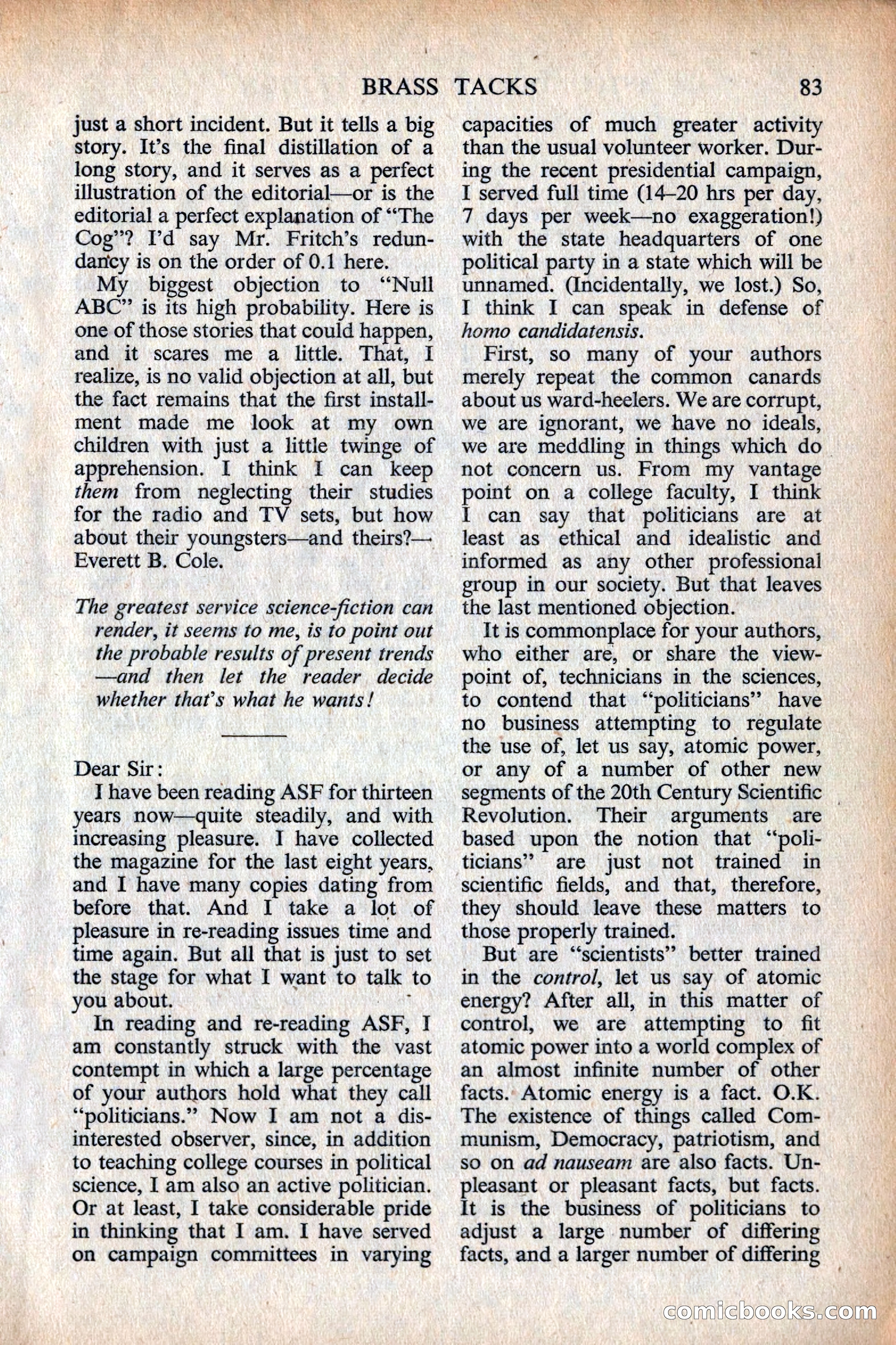
A restored page from Pulp Fiction, 1953. Page through the whole issue in the reader above.
📄 Transcribed text from this page (OCR, searchable)
Machine-transcribed from the original scan — historical spelling and the odd misread are preserved.
y. STS), ERIS LS On hus 77" +. Ue valrriy + BRASS TACKS just a short incident. But it tells a big story. It’s the final distillation of a long story, and it serves as a perfect illustration of the editorial—or is the editorial a perfect explanation of “The Cog’? I'd say Mr. Fritch’s redun- danicy is on the order of 0.1 here. My biggest objection to “Null ABC” is its high probability. Here is one of those stories that could happen, and it scares me a little. That, I realize, is no valid objection at all, but the fact remains that the first install- ment made me look at my own children with just a little twinge of apprehension. I think I can keep them from neglecting their studies for the radio and TV sets, but how about their youngsters—and theirs?— Everett B. Cole. The greatest service science-fiction can render, it seems to me, is to point out the probable results of present trends —and then let the reader decide whether that’s what he wants! Dear Sir: I have been reading ASF for thirteen years now—dquite steadily, and with increasing pleasure. I have collected the magazine for the last eight years, and I have many copies dating from before that. And I take a lot of pleasure in re-reading issues time and time again. But all that is just to set the stage for what I want to talk to you about. ‘ In reading and re-reading ASF, I am constantly struck with the vast contempt in which a large percentage of your authors hold what they call ““politicians.”” Now I am not a dis- interested observer, since, in addition to teaching college courses in political science, I am also an active politician. Or at least, I take considerable pride in thinking that I am. I have served on campaign committees in varying 83 capacities of much greater activity than the usual volunteer worker. Dur- ing the recent presidential campaign, I served full time (14-20 hrs per day, 7 days per week—no exaggeration!) with the state headquarters of one political party in a state which will be unnamed. (Incidentally, we lost.) So, I think I can speak in defense of homo candidatensis. First, so many of your authors merely repeat the common canards about us ward-heelers. We are corrupt, we are ignorant, we have no ideals, we are meddling in things which do_ not concern us. From my vantage point on a college faculty, I think I can say that politicians are at least as ethical and idealistic and informed as any other professional group in our society. But that leaves the last mentioned objection. It is commonplace for your authors, who either are, or share the view- point of, technicians in the sciences, to contend that ‘politicians’ have no business attempting to regulate the use of, let us say, atomic power, or any of a number of other new segments of the 20th Century Scientific . Revolution. Their arguments are based upon the notion that “‘poli- ticians’” are just not trained in scientific fields, and that, therefore, they should leave these matters to those properly trained. But are “‘scientists” better trained in the control, let us say of atomic energy? After all, in this matter of control, we are attempting to fit atomic power into a world complex of an almost infinite number of other facts. Atomic energy is a fact. O.K. The existence of things called Com- munism, Democracy, patriotism, and so on ad nauseam are also facts. Un- pleasant or pleasant facts, but facts. It is the business of politicians to adjust a large number of differing facts, and a larger number of differing COMMCOOLKS Eom >