
Pulp Fiction, 1953 · page 84 of 132
Astounding Science Fiction, British Edition — page 84: what you’re looking at
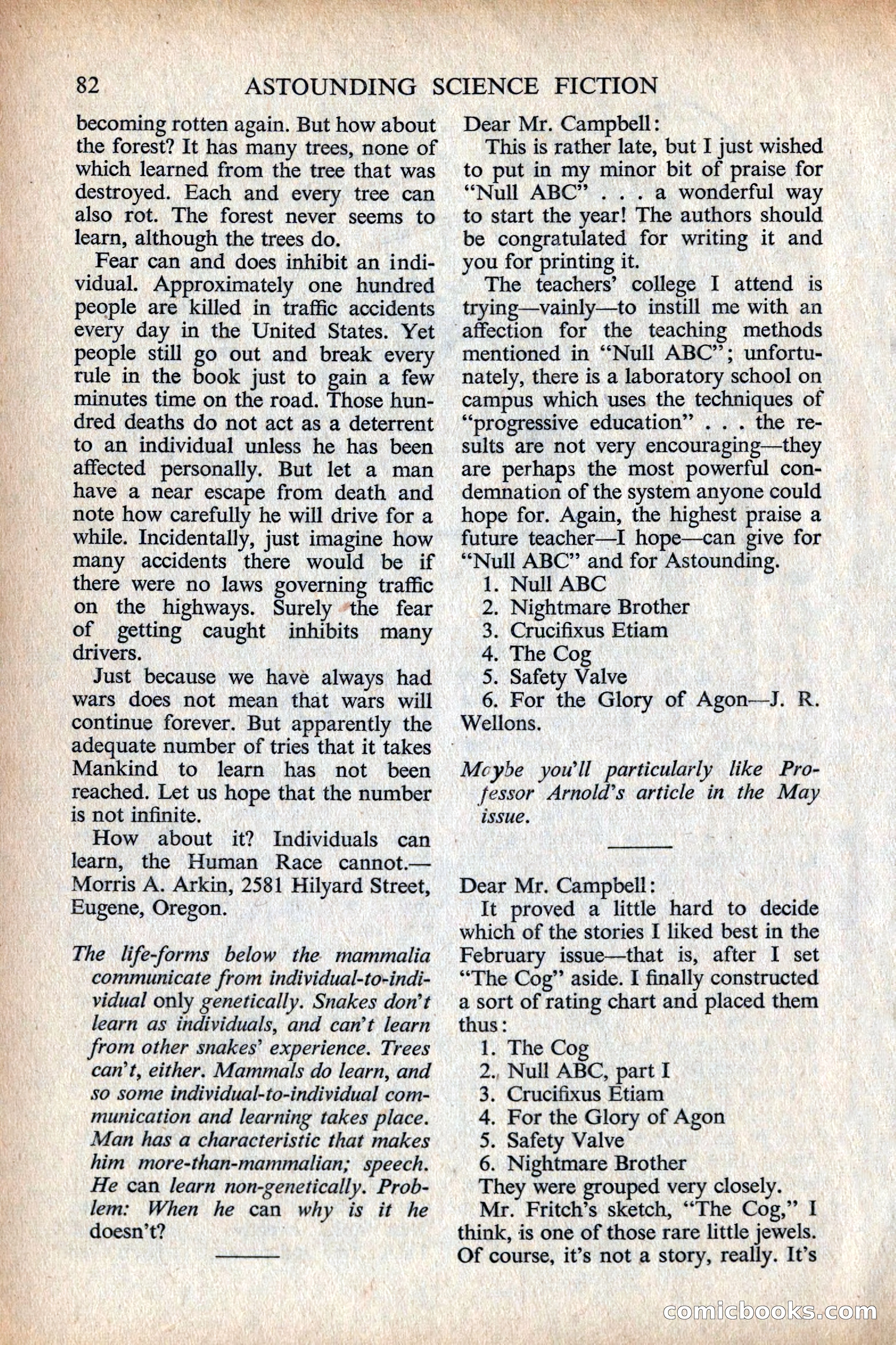
A restored page from Pulp Fiction, 1953. Page through the whole issue in the reader above.
📄 Transcribed text from this page (OCR, searchable)
Machine-transcribed from the original scan — historical spelling and the odd misread are preserved.
becoming rotten again. But how about the forest? It has many trees, none of which learned from the tree that was destroyed. Each and every tree can also rot. The forest never seems to learn, although the trees do. Fear can and does inhibit an indi- vidual. Approximately one hundred people are killed in traffic accidents every day in the United States. Yet people still go out and break every rule in the book just to gain a few minutes time on the road. Those hun- dred deaths do not act as a deterrent to an individual unless he has been affected personally, But let a man have a near escape from death and note how carefully he will drive for a while. Incidentally, just imagine how many accidents there would be if there were no laws governing traffic on the highways. Surely ‘the fear of getting caught inhibits many drivers. Just because we have always had wars does not mean that wars will continue forever. But apparently the adequate number of tries that it takes Mankind to learn has not been reached. Let us hope that the number is not infinite. How about it? Individuals can learn, the Human Race cannot.— Morris A. Arkin, 2581 Hilyard Street, Eugene, Oregon. The life-forms below the. mammalia communicate from individual-to-indi- vidual only genetically. Snakes don’t learn as individuals, and can’t learn from other snakes’ experience. Trees can’t, either. Mammals do learn, and so some individual-to-individual com- munication and learning takes place. Man has a characteristic that makes him more-than-mammalian; speech, He can learn non-genetically. Prob- lem: When he can why is it he doesn’t? es Via [PLeeen wee? RAL RAR, coc Fw piee ft 4 ne 82 ASTOUNDING SCIENCE FICTION Dear Mr. Campbell: This is rather late, but I just wished to put in my minor bit of praise for “Null ABC” ... a wonderful way to start the year! The authors should be congratulated for writing it and you for printing it. The teachers’ college I attend is trying—vainly—to instill me with an affection for the teaching methods mentioned in “‘Null ABC’; unfortu- nately, there is a laboratory school on campus which uses the techniques of “progressive education” .. . the re- sults are not very encouraging—they are perhaps the most powerful con- demnation of the system anyone could hope for. Again, the highest praise a future teacher—I hope—can give for “Null ABC” and for Astounding. . Null ABC . Nightmare Brother . Crucifixus Etiam . The Cog . Safety Valve . For the Glory of Agon—J. R. Anh wWwd Wellons. Mcybe you'll particularly like Pro- fessor Arnold’s article in the May issue. Dear Mr. Campbell: . It proved a little hard to decide which of the stories I liked best in the February issue—that is, after I set “The Cog” aside. I finally constructed a sort of rating chart and placed them thus : . The Cog . Null ABC, part I . Crucifixus Etiam . For the Glory of Agon . Safety Valve . Nightmare Brother They were grouped very closely. Mr. Fritch’s sketch, ““The Cog,” I think, is one of those rare little jewels. Of course, it’s not a story, really. It’s Nah WPS Connie ooolkks COLA