
Pulp Fiction, 1953 · page 86 of 132
Astounding Science Fiction, British Edition — page 86: what you’re looking at
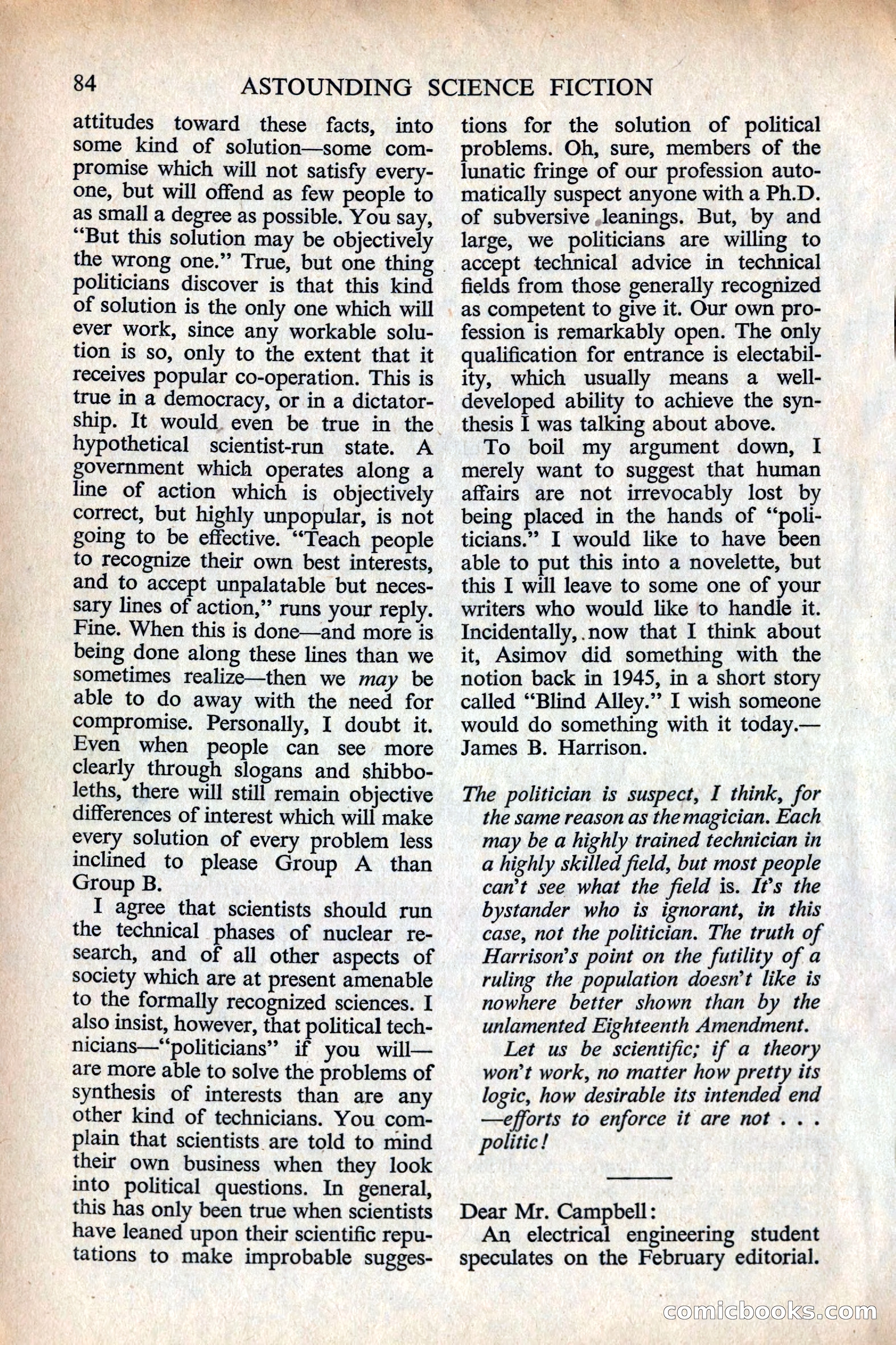
A restored page from Pulp Fiction, 1953. Page through the whole issue in the reader above.
📄 Transcribed text from this page (OCR, searchable)
Machine-transcribed from the original scan — historical spelling and the odd misread are preserved.
84 attitudes toward these facts, into some kind of solution—some com- promise which will not satisfy every- one, but will offend as few people to as small a degree as possible. You say, “But this solution may be objectively the wrong one.” True, but one thing politicians discover is that this kind of solution is the only one which will ever work, since any workable solu- tion is so, only to the extent that it Tecelves popular co-operation. This is true in a democracy, or in a dictator- ship. It would even be true in the. hypothetical scientist-run state. A government which operates along a line of action which is objectively correct, but highly unpopular, is not going to be effective. “Teach people to recognize their own best interests, and to accept unpalatable but neces- sary lines of action,” runs your reply. Fine. When this is done—and more is being done along these lines than we Sometimes realize—then we may be able to do away with the need for compromise. Personally, I doubt it. Even when people can see more clearly through slogans and shibbo- leths, there will still remain objective _ differences of interest which wili make every solution of every problem less inclined to please Group A_ than Group B. I agree that scientists should run the technical phases of nuclear re- search, and of all other aspects of society which are at present amenable to the formally recognized sciences. I also insist, however, that political tech- niclans—"“politicians” if you will— are more able to solve the problems of synthesis of interests than are any other kind of technicians. You com- plain that scientists are told to mind their own business when they look into political questions. In general, this has only been true when scientists have leaned upon their scientific repu- tations to make improbable sugges- ASTOUNDING SCIENCE FICTION tions for the solution of political problems. Oh, sure, members of the lunatic fringe of our profession auto- matically suspect anyone with a Ph.D. of subversive ,leanings. But, by and large, we politicians are willing to accept technical advice in technical fields from those generally recognized as competent to give it. Our own pro- fession is remarkably open. The only qualification for entrance is electabil- ity, which usually means a_ well- developed ability to achieve the syn- thesis I was talking about above. To boil my argument down, | merely want to suggest that human affairs are not irrevocably lost by being placed in the hands of “poli- ticians.” I would like to have been able to put this into a novelette, but this I will leave to some one of your writers who would like to handle it. Incidentally,.now that I think about it, Asimov did something with the notion back in 1945, in a short story called “Blind Alley.”’ I wish someone would do something with it today.— James B. Harrison. The politician is suspect, I think, for the same reason as the magician. Each may be a highly trained technician in a highly skilled field, but most people can’t see what the field is. It’s the bystander who is ignorant, in this case, not the politician. The truth of Harrison’s point on the futility of a ruling the population doesn’t like is nowhere better shown than by the unlamented Eighteenth Amendment. Let us be scientific; if a theory won't work, no matter how pretty its logic, how desirable its intended end —efforts to enforce it are not... politic! Dear Mr. Campbell: An electrical engineering student speculates on the February editorial. conniclooolks COM