
Pulp Fiction, 1953 · page 79 of 132
Astounding Science Fiction, British Edition — page 79: what you’re looking at
A restored page from Pulp Fiction, 1953. Page through the whole issue in the reader above.
📄 Transcribed text from this page (OCR, searchable)
Machine-transcribed from the original scan — historical spelling and the odd misread are preserved.
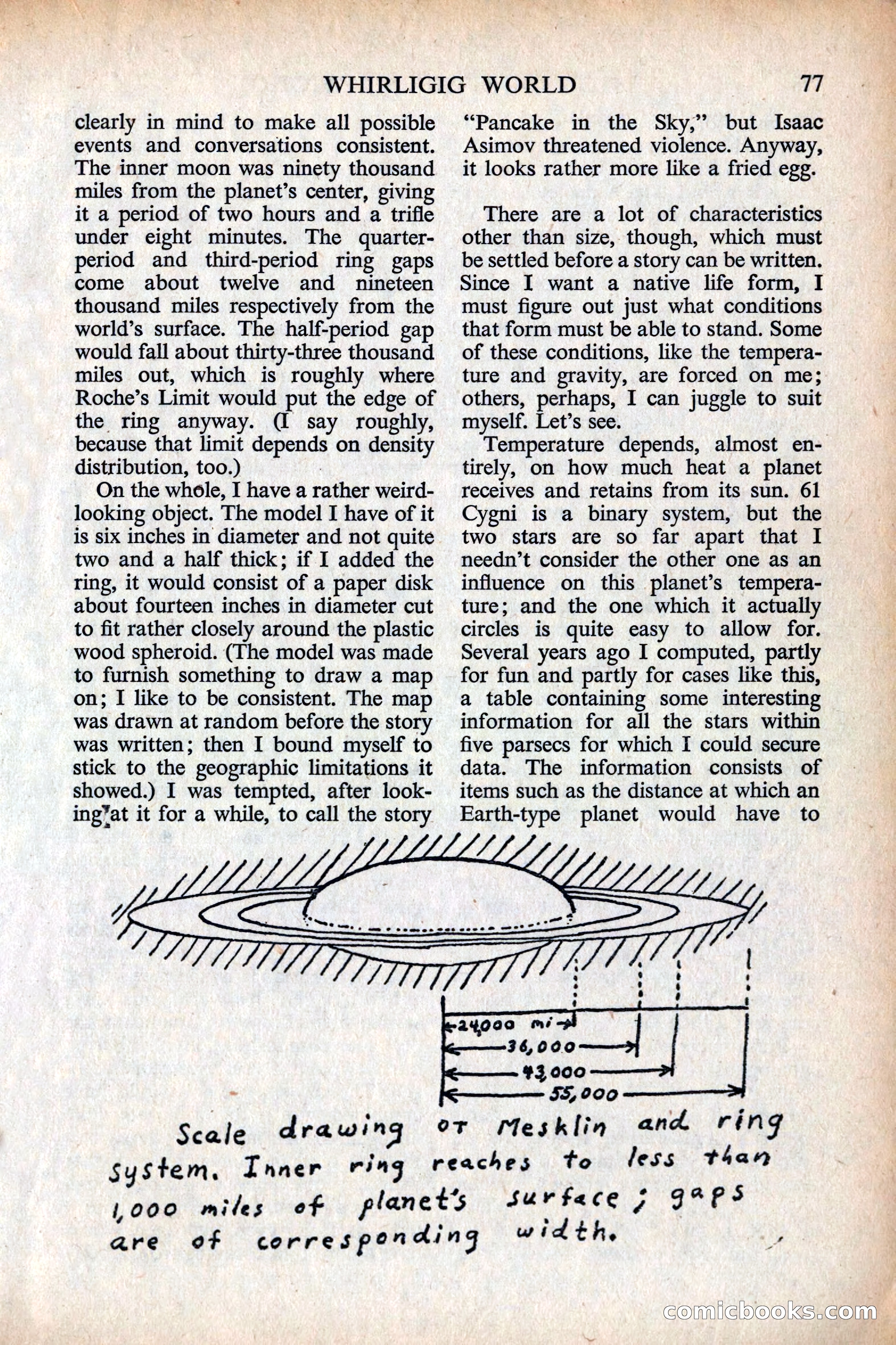
WHIRLIGIG WORLD clearly in mind to make all possible events and conversations consistent. The inner moon was ninety thousand miles from the planet’s center, giving it a period of two hours and a trifle under eight minutes. The quarter- period and third-period ring gaps come about twelve and nineteen thousand miles respectively from the world’s surface. The half-period gap would fall about thirty-three thousand miles out, which is roughly where Roche’s Limit would put the edge of the ring anyway. (I say roughly, because that limit depends on density distribution, too.) . On the whole, I have a rather weird- looking object. The model I have of it is six inches in diameter and not quite two and a half thick; if I added the ring, it would consist of a paper disk about fourteen inches in diameter cut to fit rather closely around the plastic wood spheroid. (The model was made to furnish something to draw a map on; I like to be consistent. The map was drawn at random before the story was written; then I bound myself to stick to the geographic limitations it showed.) I was tempted, after look- ing*at it for a while, to call the story pit Sibi A 77 “Pancake in the Sky,” but Isaac Asimov threatened violence. Anyway, it looks rather more like a fried egg. There are a lot of characteristics other than size, though, which must be settled before a story can be written. Since I want a native life form, I must figure out just what conditions that form must be able to stand. Some of these conditions, like the tempera- ture and gravity, are forced on me; others, perhaps, I can juggle to suit myself. Let’s see. Temperature depends, almost en- tirely, on how much heat a planet receives and retains from its sun. 61 Cygni is a binary system, but the two stars are so far apart that I needn’t consider the other one as an influence on this planet’s tempera- ture; and the one which it actually circles is quite easy to allow for. Several years ago I computed, partly for fun and partly for cases like this, a table containing some interesting information for all the stars within five parsecs for which I could secure data. The information consists of items such as the distance at which an Earth-type planet would have to Scale drawing oF Mesklin and ring System, Inner ring reaches to less than 1000 miles of planet's corresponding are of surface > 9%FS Conic ooolkks com