
Pulp Fiction, 1953 · page 78 of 132
Astounding Science Fiction, British Edition — page 78: what you’re looking at
A restored page from Pulp Fiction, 1953. Page through the whole issue in the reader above.
📄 Transcribed text from this page (OCR, searchable)
Machine-transcribed from the original scan — historical spelling and the odd misread are preserved.
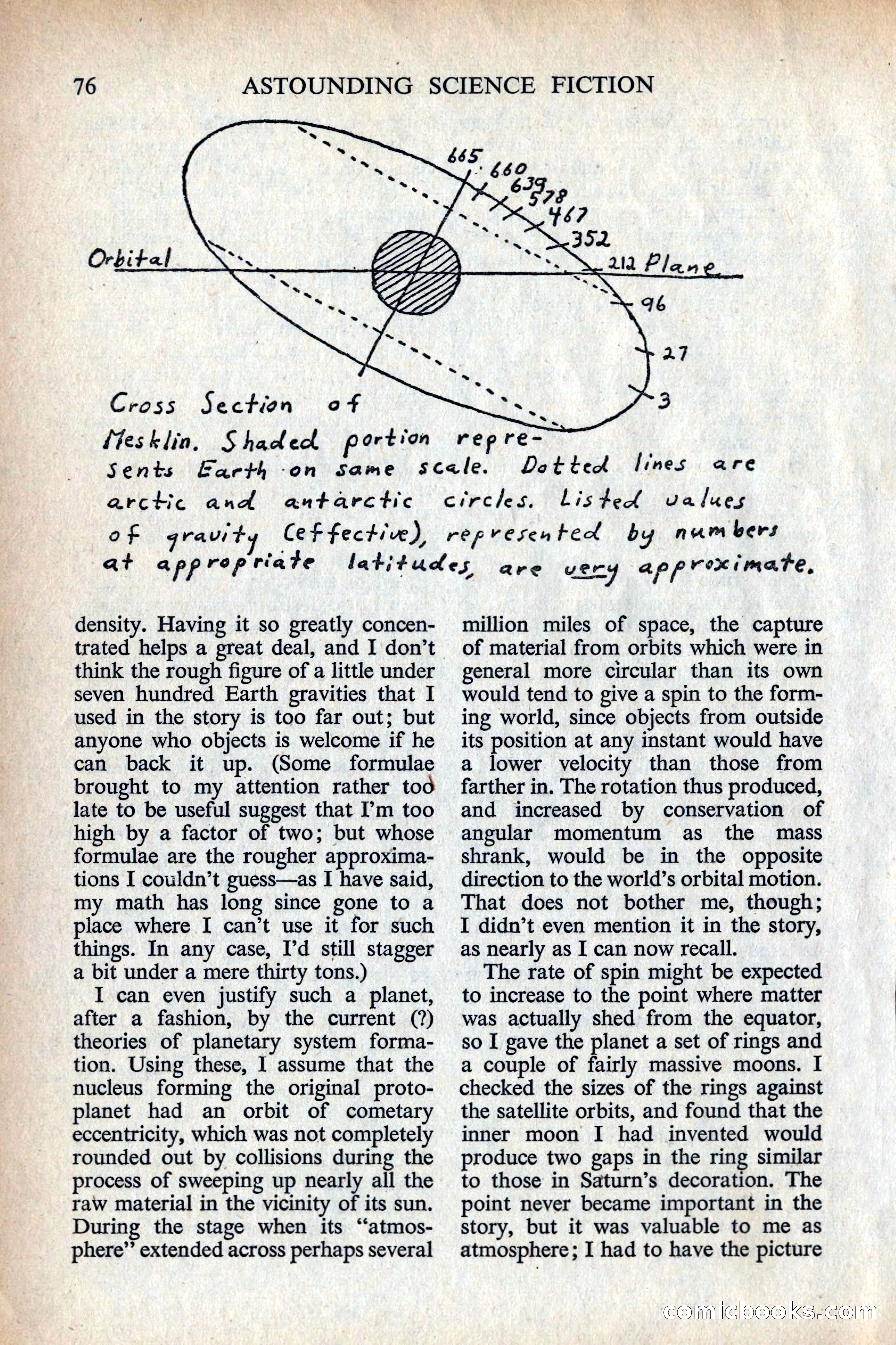
76 of ortion Cross Section ffesklin, Shadedcl Sents arctic and antarctic of qra ut Earth -on same scele. circles. Ceffective) represented by numbers ASTOUNDING SCIENCE FICTION ree re- Dottehkh lines are ListeH values at appropriate latitudes are very appreximate, density. Having it so greatly concen- trated helps a great deal, and I don’t think the rough figure of a little under seven hundred Earth gravities that I used in the story is too far out; but anyone who objects is welcome if he can back it up. (Some formulae brought to my attention rather tod late to be useful suggest that I’m too high by a factor of two; but whose formulae are the rougher approxima- tions I couldn’t guess—as I have said, my math has long since gone to a place where I can’t use it for such things. In any case, I'd still stagger a bit under a mere thirty tons.) I can even justify such a planet, after a fashion, by the current (?) theories of planetary system forma- tion. Using these, I assume that the nucleus forming the original proto- planet had an orbit of cometary eccentricity, which was not completely rounded out by collisions during the process of sweeping up nearly all the raw material in the vicinity of its sun. During the stage when its “atmos- phere” extended across perhaps several million miles of space, the capture of material from orbits which were in general more circular than its own would tend to give a spin to the form- ing world, since objects from outside its position at any instant would have a lower velocity than those from farther in. The rotation thus produced, and increased by conservation of angular momentum as the mass shrank, would be in the opposite direction to the world’s orbital motion. That does not bother me, though; I didn’t even mention it in the story, as nearly as I can now recall. The rate of spin might be expected to increase to the point where matter was actually shed from the equator, so I gave the planet a set of rings and a couple of fairly massive moons, I checked the sizes of the rings against the satellite orbits, and found that the inner moon I had invented would produce two gaps in the ring similar to those in Saturn’s decoration. The point never became important in the story, but it was valuable to me as atmosphere; I had to have the picture Connicloooks Com