
Pulp Fiction, 1953 · page 80 of 132
Astounding Science Fiction, British Edition — page 80: what you’re looking at
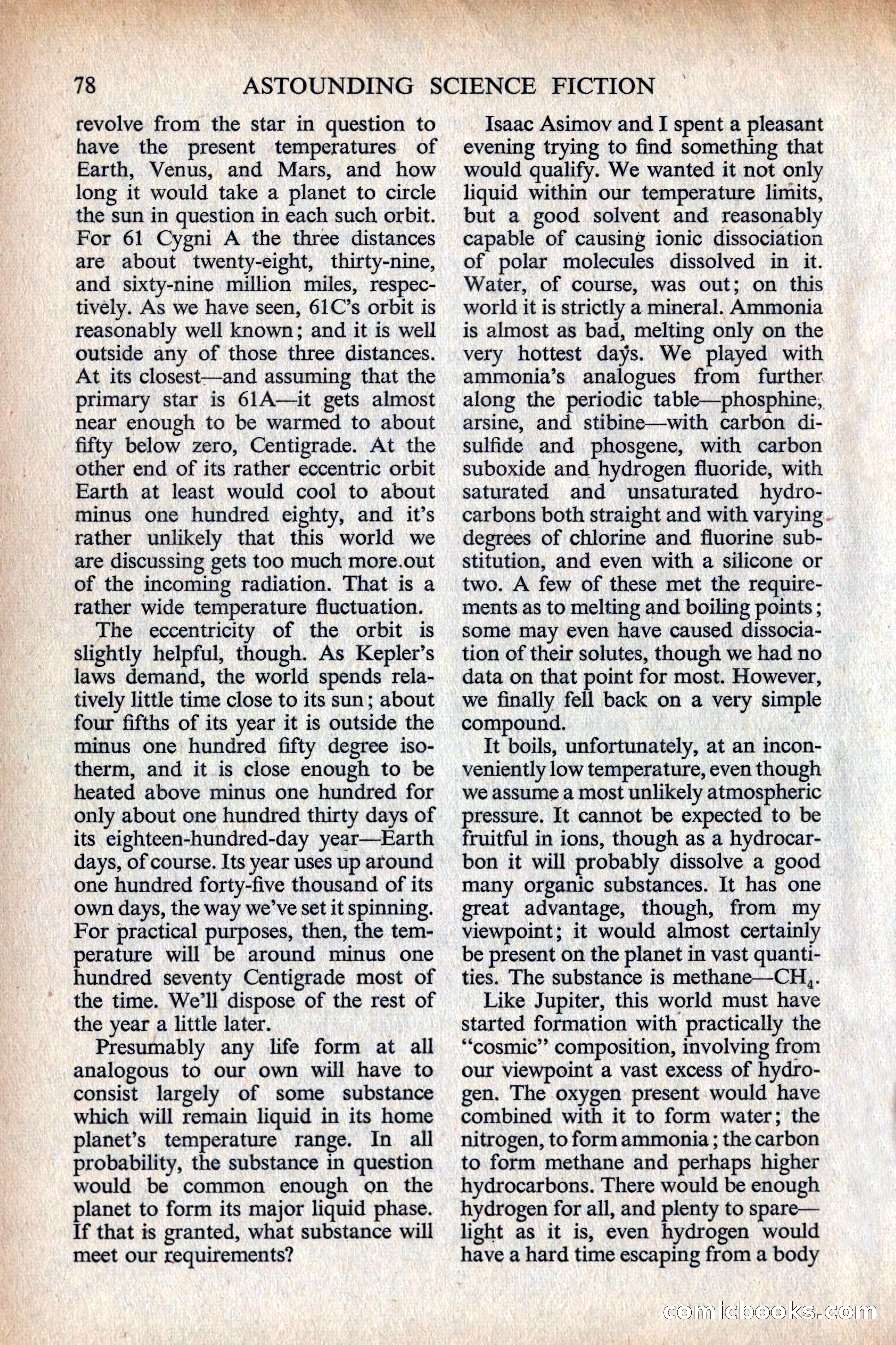
A restored page from Pulp Fiction, 1953. Page through the whole issue in the reader above.
📄 Transcribed text from this page (OCR, searchable)
Machine-transcribed from the original scan — historical spelling and the odd misread are preserved.
78 revolve from the star in question to have the present temperatures of Earth, Venus, and Mars, and how long it would take a planet to circle the sun in question in each such orbit. For 61 Cygni A the three distances are about twenty-eight, thirty-nine, and sixty-nine million miles, respec- tively. As we have seen, 61C’s orbit is reasonably well known; and it is well outside any of those three distances. At its closest—and assuming that the primary star is 61A—it gets almost near enough to be warmed to about fifty below zero, Centigrade. At the other end of its rather eccentric orbit Earth at least would cool to about minus one hundred eighty, and it’s _ rather unlikely that this world we are discussing gets too much more.out of the incoming radiation. That is a rather wide temperature fluctuation. The eccentricity of the orbit is slightly helpful, though. As Kepler’s laws demand, the world spends rela- tively little time close to its sun; about four fifths of its year it is outside the minus one hundred fifty degree iso- therm, and it is close enough to be heated above minus one hundred for only about one hundred thirty days of its eighteen-hundred-day year—Earth days, of course. Its year uses up around one hundred forty-five thousand of its own days, the way we’ve set it spinning. For practical purposes, then, the tem- perature will be around minus one hundred seventy Centigrade most of the time. We'll dispose of the rest of the year a little later. Presumably any life form at all analogous to our own will have to consist largely of some substance which will remain liquid in its home planet’s temperature range. In all probability, the substance in question would be common enough on the planet to form its major liquid phase. If that is granted, what substance will meet our requirements? TRNAS RDS IT fast aN Ne gare Th wy at Wh! st . “ies r Wea, » eas, 4 ASTOUNDING SCIENCE FICTION Isaac Asimov and I spent a pleasant evening trying to find something that would qualify. We wanted it not only liquid within our temperature limits, but a good solvent and reasonably capable of causing ionic dissociation of polar molecules dissolved in it. Water, of course, was out; on this world it is strictly a mineral. Ammonia is almost as bad, melting only on the very hottest days. We played with ammonia’s analogues from further along the periodic table—phosphine, arsine, and stibine—with carbon di- sulfide and phosgene, with carbon suboxide and hydrogen fluoride, with saturated and unsaturated hydro- “¥ ”_ VS iia ‘ele De PAd oi STEMS GREETS u/s aker We GN wy ’ back 7 ah A . ; a> ‘y> os carbons both straight and with varying. degrees of chlorine and fluorine sub- stitution, and even with a silicone or two. A few of these met the require- ments as to melting and boiling points ; some may even have caused dissocia- tion of their solutes, though we had no data on that point for most. However, we finally fell back on a very simple compound. It boils, unfortunately, at an incon- veniently low temperature, even though we assume a most unlikely atmospheric pressure. It cannot be expected to be fruitful in ions, though as a hydrocar- bon it will probably dissolve a good many organic substances. It has one great advantage, though, from my viewpoint; it would almost certainly be present on the planet in vast quanti- ties. The substance is methane—CH,. Like Jupiter, this world must have started formation with practically the “cosmic”’ composition, involving from our viewpoint a vast excess of hydro- gen. The oxygen present would have combined with it to form water; the nitrogen, to form ammonia ; the carbon to form methane and perhaps higher hydrocarbons. There would be enough hydrogen for all, and plenty to spare— light as it is, even hydrogen would have a hard time escaping from a body CORNIEOOOKS com